Looking Back: (Mis)adventures in Parque Tayrona and Santa Marta

Finally I had my Colombian adventure. I set off on Tuesday around 1 pm thinking I wouldn’t get a bus until 2:30, but to my pleasant surprise, when I arrived at the bus terminal I was immediately led to the bus leaving at that exact moment. The trip was a bit uncomfortable. Initially, I thought I had the best luck – the back seat to myself. Then this entire family climbed onto the bus, and to my dismay, there were no free spaces other than the ones next to me. So the mother and father sat next to me with their three children piled on top of them. Not the most pleasant of scenarios, but it only lasted about 3 hours. Then I was told to get on a smaller bus that would take me straight to Santa Marta. Again, another cramped voyage. Imagine me, a relatively tall white woman in the last row of a roughly 25-seat mini-bus packed with Colombians of a darker complexion. I was like a sore thumb stuffed in a box of sardines.

But before I knew it, that leg of the journey was over and I was in my hostel, Solaz, in Santa Marta. I had a really neat conversation with the taxi driver who picked me up in front of the terminal about ignorance that leads to hero worship of even the most deplorable figures – in this case, Trump and Maduro. I never considered that there were Venezuelans that admired and even worshiped him with a certain fervor. My taxista, a Venezuelan, understood it just as much as I understand the fervor people in my own family have towards Trump. He left me with his number, saying if I ever needed anything in the city to let him know. A man who had been a successful detective with several houses, for the first time, reduced in a way to a solitary life working in the public sector of Colombia. Now that would make a novel – but that was his life. The whole thing struck me as quaint.

I can’t lie, I had some unrealistic expectations for this trip, particularly for seeing my friend. After all, his posturing of things was pretty ideal. We were to go out wandering around Santa Marta talking and then later drink and dance the night away. I even imagined us traveling a bit afterwards together as well.

Well, suffice it to say, it didn’t happen that way. We all ended up being to tired to properly drink and dance, so I retired early. And honestly, that’s okay. Everything was fun but not life-altering. I kept finding myself getting quiet and pensive because it didn’t feel like I felt it should. And I realize that’s the danger. Thinking too much and figuring yourself into a story that isn’t yours. All the same, I generally enjoyed the experience I had, all because a relatively new friend had the nerve to tell me “ven” – come through.

The great, and frankly unexpected, part of this adventure was the connections I gained along the way. That night I met Clari and Dani, two incredible Argentinian girls. They were both planning on going to the same destination that I had in mind from the beginning: Parque Tayrona. My friend introduced us, and we hit it off fairly well. They are both biology majors from Buenos Aires with a myriad of other skills between them: both cook, sing, dance (tango!), ride horses, among a million other little things aside from being extremely intelligent. It’s not that often that you meet truly formidable people in life, but I felt like they could definitely be described as such.

I got to know them a good deal in Santa Marta, eating out and hanging out in the hostel and going to swim and sunbathe in Rodadero (oh, did I mention they’re both great swimmers too?). But I really saw what made them tick on our trip to Tayrona.

We went into the trip with the entrance tickets to the park pre-bought – a must to avoid long lines in peak tourist season – and (supposedly) lodging already a given. That part ended up being wrong, though, as when we arrived to the camp site with extremely over-priced food, there was actually no tents available for us to rent. It got worse considering the guy that worked there wouldn’t even help us. So not long after, it was put our bags back on our backs and hoof it to the next campsite.

When we got there, we were so relieved to have made it through this jungle of hills and sandy hikes: rivers, ant-trails, and muddy clearings we had to cross by balancing ourselves on logs – so relieved that we didn’t even consider if we were getting a good deal. $35.000 a person for 2 big tents and one little one, in a seemingly less crowded campsite? We’ll take it!

Unfortunately, when we returned from hiking along the beach that afternoon we discovered that not only was the place very crowded (so crowded in fact that the kitchen ran out of meat and there were few chairs to spare for our group of 5 to sit at), but that it was also extremely unsanitary and the food sucked, was overpriced, and lacked variety! There were 2 bathrooms on the entire campsite. One had a shower. One. Fast forward later that night when I’m trying to wash myself off while another person is dying in the stall next to me of food-poison-induced diarrhea…not pleasant. Not to mention the tents were practically on top of each other, plus hammocks outside of them and all around. And this to the fact that most people were loud, intoxicated, and sick, and you get a really big headache. I think we all learned a valuable lesson: always book ahead. And book Cabo.

Backing up a bit, the hike along the beaches were to die for – almost literally – exhausting but definitely worth it. Despite some inconvenient physical circumstances, I managed to get in the ocean, hike up all of those fun jungle hills, and make some incredible memories. I just felt very…unsanitary while doing so. And crampy.

That day, we explored Las Piscinas, la Laguna de los Caimanes, and half-hiked to Cabo before realizing it would be dark on the hike back because we left way too late (we’re talking about starting an hour-long hike around 4/5 pm – not a great idea). So after discovering how fucked up our campsite was, we decided to go to a different, more family-oriented campsite to eat and enjoy some music. Colombia is not Colombia without music (especially blasting Vallenato).

We convinced the lady cooking to make us pasta which was pretty decent (and huge so almost worth the $21.000 we spent on it). We also broke out the aguardiente and beers. I discovered that night that in reality, Argentines don’t drink as heavily as Colombians. Andres and Julian, both from Bogota, were all for passing out the shots. We started during our walk to the other site (in the dark under an absolutely incredible starry sky unsullied by light pollution) and continued once we were mostly finished eating. Food was accompanied by beer, of course.

Then, we started playing some hilarious drinking games. One involved using a specific letter of the alphabet to describe your genitals. I learned a lot of new vulgarities and adjectives in this one, and I actually didn’t do so bad! Another was Pregunta, Pregunta which was literally Question Master – each person can only ask a question and respond with a question. This led to more shots then you would think, but possibly not as much as the categories game (another concept I was familiar with from King’s Cup – ohhh college). Somebody picks a category and each person has to say something within the category. The Argentine girls also taught us a game involving crossing arms and tapping the table in an unbroken chain. Way harder than you would think, especially while walking the knife’s edge of tipsy and fucked up.

We were accompanied by a French girl, Alice, who we met in the shitty campsite earlier that day. Exploring with her was fun, although she also wasn’t much of a heavy drinker. I think Colombian culture has exacerbated my own party-loving spirit. When she and Clari were ready to retire, the fun had only just begun for me. I was tipsy and dancing with Andres, and Dani and Julian had coupled up as well. I’ve noticed that this coupling off to dance thing probably has a lot to do with the hookup culture I’ve seen here. Nothing happened out of the ordinary that night, but it does tend to happen under those circumstances.

When you travel, you learn so much about other people, and from them, you also learn about yourself. I suffered a couple really major crises during the trip. I went back to the party after promising to go back with Andres to walk Julian and Dani back from the site and “take care of them,” which doesn’t work very well when you are well liquored up yourself. I unfortunately forgot that I was carrying my cellphone in my purse – while crossing the laguna de los caimanes – Alligator Lagoon. On the way out of the campsite on the hill, I made an Olympic-metal hop across a log that connected one side to another. Beaming with accomplishment, I turned to share the light with my friend coming behind me. The log was not totally level of course and my foot slipped and – bam! I slipped straight down into the lagoon. Of course, my own welfare wasn’t the real worry for me in my intoxicated state – the damage the water did to my brand new Moto g5 as I scrambled to get out and continued to fall, eventually pulling Andres with me was the real tragedy of the moment. New cellphone – dead. Pride – also dead. I cried so much that night, it was ridiculous. Andres did his best to comfort me, but I was pretty distraught, so we sat by the side of the ocean for at least an hour leaning against a log of sorts, him trying to distract me from my tech tragedy, me trying to rationalize the situation and failing and just being angry at myself.

After the wild, regrettable night, I woke up in the big tent with a pretty shitty hangover, exhausted from barely sleeping, sore all over, and just generally blah. In spite of that, we decided to carry on and hike down to Cabo. We had a breakfast at the same place we had partied the night before and hurried on our way. Hiking in sand, by the way: don’t do it. My shoes were soaked and dirty, which meant soggy feet after spending what seemed like hours in beautiful aqua blue oceans and shiny, gold-flecked rivers. Cabo was a dream, and the hike there and back really was not so bad. We passed the time by swapping stories and singing Disney songs both in Spanish and English. We unanimously decided that next time, for sure, we would have to stay there. And book in advance. Just go Cabo.

What I was not prepared for was the hike out of the park. 2 hours or more, not including the 1 hour hike back to the main campsite from Cabo. My feet were soggy and blistered. Every step slowly became more painful, and then, like fools, we decided to finish the last leg of our hike (which could have been cut shorter on bus) on foot instead. The sensation of stepping on knives stabbed through me with every painful step. At first, the trip didn’t seem so far. Just a little bit further…but after each turn that did not seem to bring us any closer to our destination, I began to bitterly lose hope.

Clari was patient with me, as was Andres, who took my bag to help lighten my burden. Clari distracted me with engaging conversations about past lives (”Muchas Vidas, Muchos Maestros” was a book she recommended me that I must remember to read). We talked about the permanence of energy in the universe and strange dreams and uncanny knowledge of things one has not directly experienced. Andres thought we sounded high, but it was just the mixture of our shared mysticism and hiking delirium. We got on to plan other potential trips, Spain being a shared interest. She assured me that I could go visit in Argentina anytime.

Finally, that little adventure was over. The other tragedy came after deciding recklessly to go out and drink cocktails and tequila shots while suffering from severe exhaustion – and eat meaty, heavy street food. The stomach virus I had the next day was so severe I was unable to even smell food without becoming nauseous and vomited pretty much everything in me that diarrhea didn’t wipe out. Andres and Dani had decided to move on to La Guajira, leaving me in the hostel with Clari and some kind German girls that had taken up residence. Clari helped me get the strength to go to the clinic to get some shots and a ton of drugs to deal with the poisoning. I lost that Saturday in Santa Marta sleeping, and the next day, it was time to go home.

So, big takeaways from the trip:

  1. Don’t take your cell with you on midnight treks over alligator lagoons while intoxicated. Just…don’t do it. Hindsight is a bitch.
  2. Don’t let shit that is over and done with affect and ruin your present.
  3. Don’t be afraid to open up to strangers. They might end up becoming some of your best company.
  4. Don’t overthink the reaction of others to that essence which is you – any negative reaction is their problem.
  5. Street food involving meat should be avoided at all costs. Eating in places where conditions are unsanitary, regardless of how tempting the cheapness of that place is must be avoided.
  6. And finally: don’t wait – buy your entradas (tickets) to the park and book your campsite or hostel in advance. Make sure you have all the facts. Don’t be like me.

In the end, I don’t regret any of it, even the misadventures and all of the callouses my feet acquired. The trip represents life in a big way. It was a microcosm of the wins, losses, and connections one experiences when they dare to live without limits and open themselves up to people. It’s not always going to be pleasant and epic, but it will teach you something if you let it. Those lessons will stay with me, buried away in my consciousness. This is the year of autonomy and letting go of fear. This trip was part of the autonomy. And it was only the beginning. Bring on the next adventure: Central America!

10 Things I wish I would’ve known about living in Colombia

Before I moved to Colombia, as you can imagine, I was completely nervous. Excited, yes. Prepared? I wasn’t sure. The uncertainties were all around me.

So, like most people in the age of technology, I took to the internet. I looked for blogs/vlogs, lists, articles, College Humor pieces – anything that could give me an idea of what it would be like living and working in Colombia.

Unfortunately, I came up mostly empty. For all that travel blogs and teach-abroad blogs are quite popular these days, I couldn’t find many vlogs or posts with information I found pertinent (and personal). It was all mostly general or stereotypical – salsa dancing, tourist attractions, and the general basics for travel and work – how much you could expect to make, where you could expect to work, etc. But as far as the different elements of culture shock, language, daily life, traveling on a budget, making friends and forming relationships – well, the internet seemed silent.

Maybe I’m just bad at search engines. Either way, I feel there is a need. So I would like to share my top 10 things I wish I would’ve known before moving to Colombia.

(I should preface this by saying this information mostly applies to the Colombian coastal region, and the difference between the interior of the country and the coast definitely makes the list of things I wish I would’ve known about Colombia before living here.)

Image result for mapa de las regiones culturales de colombia
Just keep this in mind – there’s practically a different dialect for every one of these regions.
  1. Bogota is not Colombia. And the differences between regions can be much more dramatic than one would expect (culturally, dialectually, etc.). I knew this because I had visited both beforehand, but I didn’t realize just how big the rivalry between different regions in Colombia is. You won’t be just adapting to a new culture based on the country, but also based on the region you choose to live in as well.
  2. Colombia is not as dangerous as it once was. You are not likely to get kidnapped by random taxi drivers anytime you go out. You won’t see violence in the streets. However, crime caused by the incredible degree of inequality and poverty is real. Because of this, you will probably be robbed or mugged at least once – oh, by the way, don’t go out with your cellphone at night, or if you do, don’t own a fancy, expensive smartphone. You have been warned.
  3. People are not always to be taken at face value. Things are not always what they seem on the surface, and if money is involved, one should err on the side of caution. It is very likely if you are working in anything that requires charging or loaning money that you will have to hassle that person in order to get it, because Colombians either never have money because of how awful the economy is or simply don’t want to pay when they do have money.
  4. Relationships and gender roles are truly influenced by machismo. But it’s not always as obvious as you think. Lies, deceit, and general toxicity all tend to play a role, and to many people here, this looks normal due to the culture.
  5. The cost of living and exploring is inexpensive. Even though you can’t expect to make a lot of money by US dollars standards, you can still manage to save and live your best life. Travel by bus and plane to different parts of Colombia is inexpensive, but work can be extremely draining (because schools here are not well-organized, and the hierarchy can be extremely stressful – more on this in a different post). It’s a real game of give and take with your schedule to keep things in balance.
  6. Your personality will change if and only if you are truly immersed in the culture. You wanna get good at dancing to Latin music? You have to let yourself be taught and be spontaneous. Same with your degree of fluency in Spanish. Most people here don’t speak English and are very shy to do so (aside from the annoying cat-callers that only know one phrase – like “I love you” and “hello”), so if you are interested in learning Spanish, this is a great place to do it. However, you should come willing to make an effort and learn from the people around you.
  7. Most people do not know that much about the US. So questions get repetitive. It’s kind of like how when I’m in the states, questions revolve around 30 year old issues like Pablo Escobar and drug cartels…yeah, ignorance is the same no matter where you are, but at least the questions are mostly about Trump, somebody who is actually alive and relevant.
  8. Colombia really does not have seasons. I honestly didn’t realize that. So if you pick a hot place to live, expect that to be a constant. If you pick a colder, rainy place (like Bogota), that will also be a constant, with some flux depending on the months and dry or rainy seasons. Weather is not necessarily a constant, but the general temperature and variety of weather definitely is.
  9. In a small city like Valledupar, transportation is so easy and cheap. Of course, the same can’t be said for sprawling cities with a shitty Transmilenio bus system in place of a metro, but trust me, if you live in small town Colombia, moto-taxis for $2 mil a ride will become your best friend. Cheap street food like arepas, empanadas, deditos de queso, and papas rellenas will become your best friend, too. I should probably just do a whole post on food, let me bookmark that for later…
  10. People will embrace you. Sure you have to root through the people that want to use you for the perceived money or influence that gringos have, but people here are truly so warm and willing to share with others, so long as they sense that you are a genuine person as well and you are willing to open up. That has to be one of my favorite things about the culture.

Now that I’ve written those 10, several more things occur to me. But I’ll leave that for another post. Basically, living in (coastal) Colombia is a spontaneous experience, so you need to be open-minded and aware of your surroundings. Appearances often are not to be trusted, but life is looser and more flexible – which means if you crave and thrive on structure, la Costa probably isn’t the place for you.

However, that being said, I think this country offers something for everyone. Medellin, Cali, Bogota, Bucaramanga – all of these great cities are different from cities in the coast. In Colombia, one size definitely does not fit all.

I hope this is helpful to anyone considering living, working, or at least traveling in Colombia. As with life abroad in any country, a willingness to adapt to your environment is always important and necessary. There will always be things you don’t like – be it the slowness, the poor attitude toward customers, the backwards gender norms, the superficiality, in the cases I’ve seen that were less than pleasant – but you can learn and grow from these differences and observations as well. All of that makes the experience that much more rewarding and totally worth it.

If you’ve lived in or are living in Colombia, do leave a comment below sharing what you discovered but didn’t realize before living in Colombia (along with which part of Colombia you lived/are living in!).

Tu tranquilx: Finding Time for ME, Festival Vallenato, and Costeñol

In life, it can be very difficult to make time for yourself, and more so when you think you’re making time for yourself when you’re actually juggling your time with a million different activities or obligations.

Sound familiar to any of you out there?

We find ourselves running in circles, trying to fulfill so many duties and live up to so many expectations – our own expectations – that we forget to sit back and reflect on the nice little things happening in our everyday lives.

So here, I want to reflect (also because my therapist suggested it and its therapeutic and maybe, just maybe, this will help someone else) on all of the little ways life in Colombia has led me to explore new things and challenge my own mindset.

Last weekend was the celebration of the 51st annual Festival Vallenato. To Colombians from this region, Festival Vallenato is like freaking Coachella. The Coachella of Vallenato music. Of course, Vallenato music is a niche genre (shhh, don’t tell the average Colombian that (obviously I’ve met many exceptions that don’t like Vallenato, but yeah)). So while people here will boast that Festival Vallenato brings people from all over the world to the humble city-town of Valledupar, they mostly mean it attracts cachacos, or Colombias from further inland and south in Colombia, to come visit, drink in the street, enjoy a few parades, live music, and general chaos.

IMG-20180505-WA0026

IMG-20180505-WA0027
The Piloneras is one of the biggest cultural attractions – people dance in traditional clothing to the rhythms of traditional music. Carlos Vives happened to be present in the middle of the parade this year, which meant people were even more obnoxious than usual.

Any New Orleanian reading this will probably think, “Hey! That sounds like Mardi Gras!” Well, you would be correct, because just like New Orleans in Mardi Gras, for anyone that doesn’t enjoy an overly-crowded, intoxicated, stuffy, obnoxious atmosphere brimming with tourists, it is absolutely exhausting and overrated. Don’t get me wrong, I enjoyed going to some Mardi Gras parades (like Bacchus and the more adorable Barkus and the more nerdy Chewbacchus -spin offs for the whole family to enjoy- that’s why I love New Orleans, right there), but overall the city just became a lot…heavier, and I’ve never had much love for tourists. For one thing, everything revolves around making a buck and taking advantage of those that don’t know that things are actually usually way cheaper. It happens here, it happens there, it happens everywhere.

That’s how the two cities are connected. They are both popular for clear reasons: party, music, and atmosphere. However, those same things make the cities slow and stagnant. Which is where I’ve been thinking I feel stuck in a pattern of always picking the same sorts of things, even if I don’t like them and they aren’t necessarily good for me.

Beyond the comparisons between Festival Vallenato and Mardi Gras, the folclor of both lends some time for teachers to rest because the world of these small places revolves around niche annual celebrations. So I had Thursday through Wednesday off. Not bad. However, did I get anything done?

No.

I got drunk, and I got sick. I missed work, and I didn’t go to the gym. Basically, I had a down week. But I’m hoping to use this apparent down week to put together renewed energy to return to old projects.

IMG-20180503-WA0003
Graphic description of how “productively” I spent my relaxing weekend off. Also pictured: Churro.

It’s difficult to start over in the middle of the year, but in reality I’m not starting over because I got a strong start. The school year is almost over, and there’s a lot to do and even more to look forward to. It’s just moving on to a new chapter, really.

In the past few months, and especially during Festival, I’ve become much closer with my Colombian friends, specifically of the costeño variety. Remember that costeños don’t necessarily live in the coast but are referred to by this term based on their location in coastal departments (states connected to the coast in some way), accent/dialect (they share a common language that is deeply embedded in their culture), and folclor, or a general set of musical, dance, and folkloric traditions that the likes of Festival Vallenato and Carnaval embody. I want to share with you guys a small list of vocabulary I’ve picked up by spending more time integrating myself here and practically becoming* costeña:

guandolo/wandolo: an alcoholic beverage, resembling a moonshine that tastes like a sweet beer, distilled from panela, distributed low-key in Valledupar. I have tried it, and all I can say is: I couldn’t feel my face. My ear felt like it was on fire. I felt woozy and like general crap. I drank it too fast. Apparently I was drunk. Without the euphoria. Hopefully it’s better next time (whenever that will be).

panela-100-organica-la-mejor-panela-de-origen-natural--D_NQ_NP_853725-MCO25492020671_042017-F[1]
It may not look delicious, but panela does wonders for congestion and a sore throat. Just heat it up in boiling water, add lemon and honey, and voila!
Churro: a strong, tequila-like alcoholic beverage also distilled from panela – not to be confused with the delicious cinnamon treats you can buy from local street vendors. This was great when michelado with lemon, orange, and pepper (weird, I know, but when in Valledupar…), but I swear the hours of high did not prepare me for a whole day of feeling like absolute shit. This brings out the worst in people. However, will try again. It’s hella good but look out for the…
guayabo: term used in Colombia for hangover. Every country has its own term: crudo en Mexico, goma in Nica/Costa Rica/Guate, etc., resaca in most other places. But in Colombia, you can be enguayaba@. And also it feels like shit.
parche: a group of amigos that do amigo things, like drink wandolo in the plaza or go on trips to La Mina or a casa campo. The verb parchar means to do these sorts of things, or just chill/hangout and gossip with friends.
‘So va (eso va): the adorable costeñol way of saying I’m down, that’s on, hell yeah. Also, most words and syllables are shortened here in the coast.
marica/mk: used to express strong or serious feelings which should punctuate all your sentences when talking to someone in confidence (i.e. a good member of your parche), shortened to mk in text, not to be confused with the homophobic insult.
el vacile (se pega): catchphrase of Monofonico (a popular and spectacular local champeta band), the term vacile has several meanings, including a non-serious, uncommitted relationship within which the goal is having fun to anything that is considered a good time, entertaining, or fun; can be applied to music (i.e. a live show), a group of people with a good vibe, an entertaining person or video, etc. i.e. Eso es cule vacile, marica. (That’s chill as hell/a hella good time/fucking amusing, dude – wow this is really hard to translate into American slang because Americans also have way too many phrases and slang depending on the region you’re from, plus it’s constantly changing and evolving. And I’ve been out of the country for most of the time for almost 2 years now, so forgive me if the phrase I use is actually super outdated and lame).
Cule: literally culo de, or an assload of something. A lot. So if someone wants to understate how much they like you, they might say, tu me gustas cule poco.
barro: used to react to something shitty. Oh, your girlfriend cheated on you? Barro, cachon.
cachon: a guy that’s been cheated on. I don’t know why in Latin America they add insult to injury by having terms for people that have been cheated on, usually used to insult or mock them, but here you are. It comes from the phrase pegar cacho which is the Colombian way of saying to stick horns on someone, which was an old English phrase as well (used by Shakespeare, even!) for cuckolding. The more you know! I suppose another translation would be a cuckold or a cuck…without the erotic/fetishy connotation that is. The female alternative is, of course, cachona.
peye: something that is just really shitty or lame. Cule cosa peye – that’s some lame ass shit.
jopo: ass or butt, usually a fat one, but can also be referred to something that’s lame and sucks. Cule evento jopo. “Fucking lame/shitty event.” Cule vaina jopo = any random thing that is really, seriously ass in nature.
arrecho: in la Costa de Colombia, not in Venezuela or many other places, this means horny. Anywhere else it means pissed off. Be careful with this one.
Nojoda: used to punctuate a sentence to express frustration or shock. Deja la flojera, nojoda! “Stop being so fucking lazy!” Nojoda, enserio, mk? “Fuck, seriously, dude? Are you fucking kidding me?” I could list a million examples more, this one is super common. And not only Colombian – I first learned no me joda/no me jodas in Costa Rica back in 2011. True story.

There’s waaaaay more where that comes from, but I think I’ll save that along with a more comprehensive list of examples and English-language equivalents for another post. To summarize, it’s been cool to immerse myself so thoroughly in another culture and dialect. Soon I’ll be talking about my time in Bogota and Medellin and sharing the different ways in which people there speak and act. Language, as I have always believed, is so deeply entwined in culture. It exists to compliment culture and also to express its invisible beliefs and values. So, rest assured: there’s more to come on this subject.

Please feel free to mention any of your favorite costeñol expressions or terms I may have missed below! Costeño Spanish is fast becoming one of my favorites, and it is in no small part due to the expressive, dynamic culture it is a part of.

So, while Festival Vallenato was full of peyes and being sick is even more peye (cule vaina peye, mk, at that), I’m happy with everything I’ve been able to take in while living in Valledupar. I’ve been staying productive with English classes and transcription writing. I’m trying to remain grounded and centered on both what I want and what I need for this moment. Yes, even in a city as small and slow as Valledupar, good times are all around to be had. To appreciate other places, we must also learn to appreciate the place we are at.

IMG-20180505-WA0017
Parchando con las mejores ❤ Festival Vallenato 2018

*Spoiler: I will never actually be costeña; relax people, it’s just a “decir

Third-of-a-year Self-Assessment

I hate that I haven’t been able to write lately. As it happens, I have more to write about than ever. Last week, I went to Bogota and Medellin for Spring Break (or Holy Week/Semana Santa according to the very Colombian Catholic tradition). A couple of weekends before that I went to Bucaramanga. I have every intention of writing about my experiences in all three cities, as they really are some of the greatest cities in the interior of Colombia, but I’ve been utterly drained.

Let me explain what the hell is up with me. I’m now giving tutoring twice a week – it’s about to be four times since I’m adding a new student. Plus I’ve had to give refuerzos or unpaid tutoring sessions at the school to help my kids catch up. It’s the end of the third school period, so that means planning (oh, by the way, I get to go in to work tomorrow bright and early – on a Saturday. Joy), uploading grades, writing reports, observations, making sure I don’t break down or forget anything. You know, lots of stuff. Aside from the tutoring, I’m teaching English to a couple twice a week (which I love because they are so in to it that it’s almost not like teaching at all), and I might add another class to that.

On top of this, I just started transcribing interviews for my aunt. This is work I really love as it helps contribute to her doctorate thesis and some important research related to indigenous rights in Nicaragua. With all of this, I’m also working toward saving for one of my goals – a backpacking trip through Central America. I opened a travel fund pretty recently to help save for my tour of South America which I’m going to postpone for next year, since going through all of the countries in Central America twice is not going to leave much time (and possibly money) to do anything else this summer. However, as great as it is to have extra money, I feel like my energy has been invested pretty heavily in all of the teaching and work. Writing and language study have virtually went on the backburner, and because I’m too tired to write to coherently, I figured a brief reflection and recollection would be better than trying to chip away at the 5-some drafts I have sitting around.

That being said, I will be posting about my travels in Bucaramanga, Bogota, and Medellin. Those experiences really reminded me of why I love living in Colombia – the three places are so diverse and different from Valledupar, where I currently live, and yet they are all part of the same country. For those that might generalize Colombia as a monolithic drug lord-dwelling jungle paradise, I am happy to show just how mistaken you are – but no harm no foul. We all fall victim to the influencing power of the media, which paints a picture of our world using colors we are familiar with to mask the reality beyond. With these adventures, I have felt full, but I need to hop back on the creativity and intellectual pursuits of a deeper, personal significance.

I’m also still reading. I finished My Ishmael and have since started on a Spanish book, Opio en las Nubes, by Rafael Chaparro Madiedo. An acquaintance who is a big fan of literature and poetry loaned it to me, and so far, I’m impressed with its surrealist, stream-of-consciousness elements, but I haven’t gotten terribly far. I’d like to have a review of My Ishmael up soon as well while its still fresh. It impacted me pretty strongly, if not as much as the original Ishmael did. Still, great book.

I’m beginning to realize how easy it is for routines and plans to come undone. I started going to the gym again this week. I had about a week and a half off because I was traveling and busy doing other things. Now, with these new classes and responsibilities, I’m worried I won’t be able to find the time or energy. Planning classes takes time, not to mention my main job… But I’m going to do my best.

It’s hard sometimes to look at all you said you would accomplish and feel like you’re coming up short. A thought crossed my mind that calmed me today as I considered all of this. We’re a third of the way through this year. That means three more thirds to go – a perfect time to look at what I’ve done so far and where I’m going.

So far, I’ve traveled plenty, spent time with friends – even interviewed for a new job. That was another reason I wasn’t able to do much in the past couple of weeks. I had to prepare a demo lesson to perform with adults acting like students (definitely as weird and uncomfortable as it sounds). It went relatively well, but to my relief, there is nothing concrete there. The school would be a great opportunity, don’t get me wrong, but I think I need to not jump on the first opportunity that comes my way. I may not even be working as a teacher next year – who knows? I feel tired of it at the moment, and I’m not sure if its the stressful work environment (which causes pressure apart from the actual duties involved with being a teacher) or just the universe’s way of pushing me towards my other goals and passions. It’s almost like a whisper saying enough is enough. Time to move on.

All in all, nothing is decided yet. I’m still making progress with language acquisition, even if my daily studies and writing have dwindled. I’m trying to look at things as a continuous work in progress, bit by bit. I know success and self-actualization don’t happen over night. I’m trying not to stress myself out more or get depressed by these changes – because, for the most part, they really are positive and will definitely pay off. But it does raise the question: what do I want to dedicate myself to?

What do I need to dedicate myself to? Writing is a necessity for me, like curing a wound. If I don’t do it, the gap gets bigger and I feel myself slipping away. No matter how busy I am, I will always write.

However, I started this blog to write with a purpose. To talk about my experiences, my insights. To share my adventures in order to educate people about the wonderfully jodido and complex country that is Colombia. I met several people in my stay in Yolo Hostel Medellin that were jealous of me getting to live in Colombia and have this experience – that craved more. At the same time, there is so much ignorance surrounding Colombia – its history, political situation, culture(s), and present. I hope to shed a bit more light on that through this blog. I hope it reaches not only my friends, but other people that might be curious about living and working in, or at least traveling to Colombia, as it is so worth it. But you need to do it not only with an open mind, but an open heart and a clear headed view of the pre-conceived notions you are doubtlessly carrying with you. There is so much more than meets the eye.

So here’s to adding that goal to the list and hopefully scratching it off! I’m now trying to maintain an agenda, some good advice given by the counselor I’m seeing. I recommend it to anyone else feeling overwhelmed by busy schedules and conflicting priorities.

Any advice for keeping it all straight? I could sure use some more tips, as much as I’d like to offer some of my own. Share your experiences below!

Birthday Reflections: How living in Colombia has changed me (from 25 to 26)

It’s been an amazing birthday week, the kind of week that has me reflecting on all the changes in my life that have brought me to where I am today. One of the greatest changes by far has been all of the transformations and confrontations with self I have made since living in Colombia.


Before, I was never one to socialize among coworkers. I kept my head down and my eyes on my work. I felt afraid to show who I really was most days because I wasn’t sure if anyone I worked with would be able to relate to me. As a result, I stole from myself the opportunities to form bonds with my coworkers and create lasting friendships. I also struggled to define limits in my romantic life. I spent more time spinning my wheels than actually acting with the end result in mind, and that was mainly due to self-doubt and insecurity.

Last year, I was still green to living in another country. I didn’t know many people – I barely knew my coworkers. I mostly spent time with a girl that lived in the same house as me and took care of the kids and the chores (we became friends and have been ever since!). I was far from home and at moments very lonely. But with a few spontaneous invites – and then spontaneously accepting them – from my coworkers, I slowly began to go out and really experience the culture of Valledupar and form relationships which became key to my self-esteem and growth.

I’ve learned that ex-pat camaraderie is strong, even if you don’t come from the same country. My first step outside of my comfort zone in Colombia came when I made and shared king cake with a few coworkers. One of them, Noel, took interest in the place I’m from, Louisiana, mainly for the food and music, and I couldn’t help but open up, little by little. So we began to hang out more, and from there we decided to make a king cake together and have a get-together to share it. Since then, he has become more of a brother than a friend, a trusted confidant that has seen me through hard times, listened to me and my whining, and shared advice with me, and I with him.

Slowly, I allowed myself to get to know my coworkers more and stopped closing myself into my classroom and focusing only on the serious aspects of work. It didn’t hurt that I also finished my TEFL certification around the same time and suddenly had the time to go out and socialize. By keeping my eyes peeled for opportunities to go out and explore my new home, I began to get to know a Colombian teacher at that time working in Prekinder in the school, Osiris, and a young woman from Nigeria working in Nursery named Dami. Osiris spontaneously invited us to go hiking up the local lookout point, Cerro Ecce Homo, one weekend in February and from there the three of us became good friends.


Shortly after that, the adventures began. Dami, Noel (my British brother), and I along with a Colombian friend spent a weekend in Nabusimake, an isolated indigenous village nestled in the Sierra Nevada. We slept in tiny bunk beds in a cozy cottage and built a fire outside to make our dinner under the night sky, sharing music and laughter throughout. It’s funny how strangers can become so close in so little time. But near-death experiences will do that. During that particular trip, when we decided to go back to Valledupar, it had started drizzling. Of course we thought, who cares? We were ready to get back and rest and prepare for another exhausting week of work. However, once we were zig-zagging and swerving up and down steep, narrow mountain passes covered in mud and clay, we swiftly realized the err of our thinking. We were screaming in the land rover and hiking up along side it, trying not to get hit, all the while and not to slip down the mountain in turns. It really brought a whole new layer of meaning to our friendship, as surviving a near-death situation usually does.

In this way, many of my coworkers also became great travel companions since we all have pretty much the same aspirations to get out of Valledupar and explore. Last year I managed to either plan or be involved in 4 different trips, including a weekend in Palomino and a whole week discovering coastal cities like Santa Marta, Barranquilla, and Cartagena, and then later go further South to Ocaña – but I’ll have to dedicate another post to those trips.

Then there were all of our little get-togethers. We would go to the large house that Noel and his brother lived in, a hostel of sorts because it housed many temporary or short-term tenants, and make food and blast music. At the end, we would always get fussed at by the house owners for turning the house into a discoteca (which, by the way, we now practically live in one since getting our own house), but we rolled our eyes and turned down the music, choosing to ignore the negativity and keep enjoying each other’s company. It’s not like we don’t suffer through the hours on end of blaring Vallenato music constantly.

Our team has always been close knit. There was birthday party after surprise party throughout the last school year that added to my sense of integration with my coworkers. Even my birthday was celebrated as a surprise which was and wasn’t a total surprise since there was a group dedicated to doing just that last year. Still, that party was one of the most beautiful moments yet and continues to stick with me to this day. After all, I could have never imagined that a group of virtual strangers would take me in, buy me a cake and booze, and celebrate my special day as if we had known each other for more than a couple of months.

People here have sincerely taken me by the heart and the hand and welcomed me into their lives. I began to dance and be myself among these diverse people. We traveled together, from the beaches of Palomino to the rainy streets of Bogota, to the Walled City of Cartagena. We rang in the New Year together, drank together, and complained together about the injustices we have faced at the school and the shitty discrepancies with our own expectations.

More than anything, I became entirely me this year, while also letting another culture transform me. I felt myself truly adopt the costeño dialect when conversing with my close Colombian friends while also being able to stand up and give presentations in Spanish and English in workshops and trainings. I’ve spoken my mind and stood up for myself and my friends more than once in the face of the aforementioned injustices at the school that range from unfair working conditions and sanctions based on false information and bias. I’ve realized I’m not afraid to be the person that says no, that doesn’t work and it doesn’t sit well with me. I’ve discovered my voice, both personally and professionally.

Now that I’m 26, I’m staring over an intimidating precipice. On one side stand my goals, my mountain, the things I’ve been working toward tirelessly since I was in college, and perhaps even before that. I’ve always been tenacious, and now I feel I’m halfway there. First, I wanted to get out of the country. Before I turned 25, I accomplished that goal and found a job that worked for me. I wanted some semblance of stability, which I have achieved, while still being able to save and travel all at once. Then I wanted to continue my education and explore other avenues of employment. That is the part I’m still working on – mainly with writing and translating, but I also have a desire to break out into work related to human rights, social justice, and international relations, because that is where my passions truly lie. But in the meantime, I have to give myself some credit – I’ve become a full-time, certified teacher, and damn competent one, one that knows her students and does everything she can to help them reach their full potential and learn and to be passionate about learning.

I’ve discovered my capabilities and that I don’t need anybody else in order to feel fulfilled in my life or have significant and extraordinary relationships. I’ve also learned and thoroughly internalized that it does no good to compare my life to others. We all get where we need to go at different times. The key is living our moment one second at a time.

I am now quite content with my close friendships, with the variety of people that share their time with me and support me in a variety of ways. The next step is simply deciding: which direction do I need to go in in order to get closer to my mountain? How can I stop measuring every step and just let go as I fall into my future? Because in the end, all we are doing is falling. Nobody knows where we will end up, as much as we try to plan and plot our stops along the way of this vast journey we call life.

I will say that the spontaneous choices I’ve made have ended up being the most rewarding. When I set my mind to something, from the age of 5 to 25 and beyond, I have always found a way to see it through. And even if the results are not what I expected, I find a way to learn so much that the experience is totally worth it and part of what makes me me.

In Colombia, I’ve encountered some of the most loving and genuine people I have ever known. I’ve also encountered selfish people, rude people, people that are only interested in themselves and think nothing of how that self-interest can affect others. That, however, is the human experience – no matter how much culture shock was locked into that experience, it is not culturally dependent – and learning how to distinguish one group from another is also part of growing up. I guess what I’m trying to say is that this year in Colombia has been like a rite of passage for me in which I came through the other side as a fully-fledged woman that has committed herself to her vision and doesn’t back down in the face of adversity.

That’s the direction I want to continue going: upwards and outwards, to help and to let myself be helped in order to grow and mutually impact others in a positive way. The interconnectedness of people is one of the great lessons I’ve learned here, just how much we can make or break an experience by being involved with each other. For those that have blessed my days with their light, I will be forever grateful. And for those that steal my energy, I am thankful to know how to distinguish them from the genuine people who are worth the effort and simply remove them from my life in order to focus my energy on the people that fan my flames.

Life happens fast. I imagine we all experience different rites of passage throughout life and at different stages. When was yours? When did you look in the mirror and realize that you were no longer pretending to be a self-sufficient, self-aware adult, but that you actually were one, and not just a scared, lost kid trapped in an adult’s body? I’m interested to know what that turning point is for people. But I would say in spite of everything I lived in my two post-university years in California, Colombia has defined that for me. And to the universe, I will be forever grateful for pushing me to leap from that precipice and into a new challenge. May I have the courage to leap some more in all the deciding moments that come my way.

snapchat-2108508966.jpg

Escapaditas/Weekend Getaways: La Mina

Sometimes you have just got to get away. Away from your routine, work, socializing, stress, the endless toil and trouble that seems to fill life in the city. Not to say that I live in a particularly booming metropolis, but sometimes being constantly connected to everyone around me, glued to my phone, obsessing over my goals, planning parties – it can all just really weigh me down psychologically.

Luckily, living in Colombia means having lots of inexpensive avenues to explore more and to really soak in and appreciate the natural world around you. There are so many communities, seemingly untouched by the outside world. Not to say that they aren’t perfectly modern – everyone has to have their smartphone, their TVs, their car, etc. You know, technology is ubiquitous.

But these places are low on signal and high on calm. The interactions and pace of life is slower and more relaxed. It’s almost like being in another time, simply because these places are so different to what any American is used to.

For a while now, I’ve been wanting to get out of Valledupar. Parties every weekend can be draining. My friend Linda had mentioned wanting to go to this river called La Mina and stay with her relatives, camping out, so all that was left was to make it happen.

Allow me to help you envision it: a big backward, filled with dogs, ducks, chickens, and plants of all kinds, all set against the most serene of backdrops, the Sierra Nevada mountains.

IMG-20180225-WA0008
Basically: this.

finca, which can translate to property or farm depending on how you look at it, is just that – a large patch of land with some crops, palms, and animals (usually) running around. Sometimes its accompanied by a casa campo (country home) and sometimes it has nothing more than a small, hand-constructed casita. The latter was the case in the finca I went to. In the end, my friend was kind of enough to ask her aunt and uncle, who were then kind enough to accept us into their finca.


First thing’s first: transportation. How did we get to La Mina? Well, in Colombia, it is also really easy to get around with minimal planning beforehand. Linda already knew where to go to get the little car, or carrito, that would take us out of the city. My friends Josh, Ninoska, and I met up with her downtown and immediately hopped into the back of a little van.

20180224_15071020180224_144439

The goal of these vehicles is to fill up as much as possible, which is why they are so cheap (we only paid $8.000 each to ride – that’s only about 3 dollars to travel almost an hour away!). So of course the car was full – a lady and her baby and a man in the front, another man, woman, and baby in the back along with the 4 of us. At one point, a man even stood on the back bumper and held on to travel from another town to La Mina! Needless to say, these cheap, easy modes of transportation are a bit clown-car-ish, but they’re hassle-free and cheap, so no complaining is ever done, no matter how sweaty and crowded the conditions.

20180224_15344720180224_15340520180224_153455

The ride was short but filled with lovely scenery. There are around 4 rivers (Rio Guatapurí, Seco, Badillo, Mojao, and a couple other smaller ones I can’t recall) along the way. Once we made it to a small town called Patillal, we headed off-carretera and worked our way along a bumpy path leading towards the mountains.


After arriving, we went about looking around, deciding where we would sleep and setting up camp. Linda and I made the back-friendly decision and slept out in hammocks under a couple trees while Josh and Ninoska set up camp in a big tent towards the far end of the finca.


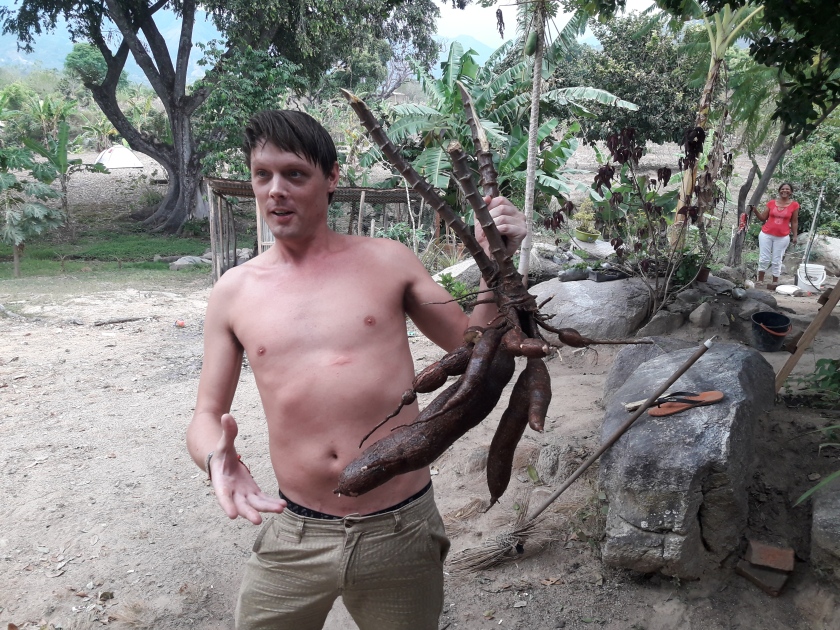
We goofed around and took loads of pictures. Our hosts treated us with the utmost of hospitality. Not long after we arrived, they picked some large plantains and grilled them up for us while we set up camp and then headed off to take a swim in La Mina river. They also picked some giant yuca which would be our breakfast on Sunday.

20180224_163546
Josh pretending he dug up this amazing yuca that Linda actually dug up. So very British of him.

After settling in, we all were ready to go dip our toes into La Mina river. The quiet walk through the town was enough to spark conversation between me and Linda as we found ourselves walking much faster than the couple with camera in tow. As we past indigenous Arawak people with their traditional dress – ancient men and young children playing on the side of the road – donkeys and hogs, we discussed how life has become far more complicated for us over simple illusions: time and money. So much of what we do is rushed by this feeling that we aren’t doing enough. This year is for me, I told her, and I want to spend it doing what matters to me, not simply living to work and spend money and then work some more.

IMG-20180225-WA0133
Loving the sky I’m under.

As we strolled through the crepuscular dirt paths leading down towards the river, we both agreed that it is important to disconnect from all of that noise in order to discover what it really means to be human. We are not so different from any other animal – yet we over-stimulate ourselves constantly with no regards for our basic needs. So much of what we think we need is based on distractions modern society has filled our heads with. Both of us took this trip for a mutual goal: to get out of the city, away from the things that endlessly leave us Stressed Out. We dared to ask ourselves if any of that was what life was actually about or if it is in fact a simple departure from something our ancestors knew all along.

IMG-20180225-WA0099IMG-20180225-WA0132

It’s interesting to note that even though this walk was peaceful, blasts of Vallenato were not far away at any given moment. People in the coastal region of Colombia are bullosa – loud and not ashamed of it. So even as we enjoyed this lazy walk from the finca to the river and back again, we were accompanied by Vallenato blaring somewhere in the distance or at the nearest local. Linda explained that this is a tradition in coastal towns and a strategy to get people to go out and drink at the estancos, or watering hole-bars located along the winding, otherwise abandoned roads.

La Mina river is dangerously beautiful. In some parts, when the water is high, a wrong step on one of the rocks will send you slipping into swift currents that will pull you down into the harsh rockbeds laid out throughout. Some areas have whirlpools and dark waters full of soapy foam. Linda said it was probably due to the water trapped in the same area being splashed against the rocks. A part of me mused if it wasn’t because people often literally bathe in these rivers. Either way, I did very little swimming in the river because though the waters were low, the movement seemed much swifter than what I had seen before and in other places. Not to mention the recent death of a boy in the river came up during conversation. Still, the view at sunset was absolutely breathtaking, and the calm was perfect for an impromptu yoga session.

IMG-20180225-WA0144

Once we were back at the finca, Josh continued to gather wood to make a bonfire. We had decided to roast our salchichas (sausages) over the fire old school camping style and enjoy the clear panorama of the night sky. When we got back, the plantains were ready to eat, so first we restored our energy by eating large, grilled plantains with sloppy, sweet suero, a white cream akin to sour cream but a bit more chunky and – of course – homemade. Linda’s aunt and uncle offered us as much as we wanted, which meant pile after pile of delicious suero on the two big plantains I managed to consume. It’s a must if you live or travel in coastal Colombia!

Then, we stuck our salchichas on sticks and began cooking them up on the fire we built. This went better than expected, however, don’t be fooled – it was hot. It hadn’t hit those low 20 degrees- Celsius temperatures, and the blazing fire just about melted the skin off my hand and face as I tried to hold my sausage over the fire. Josh’s clever solution was to stick the skewers in the ground and watch as they roasted. Once mine was ready, I stuck them in bread and added ketchup American hotdog-style. Linda and her aunt and uncle seemed to find it pretty novel – and tasty.


With bellies full, all that was left was to sit out by the fire and share stories and marvel at the night sky. We looked up and tried to find satellites among the constellations which we also tried to identify. The moon seemed so bright that once the fire simmered out, everyone was lit by an eerie blue light.

With limited technology, I realized how quickly the fatigue filled my body after sunset. Once the sun is down, without artificial light, it’s actually very easy to go to bed early. By 9, Linda and I were curled in our hammocks under blankets, being rocked by the wind – but not sleeping, all the while stirred occasionally by the undulating boom of distant Vallenato and the occasional bursts of barks and cries from the dogs and roosters.

At night, Linda and I were freezing in our hammocks. Turns out one blanket was not enough – my back was cold against the hammock and I curled up to form a cocoon against the chill wind trying to cover every inch of myself with the blanket and the hammock to trap some warmth. Still, in spite of the cold and noise, there is nothing as peaceful as sleeping under the stars (even if the distant music did steal from the orchestra of insects surrounding us – until it finally stopped, briefly at around 4 am).

The climate of La Mina is much cooler than Valledupar because of the higher elevation, and we even saw a bit of rain on the way back (sidenote: it hasn’t rained at all – and much less torrentially, which is the norm – in Valle for over a month). Even though the sun can burn during the day, when the sun went down at night, things gradually became cooler and cooler.

20180225_064419
Morning shadows and hammocks.

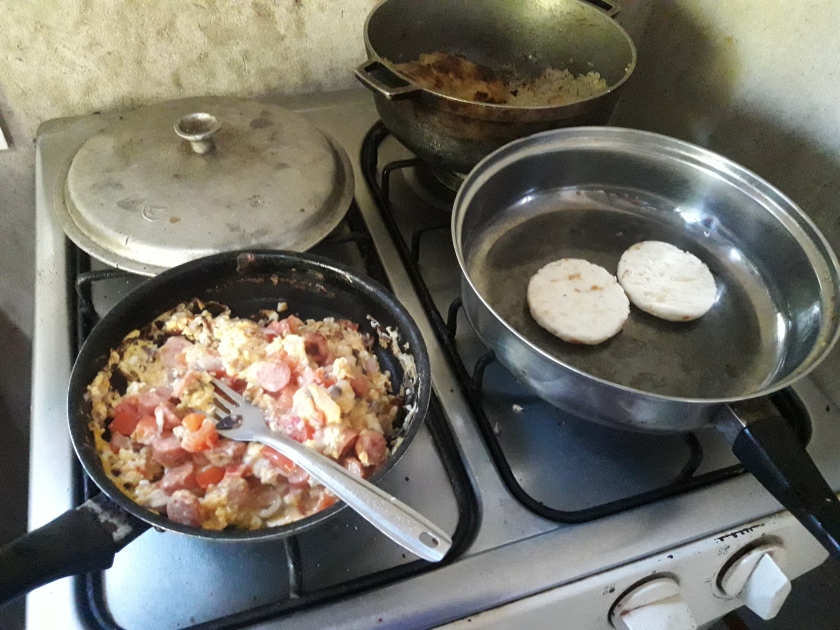
The next day, I struggled to get out of the little womb I had made of the hammock to start the day and make breakfast. By 8 am, everything was ready and eaten. I made a small omelette and some arepas and Linda’s relatives made boiled yuca pulled from the ground the day before along with that delicious suero casero. Of course, all of this went with the traditional tinto, little cups of delicious black coffee. Josh and I couldn’t help by sigh, feeling lucky to be living this amazing Colombian life.

20180225_070817
The eggs and arepas I made, my humble contribution.


We didn’t have enough time to go up the mountain path to Atanquez, a small indigenous village with its own river landmark. So instead we took off for the chorros, or rushing waters (like a small waterfall crossed with a natural water slide) of La Mina. We took lots of pictures along the hike and enjoyed ourselves splashing in the clear waters (at least until a few families with kids in tow showed up and kind of muddied the experience). It’s a good thing I put on sunscreen, because that sun was blazing hot. Whenever we made it back to the house, we were happy to find bolis, or little bags of ice and juice, waiting for us. They had chocolate, lulo (one of my favorite juices found in Colombia), and some other berry; all were utterly refreshing.


Three things you cannot do without if you make this trip: marshmellows (obviously), bug spray, and weed (if you’re into that sort of thing). We had no insect repellent, which led to Linda and I using the local method of warding off gnats with bites more elusive than bigger mosquitos – a “magic” soap that actually does a good job of keeping them away (don’t ask me how). Still, if you go, I recommend you go prepared. Also, extra blankets don’t hurt either.

We finished our stay by having lunch and lounging around, napping, reading, and joking around in the hammocks. The weather cooled so much that I really did not want to leave, but a bit past two, our transport arrived to take us back, this time in a tiny car with no AC (just like the first).

IMG-20180225-WA0147

I won’t soon forget the hospitality shown to us by Linda’s family, the beautiful sunset and chilly sunrise, the rejuvenating rush of the rivers, and the peaceful Colombian paradise tucked away a mere 45 minutes from Valledupar. It’s mini escapades like this that remind me of just how privileged I am to live in a place still so connected to its land and traditions.

All in all, it was a pretty great way to start my birthday week.

La Pantera Negra: an analogy of resistance against colonialism

When you see a great film, it’s almost impossible to let it go without noting just how fucking great it is. Now, any film is subject to criticism. The greatest works generally are not without their flaws, because, well, they were produced by a team of humans, and yes, we are all flawed. However, the concept of Black Panther, after seeing it, has left such an impact on my mind so as to overlook or deem less important its flaws as a work of fictional entertainment and to praise it, not simply as a work of popular fiction, but to appraise it intellectually for the concepts it draws out of the psyche upon watching it.

Pantera-Negra-Payoff-Poster.jpg

While I loved this film a lot, I don’t just want to explain what was great about it (though I will, inevitably, be doing that throughout), but I’d rather discuss just why this film is important for so many as a definitive reflection of culture and the desire to preserve it in spite of colonial and globalizing influences.

Maybe it’s because I’m reading My Ishmael right now, I don’t know, but I can’t help but relate this film to the struggle that the book explains – that primordial struggle between the survival of the Leavers society in face of the Takers unending march toward advancement – and self-destruction. Some of my criticism will be put into those terms, so to provide definition for those who haven’t read any part of Ishmael by Daniel Quinn, Takers are considered the champions of our modern society, the root of our industrial revolution and, ultimately, capitalism. Leavers are those we consider the “vanquished,” the fringed indigenous societies that have lived off the land for millennia and fought to preserve their own culture and ways of life, which also bespeaks a complete preservation of the land itself which they are native to.

myishmaelcover
Obviously, this is a cross-over waiting to happen.

In Black Panther, the Wakandans are the epitome of a Leaver culture, an isolated society struggling to preserve its essence and the secrets its lands possess – especially its abundance of natural resources. It does this by maintaining a closed border and a non-threatening facade. Like so many Leaver societies, it is tempted repeatedly by the seductive promises of the Takers: influence, recognition on a global scale, and (inevitably) endless warfare in order to maintain that position.

The plot thickens when racial relations are added into the picture. Many are forced to question (and the film does this itself as a major plot point which I will try not to spoil) why it is that such a rich, advanced, powerful country would hide away and masquerade as a poor, third-world nation of little status or importance in the world arena. Why would Wakandans turn their backs on the struggles of Africans during the Triangle Passage and slave trade days? The answers, however, become more and more obvious through the internal and external struggles of the protagonist, T’Challa, serenely and sympathetically portrayed by Chadwick Boseman. He fights to maintain a clear head and right the wrongs of his father’s legacy (well, one in particular which rises to haunt him). For the Wakandans, as for most Leavers, the preservation of culture and folkways, of peace and balance, is far more important than the involvement in world affairs that could destroy it.

blackpanthertchalla.jpg
Doesn’t that face just have serene and kingly written all over it?

Pan left, and we see the Takers’ side of things through the eyes of a young, ruthless Erik Killmonger. Cousin of T’Challa, as his name suggests, his goals are to avenge his father while violently seizing the resources of Wakanda in order to establish a new world order. His goal? To bring justice to those affected internationally by the African diaspora, communities impoverished and disenfranchised by the consequences of the slave trade and the systematic racism. Erik knew this struggle growing up as an orphan in Oakland, California. When his father is murdered by T’Challa’s father for betraying his nation and putting their secrets in danger of being compromised, he is left with nothing but a violent city and memories of his father’s vision to bring him to maturity.

black-panther-michael-b-jordan-killmonger-759.jpg
Angry, angry eye-candy: Michael B. Jordan as Erik Killmonger.

One could say that Erik is a bicultural character, the son of an immigrant who never experienced his father’s culture firsthand and therefore was bound to misinterpret it and even intentionally rebel against all forms of traditionalism. Being only partially initiated into the culture of his father, he knew it only on the most superficial level: resources of boundless power and (in his mind) selfishly stark isolationism, a world that does not accept or want him. Erik does not jibe with what he views as a senseless withholding of the powers Wakandans hold which, in turn, contributes his own personal sense of entitlement to take those for himself. He is inevitably affected by the militant visions of his father’s revolution, and rightfully so as they serve an essentially noble, humanitarian cause: bringing justice to the Black community via violent revolutionary means.

If we back up, we can see the references made throughout The Black Panther to the real life consequences of colonization. Africa has been ravaged by the British, the US, and other Western countries for centuries, leading to a complete corruption and fragmentation of identity of some groups within the continent. From diamonds to human beings and the labor they provide, Africa’s riches have very often attracted outside attention and that attention has led to the bloodletting of those tribal societies. In essence, the Takers have done exactly what their name implies throughout African history on a broad scale.

So, let’s imagine that Wakanda did exist. A country with the power to camouflage itself and go unnoticed by the rest of the world while perfectly preserving its cultural pride and way of life. Is there any question that the outcome would be for the country to do just that, even at the expense of its African relatives and displaced descendants? It would be the only country in Africa never to be colonized, which would create a bond so great so as to make such a proud, closed society completely conceivable.

Outside of Africa, the diaspora created a bond of sorts not previously known in Africa – for many, it created a monolith by ripping Africans from their homes and denying them the practice and knowledge of their own native cultures. This is why, while Caucasian Americans generally know their ancestral origins and proudly proclaim themselves x% Irish or y% German, African-American is the term most widely used in the United States, with little recognition of Africa as a diverse, incredibly complex continent of 54 official countries.

Killmonger falls into the African-American, post-diaspora camp with generations worth of anger and little understanding of the complex context in which his relatives live. He sees himself as part of the larger culture of post-slavery pain and disenfranchisement – literally, he lost his kingdom and his father in one fell blow – and one which Wakandans cannot relate to. However he doesn’t know the world he wishes to rule or the urgency the Wakandans feel to protect it at all costs.

And it’s important to note that it isn’t just the Wakandans’ own culture and future they wish to protect. After all, they have no ambitions to impose their culture upon others or to be a ruler in the world arena the way Killmonger does for clear reasons – they are aware of how small they are in terms of population and how big the resources are which they possess. Leavers are now a scattered minority, trying to protect themselves from the corrupting influences of commercialism (this would be why selling Vibranium is so looked down upon by the Wakandans – it is not just a commercial resource, but like the water of the land, it is a part of their very identity as a nation).

On the other hand, Wakandans have seen exactly how far the Taker culture will go to exploit the natural resources of Leaver cultures – from the coal and fruits of South America to mining in Australia and the torture and decimation of Aboriginals. And the movie makes evident that this corruption could lead not only to destruction of the Wakandan way of life but a destruction of the very planet, brought low by endless fighting and the misuse of the mythical Vibranium.

Only through looking inward and outward for guidance can T’Challa overcome this struggle for the future of Wakanda. How will they enter the world arena? He decides by remaining levelheaded and safely grounded in the values of his culture while also keeping an open mind and heart to those struggling around him. He sees the wrong his father did by taking Erik’s father and does everything in his power to right it, even going against the wishes of Erik himself by trying to save him. That is what makes him such a great king: he does not act simply on base emotions of vengeance, anger, and self-preservation (even though he certainly could) but with empathy, even for his enemy, as he meditates and seeks the greater good for all.

Even though Wakanda is a fictional place, it serves as a clear analogical metaphor for so many countries and cultural groups that seek and have sought to stick to their own path in an ever-evolving world. Latin America has also faced this struggle, with many countries having to make the decision to isolate itself, like Paraguay and Venezuela, or become a pawn in the world arena that results in debt and dependence on outsiders for resources that could just as easily be produced on native soil.

Ultimately, Wakanda chooses to “step into the spotlight,” neither as a warring nation seeking to avenge the oppressed and dish out just deserts to the oppressors nor as a pawn for those bigger nations, but as a force of peace striving to protect and provide aid to those disenfranchised outside of its borders. Like a true Leaver society, T’Challa and the Wakandans choose peace over power.

I loved this concept because it goes against the blatant machismo seen in other Superhero movies (and brilliantly expounded on by Adam Chitwood of Collider). The focus is not placed on the number of explosions but on the internal strength and character of T’Challa and the unity of his people which face a serious dilemma brought about by the antagonist’s actions. The way that they choose to handle this struggle shows their love for their culture. Wakanda Forever echoes throughout the movie and reflects the enviable bond of the Wakandans and a deeper desire for unity and preservation of African cultural values across the diaspora.

Also, the characters, costumes, and sets are stunningly gorgeous. The soundtrack bumps with the rhythms of Kendrick Lamar and The Weeknd and other urban wonders and sucks you into the action in a way that sends your pulse bumping along with it. The female cast that brings General Okoye (top warrior and the bodyguard), Princess Shuri (T’Challa’s sister and tech extraordinaire), and Nakia (War Dog spy that manages not to be pigeonholed by “love interest” despite her romantic ties to T’Challa) to life is absolutely superb and reflects the importance given to the role of women and the (hopefully) continuous expansion of female roles in movies, especially for women of color. Pleasantly, they were untouched by the usually glaring filter imposed by the male gaze when dealing with “empowered” female characters. All of the cast was nuanced, individually interesting, and real, while also being really badass.

See this film. See it to witness the analogy of resistance and strength in the face of colonialism. See it to understand the struggles faced by Leaver cultures forced to choose between preserving themselves and reconciling the past with the present by providing a safe haven for its descendants shattered by the consequences of colonialism on community and psyche. See it for…Wakanda, a place of wonders and hope for a new generation.

**Edit: this will probably be updated (think of it as a draft) because I was ridiculously tired this week and writing was not coming easy. Feedback welcomed!


Things I’ve been doing that haven’t been working: a blog post about being sick and teaching

I just wrapped up my second week of teaching while sick, and let me just say, it was not easy. Maybe this is common sense, but being around children (often who are also sick) and coughing up phlegm/having a nose that is constantly running are not ideal situations to be in.

So without further ado, let me introduce you to a list of all the mistakes I’ve made as a newbie teacher what not to do, especially when you’re sick while teaching.

  1. Do not scream. No matter what.

I know, I know, it sounds like the tag to a horror movie more than advice on working in a classroom (while sick). But no matter how badly you want to yell at your students, take a deep breath, recollect and find a way to stop the action and get their attention without screaming.

If you must scream, find a way to do it with as little exertion as possible. Maybe into a pillow before you go to sleep as your nightly ritual.

Well, unless you are working with kids that literally will ignore you no matter what language you speak to them, no matter what tone you use, no matter if you change their color on the behavior chart or take away their recess. But you know. Do the healthy (professional) thing and hold it in.

   2. Do not come up with complicated or at least somewhat challenging lessons/activities. You will be disappointed.

Less is more – the mantra of all teachers on top of their game. The mantra of champions. The longer you spend explaining things to the tykes slowly wiggling away from you on the rug, the less they are going to retain what you say. And if you say anything, it needs to be short, sweet, and to the point. Oh, and running around having to explain each complicated but what you thought would be “stimulating” activity is just…not rewarding.

Again, less is more.

   3. Do not drink cold water, no matter how much you want to.

Oh, the heat. Oh, the sweat, the unquenchable thirst. But I have learned the hard way that no matter how much you think drinking cold water is the right thing to do on a hot day, if you are sick and congested, it will only make matters worse. The change in temperature from hot to cold disturbs the vocal cords. They cringe and shrivel, leaving you with a very weak voice. As opposed to the mannish, rasping boom that being congested boarding on hoarse will grant you. Word to the wise: it’s not worth the damage.

   4. Avoid talking to parents. In fact, just avoid talking outside of the classroom. Smiles and grunts are more honest and straightforward anyway.

I mean, who needs communication with your children’s parents anyway? It will only make your already complicated, demanding job more complicated and demanding. And besides, you sound like a squeaky door opening and closing when you attempt to speak anyway, which leads to looks of false-sympathy and possible chagrin. Your coworkers, nosy parents, and the school gossip are also not worth breaking the vow of silence.

  5. No expectations. Disappointment is easier to stomach that way.

Goals are good and healthy for your students. You should always have a goal posted and a plan to reach said objective. However, if your students (or at least half of them) continue to fail to meet that objective, it is better to just let them instead of wringing your hands, tearing your hair out, and asking them what in the world is going through their little heads. (I seriously did this a couple times this week out of frustration. Spoiler alert: it solved nothing.) Just hope for the best, and plan for the worst. The adage never lets you down. Expecting to move mountains with tiny sand-castle shovels is just not realistic.

  6. Don’t lose your cool. This goes with the not screaming thing, but can be much, much harder.

Especially if you routinely feel like the unstoppable force that meets the unmovable object. Or vice versa. Sometimes classroom management plans fail. The class falls behind and is late. Things get messy, but even if things are going badly, just let them happen. Observe. Then act. Don’t stress and make yourself sicker. It’s not worth it. Plus, students don’t respect a teacher that loses their cool. Although, yes, it is difficult to determine what these students do respect, and you think that repeating yourself or speaking louder should be enough, but let’s be honest…

7. Don’t repeat yourself ad nauseum or sweat the small things. You will get sicker.

There is a time and a place for sweating the small things. It can improve behavior, and consistency is key. But is it really necessary to call out every little misbehavior that you see? Every whisper or rolled eye or scissor fight? No, no it is not. You should address the behavior according to your classroom management consequence plan (so move them down and praise the students that are following directions), but the economy of words is never as vital to bear in mind as when you are struggling to speak without your voice squeaking. If the students can’t accomplish the task properly the first time, take into account what may have went wrong, guide steadily but in a detached manner, but…well, you’ll sweat regardless. It’ll just be more do to the heat than the strain of constant repetitions at an steadily increasing, strained volume.

8. Don’t forget you’re living in the context of another culture – machismo and all.

Culture shock is part of the process, and while you seldom predict that it will come in the form of having to manage several students who insist on striking each other to solve their problems, you also must find a reasonable solution for the problems which cause them to resort to self-defense in the first place. (And consider the lessons built into their culture and society. Such as parents actively encouraging their children to take matters into their own hands, especially if they’re boys.) That includes a reasonable set of consequences that you must uphold, no matter how much they growl and roll their eyes. If, at the tender age of 7, they are already obsessed with showing how manly and macho they are, do not be alarmed. They are simply reacting to the cultural demands put on them.

These are just some of many mistakes I have made that I must say, no matter how frustrated you become or convinced it’s the only way to establish control, you shouldn’t do, especially while sick. Because it will just lead to more regrets and slower recovery time overall. Oh, and on that note, don’t share much space with your sick students if you can avoid it, especially while they’re eating.

More than an advice blog, I think this is my big cry for help and advice. Seasoned teachers, please tell me what I am doing wrong. Or better yet, tell me what I could or should do to handle the group of students that I have and recover from new-teacher-itis. My students are uniquely difficult for several reasons I will save for another post (mostly related to a mixture of undiagnosed learning and behavioral disorders – I mean, seriously, I have at least three students that will hit their classmates, in front of me, no matter what consequences are set – perhaps because the school itself does not have a policy for dealing with).

All this being said, I do have an idea of the moments things went right and what I was doing. So I am going to try to take my failures in stride, the general struggle with the ups and downs of “training” my students. It’s important to breathe, step back, and regroup, I’ve found. Reevaluate, reflect, and refresh. Start the new day with a clean slate on a positive note. And so far I’ve still been able to accomplish that much at least. Oh, and my room’s AC is finally working. That helps too.

For now, it’s just the general trial and error that is making me feel so incompetent. That, and this damn coughing sickness that makes me feel so tired. And a very unsupportive, non-constructive administration. But hopefully this week I will start seeing some more of those Tiny Victories I will talk about in another post. Stay tuned.

P.S.: Pardon my lag. I’m currently juggling an online TEFL certification course as well as all of these exhausting school responsibilities, but I promise that once the course ends in the next couple weeks, I will dedicate a lot more time to the blog. Well, assuming anyone cares.

Plans, Goals, and Time: How I got to Colombia

I’ve decided to document my time teaching English in Colombia at a bilingual school in Valledupar. This latest chapter of my life opened at the end of last year and the beginning of 2017 in a rushed state of post-drunken incoherence.

Literally.

I started the year hungover, weak, and exhausted on a plane to Bogotá. Although unable to process anything after my imprudent New Year’s Eve shenanigans, my mind was made up; in spite of all of the crippling self-doubt I’ve dealt with time and time again, I was going to do this, make this move, and live and work in another country. Ever since I graduated from UNO in 2014 (already nearly 3 years ago), I knew that was what I wanted. This was what I wanted.

Yet for all of my dreams and desires finally determined, nothing could have prepared me for what I’m living now. You see, dreams aren’t real; they’re manifestations, and reality is seldom as pretty as we wish for it to be. You tend to think about the excitement and fervor of being in a new place. Making friends, going on excursions, and eating all of the food. You don’t stop to think about the buffering period of adjustment and readjustment that you have to be put through and molded by first before reaching that satisfying point in the journey.

To give full context, I feel I should give a little background. When I first decided to teach in Colombia, I was desperate for a change. I felt like the past couple years since graduating I had just been spinning my wheels. Yes, I developed some very valuable experience, but patience and perspective of the value of waiting have never been strengths of mine. Worse, I kept getting hung up on different things – namely, boys and doubts about if I should continue grinding or go back to school. If it wasn’t financial difficulties and indecisiveness, it was some kind of relationship-related messy entanglement allowing me to make excuses about putting my real goals on hold.

Granted, those years had not passed by wasted nor had my struggles been in vain. I did gradually make it to the point I am at today – first by moving to California after graduating, getting my translation certificate like I wanted to do in 2015, working in two separate schools in a bilingual position – one of which was in LA, a city I developed a strange enough bond with to long for it only in my states of passing melancholy. It’s a fantastic place to explore, for sure, brimming with culture and depth beyond the plastered Hollywood stereotypes. However, it was ultimately a cold place to me. I didn’t make the connections I had hoped for. I felt alone and unfulfilled.

So in the throes of the last breakup and rebirth stage, I made a decision to finally get out while I had the chance.

Last March, I received an email from an acquaintance I had met the first time I visited Colombia in 2013. The trip had been short and strenuous – I had gone as a volunteer delegate with Witness for Peace to learn about environmental and social issues caused by coal-mining carried out by multinational corporations. I witnessed the displacement of indigenous Wayuu and Afro-Colombian communities from their ancestral land and the destruction of that land. The experience had moved me in a way I knew would be significant at some point down the road…

However, I hadn’t anticipated that it would lead me to going back to teach English. Even now, I’m still not entirely certain how I’ve ended up in teaching, except that it seems I’m not too terrible at it, as my past two years working with mainly elementary students has taught me. It fulfills a need to help and do something constructive that involves planning and creativity. But what I really want to do is work as a translator and interpreter for organizations like Witness for Peace, or at the very least use my skills to help communities that have struggled the most due to Capitalism, Neoliberalism, and US interference.

When I got the email about teaching English in Fonseca, La Guajira, I thought, well hell, maybe I can find a way to give back to the community there in some small way. And since teaching wasn’t the end game, I buzzed at the idea of finding other opportunities along the way.

Once my plans were made, months after the original email (which I had coincidentally received during my second trip to Colombia to visit a dear friend in Bogotá), I arranged to resign at my previous job at the Global Education Academy and try my hand at coming up with my own lesson plans and working independently.

Before I go on, I feel I should point out that my idealized vision of the whole English-program-in-La Guajira thing ended up being pretty remote from the reality. But you’ll find that’s a trend with me. Idealists, am I right?

But without making a long story longer, suffice it to say I learned a lot about what I wanted to teach and how I wanted to teach it during October and November of last year. I discovered I had developed some decent teaching instincts, and though it was little time, resources were scarce, and people were flaky, I managed to teach my mainly True Beginner students something in that span of time (even if it was really just really basic vocab, class rules, and being able to introduce themselves and ask questions).

I was also greatly exposed to the Dark Side of Colombian culture. Or maybe the “Dark Side” is a bit harsh, but frankly culture shock, though mild considering my previous exposure to general Latin American culture, has not been nonexistent.*

In the coast, people tend to have their own folkways. There’ll be more on this later, but basically life is slower and people can be very noncommittal for any number of reasons. I’ve learned that it is not just my foreigner’s perspective that makes me feel frustrated by these things (as Colombians from other areas have complained to me about them, too), but that didn’t make it easier to do the whole independent teaching thing.

So when I found out about a stable job at a prestigious bilingual school – one that would put me in an ideal location to travel and explore the immense natural beauty of Colombia in my free time** – I jumped on it like white people on Wonder Bread and the latest recycled trends.

And for all of my fear that I wouldn’t be considered, I got the job on the same day I went in and was interviewed. As my own biggest critic, it often surprises me how often I prove myself wrong and come out better than I assume I will.

I went back to the US, spent 2 slow but much-needed weeks with my family and a few very rushed days with my friends in New Orleans. Before I knew it, January 10th was here, and I was walking across the school from my new home to my new campus, anxious to meet the other teachers and hoping to make a good impression.

Today marks 3 weeks since I’ve been living in Colombia, almost 2 weeks since I started working at el Colegio Bilingue. The first week was utterly exhausting.

When teacher’s say that your first year teaching is trial-and-error with mostly error and lots of improvising to solve problems, they weren’t kidding. Being an aide in a classroom is a very different experience from being a teacher – especially when your students are between the ages of 6 and 8. Add that you are contractually bound to speak to them only in English (even if you know they don’t understand you and need support) and you get really stressful times, times when you are just pure internal screaming.

Also, Valledupar is the land of eternal summer and the wile, wile West of Colombia. And my AC was broken. So I was literally sweating bullets, moving around in circles from one center to another at some points when I was alone with the students for over an hour at times trying to keep everything working, at least somewhat. Did I mention that I was supposed to have an aide?

Planning time was thwarted since the first week as well. My fellow Transition teacher is also the English Language Arts Coordinator, which means lots of meetings. Because time schedules seldom function or matter here, that means that either I end up planning alone (something I was not prepared to do last week but since have developed more confidence for after trial by fire) or we start planning and get interrupted by something else. Hoping this will teach me self-sufficiency and resilience, but it was upsetting to realize that so many things I felt had been guarantees simply were not present, leaving me severely overwhelmed. And hoarse.

There is just not enough time in the day for everything. But there is enough time in general to make things happen.

I’ll be keeping you updated on what other pearls of wisdom I learn (the hard way) about teaching and if I end up rage-quitting or getting fired for losing it on Samuelito or one of my other “estudiantes dificiles” (“difficult” here being a euphemism for spoiled little shitheads). Stay tuned and pray I recover my voice and learn how to write beautifully in cursive!

I’d also like to share stories and experiences, tips and advice with other ex-pats and English teachers, so if that is you – or you just have something to say or ask – please drop a comment!

*I’ll also be talking about how Latin American^TM culture is not a monolith for all the commonalities that can be found.
**Little did I know, “free time” is now a thing of the past until TBD (possibly, never).