Migracampi: Ecotourism in Pueblo Bello

Finally! Some inspiration to publish travel content, brought to you by my first paseo (short/roadtrip) of 2021 in Colombia!

Let’s start with the facts:

Town: Pueblo Bello, Cesar, Colombia
Lodging: Migracampi (just say “donde John” to the driver — they’ll know where to drop you off)
Distance: 53 km, about an hour from Valledupar (the capital of Cesar)
Transportation: bus or Coomaple Colectivo ($15.000/~$5 USD per person)
Style: Camping/Glamping
Prices: 35-40.000 pesos (~12-14 dollars)/night
Breakfast, coffee, and tea Included
Food and drink available to buy on site (including beer! and other more “exotic” local spirits)
Host: John Alvarez (@migracampi)

The long and short of it – follow me on Instagram for more!

Now that I’ve gotten the key info out of the way, let me narrate my incredible experience with Migracampi.

This was my second time staying at the backyard campsite. It had been just over a year ago when I first decided to explore. My third time going to Pueblo Bello.

Pueblo Bello, although a small town, is something of a cultural crossroads between the indigenous cultures under the “Arhuaco” cultural umbrella that live in and around the Sierra Nevada and the post-colonial mainstream Colombian culture. And then people like me, foreigners from all over the world that have been drawn to these little-spoken-of gems hidden among a kaleidoscope of more “developed” tourist attractions in the country.

The creator of Migra, John, is acutely aware of the cultural and ecological significance of the space he inhabits. He paves the way as an entrepreneur who has managed to grow his space greatly within the course of a single year. In fact, he never seems to tire of his various projects to expand on the sustainable mission of his lodging and tour ecotourism services.

Let me start from the beginning. To get to Pueblo Bello from Valledupar, my friend and coworker Carin and I only had to take a taxi to downtown Valledupar. Near an outdoor shopping center called La Galeria, in an alley-like street bursting with venders of fruits, vegetables, clothing, and even school supplies, you can find several transportation offices.

The one we were looking for was easy to spot — Coomaple. We walked in, gave our names, and were quickly instructed to load a white truck by the driver. We paid the driver the 15.000 peso fare once we got to Pueblo Bello — after picking up two and a half more passengers (including their adorable white puppy, Aaron).

The ride up through the mountains leading to the Sierra Nevada is twisted and gave me a bit of motion sickness on the way up, but “luckily,” the truck got a flat tire. While the driver used rocks in the place of a car jack, I sat on the curb of the road, trying to remind myself that things like this happen in Colombia all the time. A flat tire on a sloped incline should be the least of my concerns!

The greenery and blooming flowers welcome you into Pueblo Bello. Unlike in Valledupar, it has been raining regularly. The air is crisp and fresh. The sound of birds fills your ears from all sides. For those that appreciate it, like my friend Jose, it is the perfect place for bird-watching and spotting varieties of birds unique to the region.

We were greeted by John upon arrival. I felt like I was being welcomed home by an old friend — secret handshake and all. A native of Pueblo Bello, John has a sort of energy that makes you feel immediately relaxed and open. He’s just a genuine person, on top of being an earnest host, and a fantastic trail/tour guide.

He showed us our lodging, which exceeded our expectations – even mine having stayed at Migra before. When I visited Migra for the first time a year ago, I had opted for the simple tent experience. The tents are set up by John and include a sleeping pad, bedding, and a flashlight. They are comfy and minimalist. However, this time I had opted to try the “Glamping” experience.
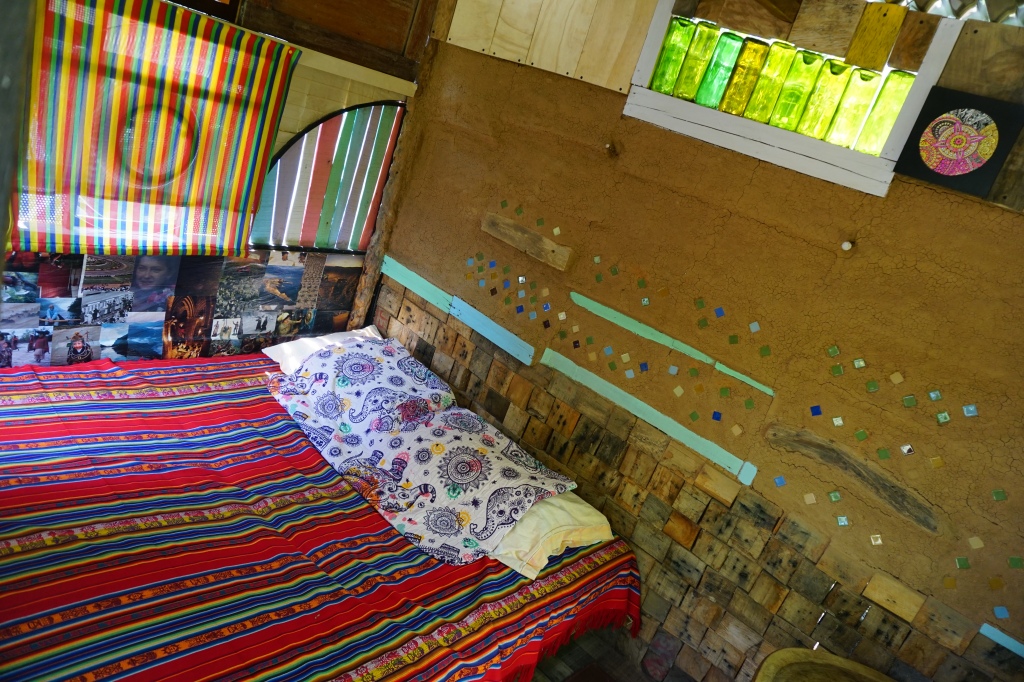
My gorgeous, inviting bed for the weekend. ~Glamping~

Products of his ingenious crafting abilities, John offers two mini homes, cabins made from recycled materials. The windows shine green as the light hits repurposed beer bottles which have been set in the place of glass windows to allow for air to constantly circulate within the cabin. The two cabins sit on different sides of the enclosed camping space. One is made for an individual and the other can fit two people in a queen-sized bed. The decorations are impeccable, reflecting the same attention to detail that you can observe and appreciate around the entire space.

Every personal touch makes sense while creating an inviting, familiar atmosphere. In the middle of camp, there is a public sink with a mirror and handsoap, additional to the two bathrooms with sinks, showers, and mirrors of their own. There is a garden with chairs set up perfectly to enjoy the sunset and sounds of nature or even a smoke, if that’s your fancy. John even dabbles in beekeeping and has his own bee house of friendly bees on the grounds. The signature bar to the left of the entrance continues to be the hub where music plays, and food and drink are offered at low prices that belie their quality.

Even a simple sandwich displays John’s individual style and attention to detail.
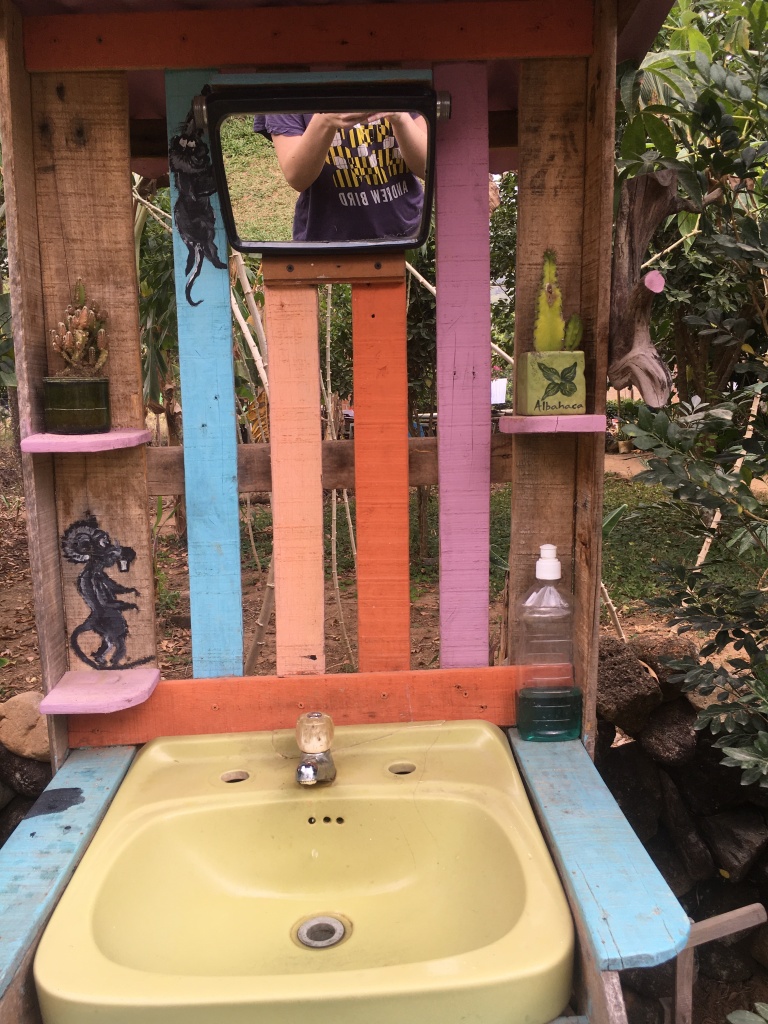
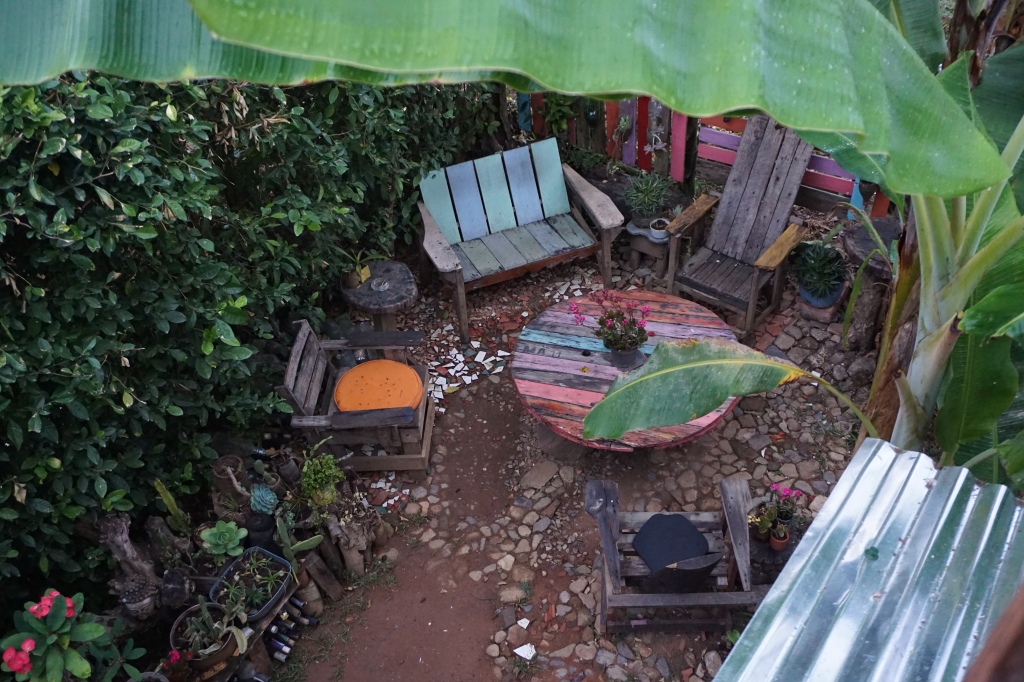
With so much to offer, I had not imagined how much more I would find this time around, only a year later. As I noted, John had not taken a day off. Now the Migra campgrounds include a treehouse deck (which will eventually be converted into a cabin) with hammocks hanging in a chill space underneath. This area is cleverly furnished with plants and books, just like the other spaces of Migracampi. We rested and ate in the shade, waiting for our other friends to arrive before going on a bike ride around Pueblo Bello.
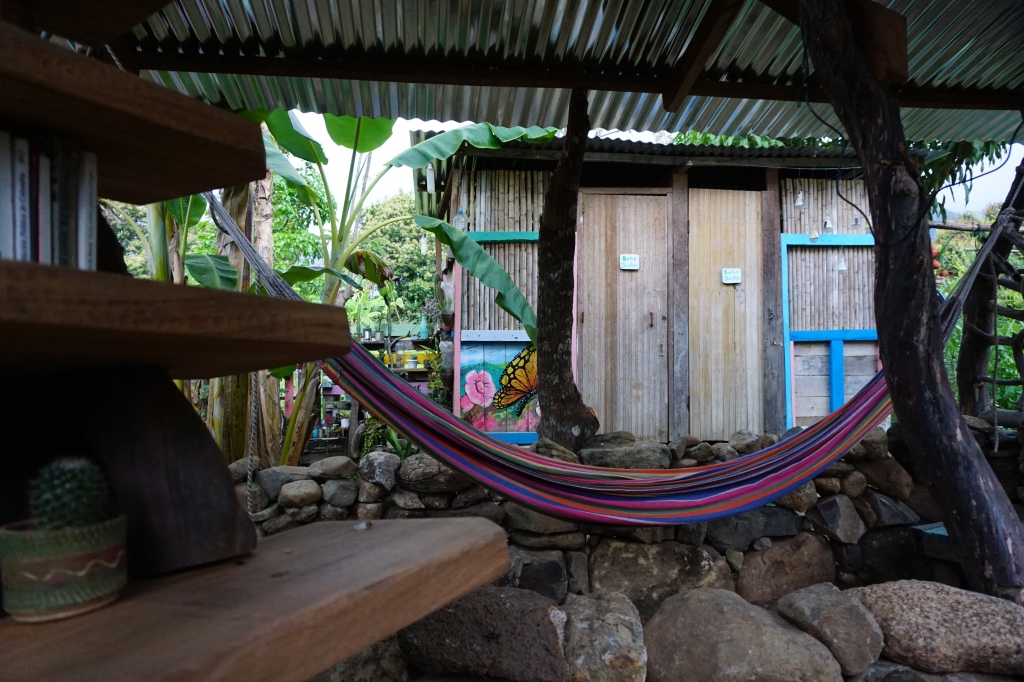

John helps you get information and reserve any activities you might want to do in Pueblo Bello. After a quick phone call, he found out that the locals that rent out bikes only had 3 available that day. There were 5 of us. John rented out two of his own bikes so that we could all take off together without a problem.

Biking in Pueblo Bello is just 5.000 pesos an hour. We spent three hours — 2 of which were spent at the river drinking and enjoying the water — exploring Pueblo Bello from top to bottom — literally. The majority of the ride through the town is downhill when heading towards the river and hiking towards the waterfall. The way back posed a problem for me since I had opted for two beers and we had stopped at an ice cream shop before going down to the river. I quickly got winded trying to fight my way up the rather steep hills. Then I started to feel dizzy and nauseous.

My friends helped me to get a bottle of water and a automoto taxi back, just as it started to rain really hard. I was more than relieved to unload the bike and leave it in the front so that I could lay down in a hammock and catch my breath. Once again, the host was graceful enough to return the bike for me without any hesitation.

Another thing to keep in mind about Pueblo Bello is that it rains pretty frequently, depending on the time of year, sometimes suddenly and heavily, especially during the rainy season. Rainy season starts around the end of February, so we are finally seeing an end to the months of drought typical of the dry season.

My poor friends had to book it to get back to the house where we rented the bikes in the rain. They returned their bikes, and we all convened for dinner and drinks on the campground. The rain fell hard, harder than I had seen since I left Louisiana, and lightning streaked the sky in a soothing yet intimidating way. There was no danger; this is typical of the rainy season.

I stayed up until the sun had completely disappeared, but once I ate, with the rain still coming down, I slid into my glamping cabin, slipped under the fluffy quilt and went straight to sleep, even as some of my friends stayed up to chat and drink Churro, a distilled ancestral liquor found in this region of Colombia.

I’ll end this with the peaceful memory of that cool night. The bedspread was just thick enough to keep me cozy and comfortable despite the low temperatures. The sound of birds is a constant symphony at Migracampi, one that lulled me to sleep and then woke me up early the next morning.

To be continued…. (leave some applause if you liked this review/check out my instagram!)

Day 2: The hike to La Tranquilidad and the Deluge that came after.

La Pantera Negra: an analogy of resistance against colonialism

When you see a great film, it’s almost impossible to let it go without noting just how fucking great it is. Now, any film is subject to criticism. The greatest works generally are not without their flaws, because, well, they were produced by a team of humans, and yes, we are all flawed. However, the concept of Black Panther, after seeing it, has left such an impact on my mind so as to overlook or deem less important its flaws as a work of fictional entertainment and to praise it, not simply as a work of popular fiction, but to appraise it intellectually for the concepts it draws out of the psyche upon watching it.

Pantera-Negra-Payoff-Poster.jpg

While I loved this film a lot, I don’t just want to explain what was great about it (though I will, inevitably, be doing that throughout), but I’d rather discuss just why this film is important for so many as a definitive reflection of culture and the desire to preserve it in spite of colonial and globalizing influences.

Maybe it’s because I’m reading My Ishmael right now, I don’t know, but I can’t help but relate this film to the struggle that the book explains – that primordial struggle between the survival of the Leavers society in face of the Takers unending march toward advancement – and self-destruction. Some of my criticism will be put into those terms, so to provide definition for those who haven’t read any part of Ishmael by Daniel Quinn, Takers are considered the champions of our modern society, the root of our industrial revolution and, ultimately, capitalism. Leavers are those we consider the “vanquished,” the fringed indigenous societies that have lived off the land for millennia and fought to preserve their own culture and ways of life, which also bespeaks a complete preservation of the land itself which they are native to.

myishmaelcover
Obviously, this is a cross-over waiting to happen.

In Black Panther, the Wakandans are the epitome of a Leaver culture, an isolated society struggling to preserve its essence and the secrets its lands possess – especially its abundance of natural resources. It does this by maintaining a closed border and a non-threatening facade. Like so many Leaver societies, it is tempted repeatedly by the seductive promises of the Takers: influence, recognition on a global scale, and (inevitably) endless warfare in order to maintain that position.

The plot thickens when racial relations are added into the picture. Many are forced to question (and the film does this itself as a major plot point which I will try not to spoil) why it is that such a rich, advanced, powerful country would hide away and masquerade as a poor, third-world nation of little status or importance in the world arena. Why would Wakandans turn their backs on the struggles of Africans during the Triangle Passage and slave trade days? The answers, however, become more and more obvious through the internal and external struggles of the protagonist, T’Challa, serenely and sympathetically portrayed by Chadwick Boseman. He fights to maintain a clear head and right the wrongs of his father’s legacy (well, one in particular which rises to haunt him). For the Wakandans, as for most Leavers, the preservation of culture and folkways, of peace and balance, is far more important than the involvement in world affairs that could destroy it.

blackpanthertchalla.jpg
Doesn’t that face just have serene and kingly written all over it?

Pan left, and we see the Takers’ side of things through the eyes of a young, ruthless Erik Killmonger. Cousin of T’Challa, as his name suggests, his goals are to avenge his father while violently seizing the resources of Wakanda in order to establish a new world order. His goal? To bring justice to those affected internationally by the African diaspora, communities impoverished and disenfranchised by the consequences of the slave trade and the systematic racism. Erik knew this struggle growing up as an orphan in Oakland, California. When his father is murdered by T’Challa’s father for betraying his nation and putting their secrets in danger of being compromised, he is left with nothing but a violent city and memories of his father’s vision to bring him to maturity.

black-panther-michael-b-jordan-killmonger-759.jpg
Angry, angry eye-candy: Michael B. Jordan as Erik Killmonger.

One could say that Erik is a bicultural character, the son of an immigrant who never experienced his father’s culture firsthand and therefore was bound to misinterpret it and even intentionally rebel against all forms of traditionalism. Being only partially initiated into the culture of his father, he knew it only on the most superficial level: resources of boundless power and (in his mind) selfishly stark isolationism, a world that does not accept or want him. Erik does not jibe with what he views as a senseless withholding of the powers Wakandans hold which, in turn, contributes his own personal sense of entitlement to take those for himself. He is inevitably affected by the militant visions of his father’s revolution, and rightfully so as they serve an essentially noble, humanitarian cause: bringing justice to the Black community via violent revolutionary means.

If we back up, we can see the references made throughout The Black Panther to the real life consequences of colonization. Africa has been ravaged by the British, the US, and other Western countries for centuries, leading to a complete corruption and fragmentation of identity of some groups within the continent. From diamonds to human beings and the labor they provide, Africa’s riches have very often attracted outside attention and that attention has led to the bloodletting of those tribal societies. In essence, the Takers have done exactly what their name implies throughout African history on a broad scale.

So, let’s imagine that Wakanda did exist. A country with the power to camouflage itself and go unnoticed by the rest of the world while perfectly preserving its cultural pride and way of life. Is there any question that the outcome would be for the country to do just that, even at the expense of its African relatives and displaced descendants? It would be the only country in Africa never to be colonized, which would create a bond so great so as to make such a proud, closed society completely conceivable.

Outside of Africa, the diaspora created a bond of sorts not previously known in Africa – for many, it created a monolith by ripping Africans from their homes and denying them the practice and knowledge of their own native cultures. This is why, while Caucasian Americans generally know their ancestral origins and proudly proclaim themselves x% Irish or y% German, African-American is the term most widely used in the United States, with little recognition of Africa as a diverse, incredibly complex continent of 54 official countries.

Killmonger falls into the African-American, post-diaspora camp with generations worth of anger and little understanding of the complex context in which his relatives live. He sees himself as part of the larger culture of post-slavery pain and disenfranchisement – literally, he lost his kingdom and his father in one fell blow – and one which Wakandans cannot relate to. However he doesn’t know the world he wishes to rule or the urgency the Wakandans feel to protect it at all costs.

And it’s important to note that it isn’t just the Wakandans’ own culture and future they wish to protect. After all, they have no ambitions to impose their culture upon others or to be a ruler in the world arena the way Killmonger does for clear reasons – they are aware of how small they are in terms of population and how big the resources are which they possess. Leavers are now a scattered minority, trying to protect themselves from the corrupting influences of commercialism (this would be why selling Vibranium is so looked down upon by the Wakandans – it is not just a commercial resource, but like the water of the land, it is a part of their very identity as a nation).

On the other hand, Wakandans have seen exactly how far the Taker culture will go to exploit the natural resources of Leaver cultures – from the coal and fruits of South America to mining in Australia and the torture and decimation of Aboriginals. And the movie makes evident that this corruption could lead not only to destruction of the Wakandan way of life but a destruction of the very planet, brought low by endless fighting and the misuse of the mythical Vibranium.

Only through looking inward and outward for guidance can T’Challa overcome this struggle for the future of Wakanda. How will they enter the world arena? He decides by remaining levelheaded and safely grounded in the values of his culture while also keeping an open mind and heart to those struggling around him. He sees the wrong his father did by taking Erik’s father and does everything in his power to right it, even going against the wishes of Erik himself by trying to save him. That is what makes him such a great king: he does not act simply on base emotions of vengeance, anger, and self-preservation (even though he certainly could) but with empathy, even for his enemy, as he meditates and seeks the greater good for all.

Even though Wakanda is a fictional place, it serves as a clear analogical metaphor for so many countries and cultural groups that seek and have sought to stick to their own path in an ever-evolving world. Latin America has also faced this struggle, with many countries having to make the decision to isolate itself, like Paraguay and Venezuela, or become a pawn in the world arena that results in debt and dependence on outsiders for resources that could just as easily be produced on native soil.

Ultimately, Wakanda chooses to “step into the spotlight,” neither as a warring nation seeking to avenge the oppressed and dish out just deserts to the oppressors nor as a pawn for those bigger nations, but as a force of peace striving to protect and provide aid to those disenfranchised outside of its borders. Like a true Leaver society, T’Challa and the Wakandans choose peace over power.

I loved this concept because it goes against the blatant machismo seen in other Superhero movies (and brilliantly expounded on by Adam Chitwood of Collider). The focus is not placed on the number of explosions but on the internal strength and character of T’Challa and the unity of his people which face a serious dilemma brought about by the antagonist’s actions. The way that they choose to handle this struggle shows their love for their culture. Wakanda Forever echoes throughout the movie and reflects the enviable bond of the Wakandans and a deeper desire for unity and preservation of African cultural values across the diaspora.

Also, the characters, costumes, and sets are stunningly gorgeous. The soundtrack bumps with the rhythms of Kendrick Lamar and The Weeknd and other urban wonders and sucks you into the action in a way that sends your pulse bumping along with it. The female cast that brings General Okoye (top warrior and the bodyguard), Princess Shuri (T’Challa’s sister and tech extraordinaire), and Nakia (War Dog spy that manages not to be pigeonholed by “love interest” despite her romantic ties to T’Challa) to life is absolutely superb and reflects the importance given to the role of women and the (hopefully) continuous expansion of female roles in movies, especially for women of color. Pleasantly, they were untouched by the usually glaring filter imposed by the male gaze when dealing with “empowered” female characters. All of the cast was nuanced, individually interesting, and real, while also being really badass.

See this film. See it to witness the analogy of resistance and strength in the face of colonialism. See it to understand the struggles faced by Leaver cultures forced to choose between preserving themselves and reconciling the past with the present by providing a safe haven for its descendants shattered by the consequences of colonialism on community and psyche. See it for…Wakanda, a place of wonders and hope for a new generation.

**Edit: this will probably be updated (think of it as a draft) because I was ridiculously tired this week and writing was not coming easy. Feedback welcomed!


A Book Review: 1984

Now, I realize this is supposedly a travel blog, or at least, like, a traveling teacher blog. But I’m rather proud of the fact that I finally finished reading a book in spite of my “busy schedule” (which, yes, I know is a sorry excuse for not being able to finish books most days, but bear with me). I also happen to be a literary enthusiast, albeit a lazy one. So, in short, my book review of 1984.

Let me just go ahead and admit it. I came late to the 1984 party. Most of my friends had to read it in high school. After finally reading it, at my 25 humble years, I must say it both makes a perfect and at once absolutely inappropriate book for a high school audience. On one hand, the concepts with which it deals are important and necessary for the budding highschooler intellect, and far be it from me to say that highschoolers aren’t capable of wrapping their heads around the irony of such party slogans as WAR IS PEACE. FREEDOM IS SLAVERY. IGNORANCE IS BLISS STRENGTH. But on the other hand, I can’t help but think that as a result of the importance of exposing this often banned book to young people it almost gets cast off as just another YA classic must-read. Classic and must-read it is. YA, though? Far from it.

I want to start by saying I disagree with many reviews claiming that this is merely (or primarily) a bleak projection of the future (now-present/past). I say merely because just as this book has been pigeonholed a bit for its controversial political nature, I think it also has been reduced ideologically to a simple black-and-white warning.

More accurately, it is a sort of road map for how exactly totalitarian governments function and by what means it takes to subdue and stupefy an entire population. Does this happen in many forms today? Yes. Is it building into some dark-future climax of which 1984 is the inevitable result? Not likely, as this book proves that these sorts of horrendous thought-control (or brainwashing) systems have been at work in any number of governments for the past century, and beyond, if not on such an extreme and absolute scale. So, in that way, limiting it to a narrative revolving around fantasies of a specific futurescape is too narrow for what it was intended, while it also seems too narrow to define it strictly as a book speaking of the trials of its time in hyperbole.

Which is, of course, the exact balance that makes 1984 a timeless classic. (and TL;DR: Erich Fromm basically discusses this in depth in the excellent Afterword of my Signet Classics edition of the novel)

To steal from that afterword, “Orwell…is not a prophet of disaster. He wants to warn and awaken us.”

Moving on to my actual review. This book does an enormous amount of world building in a brief amount of time. It manages to maintain an absurd yet convincing projection of the sort of world that could exist if the systems already in place became powerful enough to subdue all rational thought.

1984 was published in 1949, and so, in that sense, was one of the earliest novels to discuss a specific image of society set in the not-so-distant future based around social ills that were novel and terrifying during its conception (even alluding to the threat of nuclear war, which at the time, had not happened yet, although the bombs were in their early test stages). As both dystopian and social science fiction, it takes the cake for its crisp, developed image of a world in which thinking about the very words freedom and equality is a crime punishable by torture and death because of its “unorthodox” nature. It basically carries the desire to make a group of people submit to their oppressor absolutely and willingly to a logical extreme which could and does in fact (if more subtly) happen. After all, who hasn’t met a strong right-wing nationalist that doesn’t tend to doublethink (meaning holding two contradicting beliefs, one based on rational, concrete fact and one on irrational, fear-driven vitriol and choosing to believe the other at all costs)? There’s a reason the language of this book has found its way in our modern lexicon.

And on that note, one of the most fascinating aspects of this novel for me as a linguist was its explanation of a language developed solely to limit the range of thought. This speaks to Orwell’s brilliance as a linguist and language enthusiast (fun fact: Orwell became fluent in Burmese while policing in Burma–Burmese!). It appears that “Politics and the English Language,” in which he talks about the use of language and writing to manipulate the masses, is going on my to-read list.

Logically, this concept plays a crucial role in 1984 as Orwell developed “Newspeak” for the novel in order to show how government establishments like his fictional Ingsoc* could use language in order to alter the thought patterns and thereby limit the perceptions and ability for critical thought of its citizens across the generations. Andrew N. Rubin sums it up thusly: “Orwell claimed that we should be attentive to how the use of language has limited our capacity for critical thought just as we should be equally concerned with the ways in which dominant modes of thinking have reshaped the very language that we use.”

This “Newspeak” is not to be mistaken for “Netspeak”; however, I will say that there are some striking similarities which would lend them to comparison or unconscious association. The shortening and concision of words to convey basic meanings, not to mention the use of emojis in our current era to convey messages without words. Still, let’s not confuse ourselves: the purpose of netspeak has expanded and evolved outside of the rules of some militant single-party system and actually adds words to its vocabulary at an incredible rate and to serve a diverse number of purposes. Newspeak, on the other hand, was established and continuously developed by the party to eliminate “problematic, heretical/unorthodox” words from the English language, as a process of control rather than of free expression.

In the book, Orwell dedicates a whole appendix to this very subject, explaining 3 different types of vocabulary developed and implemented in written form using Newspeak and how it ties into the ideology of the Party. Linguistics, y’all. I’m in love.

Additional to language and vivid 3rd person accounts of the world that offer a window into how this world works, the government itself is fleshed-out via internal prose and the limited 3rd person perspective of the narrator who works within (and against) this system. It details an intricate layer of self-contradicting Ministries (of Peace (War), Love (torture), Truth (falsifications), and Plenty (rations)) and a Party-centered class system** that lend an otherwise distorted world its solidity and credibility – its relevance across time. The extreme nature of these manifestations proves how a society like the one Winston Smith lives in could come to exist and flourish. Plus, the irony can be appreciated by anyone aware of our own version of each ministry in the US (not to mention *cough* fake news).

The main character, Winston Smith, is not exactly your every man. In a way, that is what makes him so appealing. He is hapless, yes, and inevitably doomed (but don’t worry, if you’re like me and still late to this party, I won’t spoil that ending for you!). His crime? Loving to fornicate, keeping a journal, and possessing a smidge of human curiosity and rational thought. In every other way, he is exceedingly unextraordinary and even unlikeably, disturbingly human – paranoid, weak, and withdrawn. In a single word, grotesque. These traits create a relateable, truthful character trying to take some type of action in a cold, systematic world, so even though he’s not the sort of person I would generally root for, his perceptions and desires are real enough to bring me close enough to truly examine the twisted world he inhabits.

Relating back to why I don’t exactly consider this teen-appropriate***, the novel really takes you there as far as delivering on the violence of thought and action that living in a supremely fascist society would produce. On one hand, shocking details like that of the protagonist imagining raping and murdering a woman (that later becomes his quite unromantic love-interest) and scenes which expose the reader to torture in detail that even made me cringe seem like a lot to delve into without the right emotional maturity. But I suppose that’s what makes it a challenging and important read, and more so because these aspects highlight what a society of humans stripped of their humanity could look like – as well as the how and why.

1984 is not one of those books you can rank. Of course, we all have our preferences. But for the content, the message and how it is put across, the characterization, the writing style (crisp, sharp, and solid), and the linguistic and historical depth and analysis without being too pedantic – well, frankly, I give it 5/5 stars and approval as certainly not overrated. It continues to be relevant. And as long as the Capitalist machine functions, with bureaucracy and warfare in high demand, it will continue to be relevant, showing that it is not simply alien situations (relative to the “Western world”) like that of the Soviets, the Nazis, the WWII era Japanese and Chinese and North Korea which have sought to control and decimate its populations into mere bodies, party placeholders to uphold their regimes unknowing of the part they play in the machine.

5470

Perhaps this work is so poignant because it holds up a mirror to the Imperial West and global warfare by placing it in a country called “Oceania,” including the United States and the United Kingdom. By bringing this system close to home and using a sort of parody and hyperbole, Orwell causes the Western reader to take a good, hard look at who the true enemies of “freedom” are and who they are not.

My final reflection left by this novel was this: if thought is so threatening for a totalitarian society, what would the world be like if those thoughts actually became actions? If we all exercised our freedom to express? Many of use sit from the convenience of our homes (myself included) mulling over the issues plaguing our world. Like Winston, we feel the limits of the society we live in and the enormity of the system we are up against – imperialism, capitalism, patriarchy, the intersections of them all. In the end, also like Winston, we may try to fight back, but we do very little. Many joke by saying “Thinking isn’t a crime yet,” but the next logical step, just as Winston concluded with the proles is to turn those thoughts into actions. To mobilize. The last thing every human being is left with is the ability to think rationally. Let’s not forget to act on those thoughts, too.

*Newspeak for English Socialism, the idea produced to show an England following models witnessed in Stalinist “socialism” and more presently, in North Korea
**Three classes are strictly defined as unalterable but undefined along race, gender, or monetary lines: the Inner Party, the Outer Party, and the proles; each has different rules of conduct and luxuries, with the Inner Party having the greatest amount of luxuries and the greatest restrictions on conduct, and the proles having the fewest of both and being thought of as animals with no real power of class consciousness.
***Not to be a stiff; I read a ton of books in high school that were dark and gritty, but mostly its just that the themes are far darker than I personally would have expected to be relegated to this age group.