Migracampi: Ecotourism in Pueblo Bello

Finally! Some inspiration to publish travel content, brought to you by my first paseo (short/roadtrip) of 2021 in Colombia!

Let’s start with the facts:

Town: Pueblo Bello, Cesar, Colombia
Lodging: Migracampi (just say “donde John” to the driver — they’ll know where to drop you off)
Distance: 53 km, about an hour from Valledupar (the capital of Cesar)
Transportation: bus or Coomaple Colectivo ($15.000/~$5 USD per person)
Style: Camping/Glamping
Prices: 35-40.000 pesos (~12-14 dollars)/night
Breakfast, coffee, and tea Included
Food and drink available to buy on site (including beer! and other more “exotic” local spirits)
Host: John Alvarez (@migracampi)

The long and short of it – follow me on Instagram for more!

Now that I’ve gotten the key info out of the way, let me narrate my incredible experience with Migracampi.

This was my second time staying at the backyard campsite. It had been just over a year ago when I first decided to explore. My third time going to Pueblo Bello.

Pueblo Bello, although a small town, is something of a cultural crossroads between the indigenous cultures under the “Arhuaco” cultural umbrella that live in and around the Sierra Nevada and the post-colonial mainstream Colombian culture. And then people like me, foreigners from all over the world that have been drawn to these little-spoken-of gems hidden among a kaleidoscope of more “developed” tourist attractions in the country.

The creator of Migra, John, is acutely aware of the cultural and ecological significance of the space he inhabits. He paves the way as an entrepreneur who has managed to grow his space greatly within the course of a single year. In fact, he never seems to tire of his various projects to expand on the sustainable mission of his lodging and tour ecotourism services.

Let me start from the beginning. To get to Pueblo Bello from Valledupar, my friend and coworker Carin and I only had to take a taxi to downtown Valledupar. Near an outdoor shopping center called La Galeria, in an alley-like street bursting with venders of fruits, vegetables, clothing, and even school supplies, you can find several transportation offices.

The one we were looking for was easy to spot — Coomaple. We walked in, gave our names, and were quickly instructed to load a white truck by the driver. We paid the driver the 15.000 peso fare once we got to Pueblo Bello — after picking up two and a half more passengers (including their adorable white puppy, Aaron).

The ride up through the mountains leading to the Sierra Nevada is twisted and gave me a bit of motion sickness on the way up, but “luckily,” the truck got a flat tire. While the driver used rocks in the place of a car jack, I sat on the curb of the road, trying to remind myself that things like this happen in Colombia all the time. A flat tire on a sloped incline should be the least of my concerns!

The greenery and blooming flowers welcome you into Pueblo Bello. Unlike in Valledupar, it has been raining regularly. The air is crisp and fresh. The sound of birds fills your ears from all sides. For those that appreciate it, like my friend Jose, it is the perfect place for bird-watching and spotting varieties of birds unique to the region.

We were greeted by John upon arrival. I felt like I was being welcomed home by an old friend — secret handshake and all. A native of Pueblo Bello, John has a sort of energy that makes you feel immediately relaxed and open. He’s just a genuine person, on top of being an earnest host, and a fantastic trail/tour guide.

He showed us our lodging, which exceeded our expectations – even mine having stayed at Migra before. When I visited Migra for the first time a year ago, I had opted for the simple tent experience. The tents are set up by John and include a sleeping pad, bedding, and a flashlight. They are comfy and minimalist. However, this time I had opted to try the “Glamping” experience.
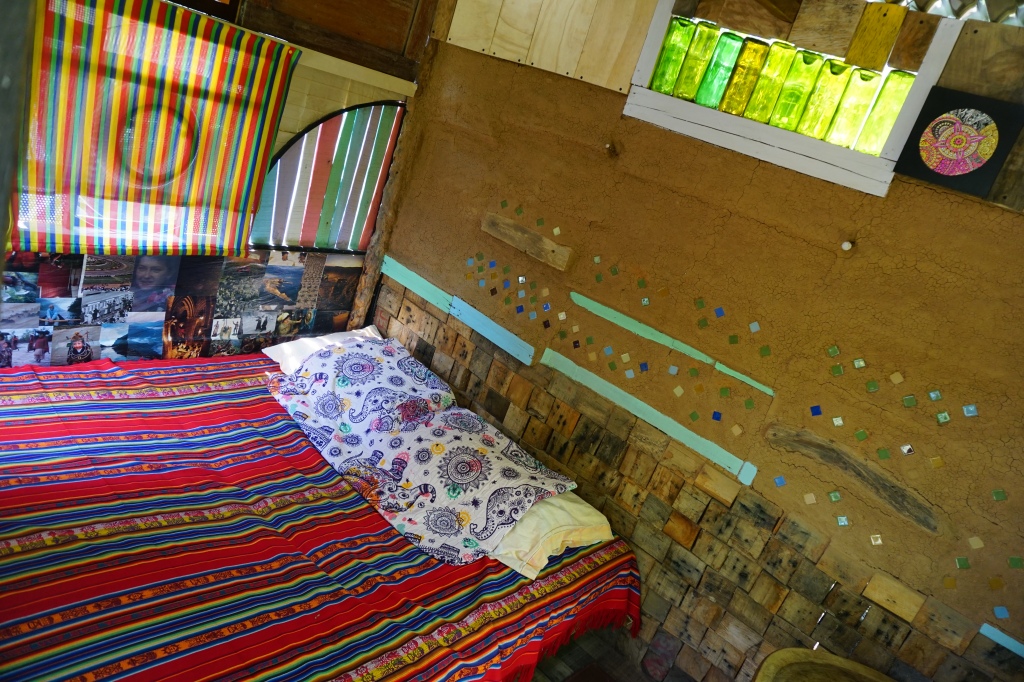
My gorgeous, inviting bed for the weekend. ~Glamping~

Products of his ingenious crafting abilities, John offers two mini homes, cabins made from recycled materials. The windows shine green as the light hits repurposed beer bottles which have been set in the place of glass windows to allow for air to constantly circulate within the cabin. The two cabins sit on different sides of the enclosed camping space. One is made for an individual and the other can fit two people in a queen-sized bed. The decorations are impeccable, reflecting the same attention to detail that you can observe and appreciate around the entire space.

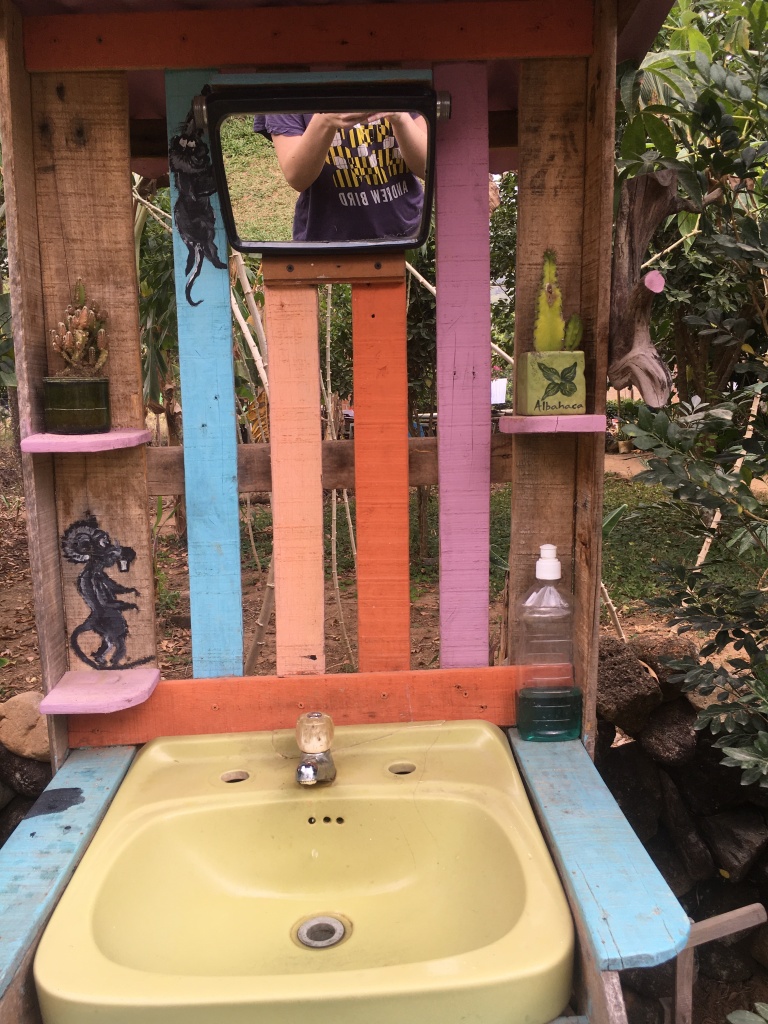
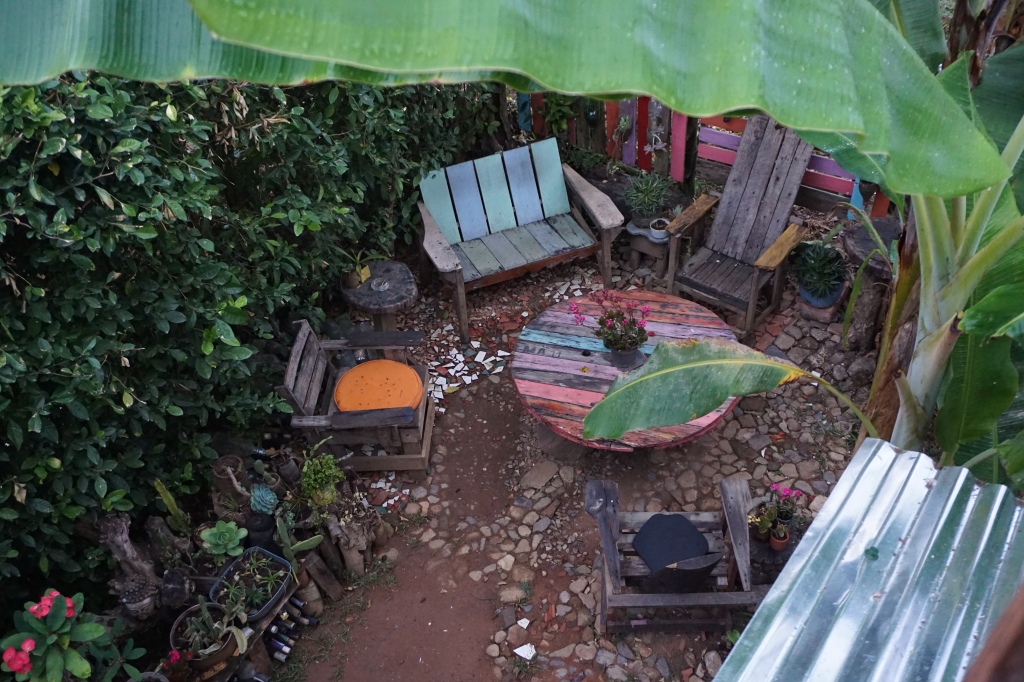
Every personal touch makes sense while creating an inviting, familiar atmosphere. In the middle of camp, there is a public sink with a mirror and handsoap, additional to the two bathrooms with sinks, showers, and mirrors of their own. There is a garden with chairs set up perfectly to enjoy the sunset and sounds of nature or even a smoke, if that’s your fancy. John even dabbles in beekeeping and has his own bee house of friendly bees on the grounds. The signature bar to the left of the entrance continues to be the hub where music plays, and food and drink are offered at low prices that belie their quality.

Even a simple sandwich displays John’s individual style and attention to detail.
With so much to offer, I had not imagined how much more I would find this time around, only a year later. As I noted, John had not taken a day off. Now the Migra campgrounds include a treehouse deck (which will eventually be converted into a cabin) with hammocks hanging in a chill space underneath. This area is cleverly furnished with plants and books, just like the other spaces of Migracampi. We rested and ate in the shade, waiting for our other friends to arrive before going on a bike ride around Pueblo Bello.
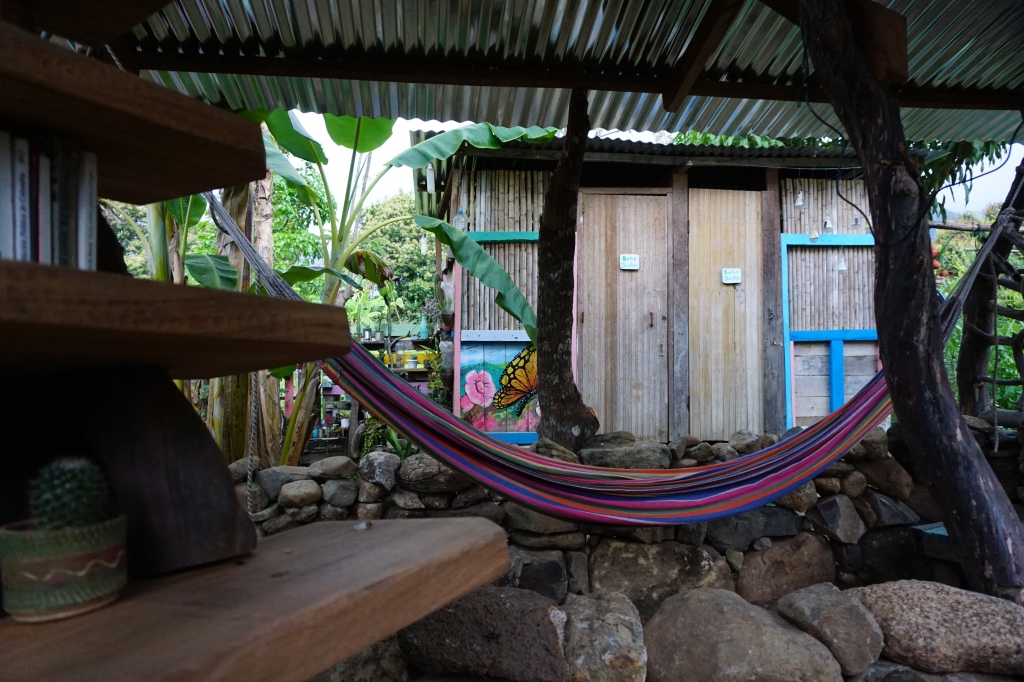

John helps you get information and reserve any activities you might want to do in Pueblo Bello. After a quick phone call, he found out that the locals that rent out bikes only had 3 available that day. There were 5 of us. John rented out two of his own bikes so that we could all take off together without a problem.

Biking in Pueblo Bello is just 5.000 pesos an hour. We spent three hours — 2 of which were spent at the river drinking and enjoying the water — exploring Pueblo Bello from top to bottom — literally. The majority of the ride through the town is downhill when heading towards the river and hiking towards the waterfall. The way back posed a problem for me since I had opted for two beers and we had stopped at an ice cream shop before going down to the river. I quickly got winded trying to fight my way up the rather steep hills. Then I started to feel dizzy and nauseous.

My friends helped me to get a bottle of water and a automoto taxi back, just as it started to rain really hard. I was more than relieved to unload the bike and leave it in the front so that I could lay down in a hammock and catch my breath. Once again, the host was graceful enough to return the bike for me without any hesitation.

Another thing to keep in mind about Pueblo Bello is that it rains pretty frequently, depending on the time of year, sometimes suddenly and heavily, especially during the rainy season. Rainy season starts around the end of February, so we are finally seeing an end to the months of drought typical of the dry season.

My poor friends had to book it to get back to the house where we rented the bikes in the rain. They returned their bikes, and we all convened for dinner and drinks on the campground. The rain fell hard, harder than I had seen since I left Louisiana, and lightning streaked the sky in a soothing yet intimidating way. There was no danger; this is typical of the rainy season.

I stayed up until the sun had completely disappeared, but once I ate, with the rain still coming down, I slid into my glamping cabin, slipped under the fluffy quilt and went straight to sleep, even as some of my friends stayed up to chat and drink Churro, a distilled ancestral liquor found in this region of Colombia.

I’ll end this with the peaceful memory of that cool night. The bedspread was just thick enough to keep me cozy and comfortable despite the low temperatures. The sound of birds is a constant symphony at Migracampi, one that lulled me to sleep and then woke me up early the next morning.

To be continued…. (leave some applause if you liked this review/check out my instagram!)

Day 2: The hike to La Tranquilidad and the Deluge that came after.

Opportunities for Growth

During quarantine last year, all of the time I had to myself gave me lots of opportunities to digest thoughts that had not yet crystalized for me before. About myself, my goals, and most importantly habits and how integral they are to being successful and staying motivated.

So often we put ourselves in this catch-22 scenario where we can only do what we want if we sacrifice our own mental health in some way. We can never win. If we do what we want, we have no time. If we don’t, we feel like we aren’t doing enough.

Wait, was I just projecting my own problems with prioritizing? I guess so. I confronted these feelings a lot during my time in quarantine, needless to say.

We want to create, but struggle to do so. We want to exercise, but fail to find motivation. Wanting to achieve our goals, but — for some reason or another — we still procrastinate on them. We fail to fall in love with the process.

We have to start. That’s the first step. Then from there we have to keep going. That’s been harder than starting, some days. So I started doing a little research on how these new habits I want to form can be done in the most logical and passive way possible. Passive, in the sense that it doesn’t have to be this aggressive struggle to do as much as possible every day. I’d been living by that rule, going against the grain and pushing myself past the bounds of self-care: all or nothing. And yes, I felt drained, and somewhat unsatisfied as a result. Because it never seemed to be enough.

Growing up, my dad would always be watching Seinfeld. I was a big fan, even if a lot of the more sophisticated jokes went over my head. It was always a groundbreaking show to me, in a way, because I felt it had a different vibe than other sitcoms that were big at the time. It felt somehow more authentic.

Never would I have guessed that there was more than just comedic genius behind its creator’s success.

“After a few days you’ll have a chain. Just keep at it and the chain will grow longer every day. You’ll like seeing that chain, especially when you get a few weeks under your belt. Your only job is to not break the chain.”

I found this wonderful article (which I now cannot refind) all about the Seinfeld strategy, described above by my boy Jerry Seinfeld. He pointed out that while most people get demotivated and off–track after a bad performance, a bad workout, or simply a bad day at work, top performers settle right back into their pattern the next day. They reset and keep their long-term goals in mind. They embrace the new obstacles as opportunities for growth.

The Seinfeld Strategy works because it helps to take the focus off of each individual performance and puts the emphasis on the process instead. So instead of obsessing with where we want to be on a daily basis, we focus on the small steps it takes to reaching our destination.

So step one is to choose a task that is simple enough to be sustainable. At the same time, you have to make sure that your actions are meaningful enough to matter. And that your strategies are varied enough to keep you engaged and passionate.

Last month, I also learned about S.M.A.R.T. goals from the Habits for Happiness podcast I discovered for free with my audible subscription. I started 2021 listening to this podcast, and I would highly recommend following this strategy developed by George T. Doran way back in 1981 to help with setting clear objectives in any aspect of life. 

What makes them SMART? You have to ask yourself about any given goal you choose to set: Is it Specific? Is it Measurable? Is it Achievable/Realistic? Is it Relevant to your overall vision? And finally, what is your Timeframe for reaching your goal? You can add on points for exciting and recorded, among other qualifiers, as you see fit.

Although it has been quoted to death, as Greg Reid asserted, writing down a goal, breaking it down into steps, and following through with those steps, with the consistency of the Seinfeld method can make all the difference.

But most importantly, the motivation must be authentic. I realized how hard it was to cultivate motivation when I was actively and frequently struggling with depression. That is true for any dopamine and vitamin D deprived individual such as myself. It comes down to chemical composition. How can we level out and correct the release and maintenance of certain chemicals in the body? I realized that addressing this issue had to be part of my plan. Every plan needs room for maintenance and repair, in the event of a setback or *ahem* breakdown. And once I was in the states, finding solutions to those on-going chemical factors became a priority. 

When it comes to treatment of a disorder or illness, not breaking the chain becomes even more important. One day without taking your medicine or exercising or meditating can cause a dramatic swing in your mood and perception of your situation, as well as your motivation and momentum. It’s not often a permanent state or condition, but it can have damaging effects on your mental wellness and overall assessment of your own progress.

So, as I coped with the new balance adjustments on my chemicals, while evacuating, having no place to call home, virtual classes, familial tension… I fell back even harder on my routine. I focused on the little things that I could do for a short period of time each day. I made sure to zero in on the most pleasurable aspects of those steps in my plan.

I didn’t stop studying French. I’ve almost cleared the lessons on Duolingo and reached a B1 level in about a year of study after knowing next to nothing and not being able to fully immerse myself in real life use of the language. I’ve gradually been building up my content on social media. I’m trying to apply my SMART goals and the Seinfeld method to my writing as well — and I think it’s getting more consistent. I still get blocked looking through all of my drafts, but as long as I am still writing a few lines a day, publishing once I’m satisfied at least a few times a month, then I feel I am reaching my goal.

Another routine that made a huge difference during quarantine was establishing morning rituals. I try to use my phone as a tool to wake me up mentally via podcasts (like Up Next by NPR to get my daily overview of the news), the Daily Stoic, and YouTube videos by channels that post Alan Watts videos and self-help/introspective tips like Better Ideas and Awaken Insight to name a few. Getting your mind right and finding your best headspace in the morning is the best way to wipe the slate of the previous day’s struggles and stumbling blocks and start with a fresh outlook.

I have continued to make this a part of my routine, as well as filling my body with light, healthy food like fruits, grains, and oatmeal to help prevent my typical digestive problems. Health can never take a backburner in our daily life — if nothing else, I think 2020 taught a lot of us that.

Additionally, I applied the Seinfeld method to doing yoga daily in the mornings during my 2 and a half months in lockdown. I reminded myself that it doesn’t matter how much exercise I do, the intensity nor the duration, so long as I don’t stop doing it. Previously, I felt frustrated seeing the results of my hard work in the gym fade after I became too busy to go regularly. What’s the point if the results wouldn’t stick and I’d repeatedly have to start over every time I went?

That’s where not breaking the chain is truly genius. Even if your growth is not linear or exponential, it does pay off in the long run. I haven’t done yoga daily since my time in the States, but since returning to the gym – and on days when I have a lot of tension, pain, and stress – I use the techniques I learned during those 60 whole days straight that I practiced yoga at least once a day. 

It worked! What I learned stuck. And not because I never took time off or never had slow days or short sessions. On the hard days, I took breaks and shortcuts, but I didn’t stop.

In 2021, I continue to think proactively, to enjoy rest and productivity, socializing and self-care in equal measure. The balance has gotten easier, even though it truly is an uphill battle. It’s never as easy as it looks or seems. That’s important to keep in mind. Comparing ourselves to others is the least productive thing we can do when looking to grow and live life to the fullest.

I’ve got to shoutout both my brothers who are a strong example to me of this persistent approach to goals. Jace has gone from knowing next to nothing about music theory and never seriously learning to play an instrument to being able to sing while playing and write songs on the guitar in under a year. How badass is that? As someone who was often a defeatist with new hobbies, I was inspired by how he refused to take a day off from playing or get frustrated, even when he was in exhausting and stressful situations or when progress seemed slow.

My older brother Seth is an extremely hardworking family man. In spite of two hurricanes, having to move suddenly, and all the other crazy consequences of last year, he continues to be a high performer in everything he does. From sports to management and sales, he’s a true inspiration to me as he has become so successful in his work and family life, alike. I’m lucky I’ve had some strong examples in my personal life that have helped me to reach this proactive point in my journey.

I write through the exhaustion of a new hybrid teaching schedule. I’m continuing to learn more about video and photo-editing, teaching and what the hell’s going on in the world — because I’ll need that if I want to get where I am heading. I have projects that I haven’t finished, but at least I have something

And while progress is not linear, the important thing is to keep going.

I love sunrises and dusk pictures, and how could I not include some of my first edits from my New Years trip and a lovely shot of my own backyard (not in that order).

My WordPress Anniversary and 2021: Rocking Beginnings

How this year began (ish) (or how last year ended?) – Roadtrip Recap of Colorado and New Mexico to come!

It’s been 4 years since I made this blog. Four years living in Colombia. A metamorphosis and exploration of the world and of self. That’s what this project has been for me. So much has changed and developed in my life. One thing’s for certain: we never stop growing, changing, and discovering new things about ourselves and the world.

And guess what? I have over 50 followers now!

Wow, that’s like, 50 more than I ever expected, honestly. Especially when I struggle to stay writing motivated even though I have so many things I want to write about. Thank you to everyone that actually reads what I write! Bigger thank you for the feedback I’ve received. That feedback, beyond the likes, really does help push me to sort out the thoughts in my head and keep writing.

I think with everything going on, we’ve come to realize that all anyone ever wants is a connection. We use social media to gain that connection with the world, and while many detractors of social media say it is making us more shallow and disconnected, I happen to belong to the camp that believes that virtual connection is the way of the future. It is the complement of empathy that allows us to see through the eyes of others. And it’s free (virtually) to (almost) everyone! The sad part of course is that it still isn’t globally accessible; we still suffer a crisis of global inequality. But we continue to march toward a future where all of those bridges have been extended across the world, across the lines of social class, race, and nationality, and we will truly be one world.

This is what I believe. And this is what I enjoy discussing with my students. Now more than ever, these children living privileged lives in Colombia have the opportunity to truly consider themselves Global Citizens. That excites me and motivates me to really educate them about history, social movements, things that are occurring outside of their geopolitical bubbles.

That’s been the objective of this bimester. January has been interesting, because my vision and the message I want my students to take away has grown with every lesson. Students teach us — teachers must be receptive to that. I’ve discovered from teaching in quarantine that while modeling and setting rubrics and expectations is important, giving students and their support systems the freedom to convey what they have learned in their own way is infinitely more important. Learning occurs when seeds are planted in the deepest parts of our brains, but those seeds can only be cultivated by our care and interest.

Long story short, if I dictated every creative choice for my students, I would be alienating so many of my students to the point of turning them off to the subject and creating a mental block. When kids aren’t given agency, they don’t cultivate their knowledge. It becomes a chore. Something to be memorized, regurgitated, and then forgotten.

If they don’t remember any of the facts by heart, I won’t care, so long as curiosity is ignited in their hearts to continue learning and exploring more.

That’s become my mission, as an educator. As a content creator (is that what this is?). I want to inspire curiosity. I want to empower others to look for their own answers and express them in their own way. Creativity should be nourished and encouraged, and I believe from that curiosity and creativity, arrives a deeper level of learning.

Looking back, my writing ended up being more significant than I gave myself credit for. I want that to continue. I want to continue commenting on my experiences, traveling and exploring, but also the daily regular parts of life that can lead to the insights I have uncovered while sharing my writing and thoughts on this platform.

2021 did not start with fireworks for me. It started in under a star-specked black sky in the freezing cold New Mexico desert. I came into this year resolving to hold onto peace amid the chaos. And boy, has this been a chaotic year already. January itself seems like this saga of sudden explosions, like a chaotic pendulum swinging from one extreme to the other while hitting things in its path.

I started this year out sick. I thought it was because of the exposure to temperatures I wasn’t used to, the long hours driving, during my road trip. I could tell it was viral when I found myself aching and laying in bed, too exhausted to walk from one end of the house to another. That only lasted a few days. I also had headaches, an on-and-off sore throat, and other sinus issues. So I got tested before coming back to Colombia. It was a swab test by the Civic Center, free and efficient, but the results were not taken quickly.

I took the test right before coming back to Colombia. Literally the day before my flight. My mom was not happy. I was embarrassed, I admit, and I made sure to frequently sanitize my hands, keep my mask on, speak to no one, and avoid breathing on anyone.

Things continued to go less-than-swimmingly when I got to Bogota and found out the SIM card in my phone had deactivated and my work visa had expired because I had been out of the country for over 6 months. Surprise! On top of that, I would need to quarantine. All I wanted to do was get to my airbnb, but my host wasn’t prepared for my arrival. When I got to the apartment building, I got to scare an old lady working the desk. It was already pretty late once I got through a mile-long customs line moving at a snail’s pace. Welcome back, right?

The rockiness continued the next day. I continued to feel tired and sluggish, and taking advantage of how close the apartment was to the airport, I chose to leave about an hour before my flight. I didn’t get the email to check in. Lovely. So when I got there, I had to fumble through my phone (which is falling apart) to find my flight confirmation number next to my name.

All of this took me just long enough to miss my flight by five minutes. Not miss my flight, really, but the gate had closed and they wouldn’t be able to load my bag. So I paid a $40 penalty to get on the next flight to Valledupar.

After making it back to this land of unending summer, I got to my apartment only to find the internet had not been restored. There was no gas. Things were falling apart — including the AC. I was feeling overwhelmed. This feeling lingered during the following week when I got my positive COVID test and immediately started taking all of my medicine.

It took some pestering and some persistence, but now I finally have things sorted with my apartment. The AC has been fixed, the gas and internet were turned back on, and now I’m back to virtual classes. And that’s been a relief.

But February is coming, and with that comes new challenges. We’re going to start our hybrid program. Classes will only last until 12 pm, but I will be working for that entire time, either in the classroom or virtually or supervision duty. Let’s hope I can maintain my flow and my vision.

Around the time President Biden finally was sworn in, things began to normalize themselves in my own life. At the beginning of the month, the upheaval I predicted unfortunately struck. We’ve all been through so much in such a short time, witnessing this National conflict and tension as the far-right rejects the system of democracy they feel betrayed by. So much is at stake. But this new presidency has involved actions that show an acknowledgement of reality and necessity. The necessity of unity. And that has renewed my hope. Let’s hope things continue on this track. And that political gridlock doesn’t frustrate this hope.

This hasn’t been a normal first month of the year. But it has been better than some. I’ve confronted these situations head-on, both personal and professional. (Did I mention I’ve got a new job in the works?) I put my plans into action, just as I taught my students the importance of not just setting goals but making SMART goals — that is Specific, Measurable, Achievable, Relevant, and Time-conscience.

Our collective goal? To learn something new everyday. To not be afraid to make mistakes. To try new things and explore new hobbies. My students really are an inspiration to me. They’re fantastic, hard-working, and compassionate. I couldn’t have been happier to talk about New Years resolutions with a group of kids who were otherwise unfamiliar with the concept. That helped me iron out my own.

The beginning may be rocky, but the end results will be worth it. Get those vision boards ready! Here’s to rocking 2021.

What are your goals for this year? How will you make them happen? Or better yet, how will you maintain a growth mindset that will allow you to be flexible with your timetables assuming that you run into setbacks along the way? I’d love to read what you guys have thought about 2021 so far and where you hope it will go!

A lovely mural outside of the Village Coffee Shop in Boulder (highly recommend it).

Teaching with Compassion

Being a mentor is not always easy. As an English teacher of students across a broad spectrum of ages, levels, and interests, I have been tested consistently and found that being patient is sometimes easier said than done. I would like to share some of the keys that I’ve uncovered during my last 6+ years of teaching and tutoring to maintaining my composure and making authentic connections with my students (that I hope could last for a lifetime).

Compassion. If we are compassionate with others, we become more compassionate with ourselves — and vice versa. Throughout my life, I have struggled to find and cultivate self-compassion. This difficulty comes from being a perfectionist, a busy-body of sorts, always wanting things to go smoothly. Always wanting to be right. Always wanting to feel competent.

As my good friend and mentor Uncle Iroh once said, “Pride is not the opposite of shame, but its source.” When you are compassionate with yourself, you forgive your own mistakes and short-comings. You are more patient and ultimately, more humble. And if we cultivate a strong compassion with ourselves, it is not so hard to transfer that compassion to our relationships with others.

Empathy. Being able to see things not only from your own perspective, but contradicting perspectives, and recognizing which of those perspectives applies to the person you are interacting with. As a teacher, empathy cannot be stressed enough. Like humility, if we lack empathy, we easily can become a caricature, the angry, exacting professor sneering down at their students without a drop of remorse or interest in the perspective of those they are teaching.

Empathy can only be built from humility, by understanding that we all make mistakes. There was a time when we were learning. Ideally, we are still learning everyday. And how do we like it when encountering someone supposed to be mentoring us who talks down to us and makes us feel dumb every time we have a question or make a mistake?

We don’t. We shut down. Shame leads to anxiety which can ultimately affect the functioning of our brains and memories. This is why it is so hard for someone that has been abused as a child to recall information and be present in other realms of their lives.

Be an example. As a teacher, we are in a special position. We are learning, just as our students are learning. However, our students oftentimes act as a mirror, holding up our own best and worst traits. (This is also true for parenting, but since I’m not a parent, I realize I can’t really speak to that relationship directly)

When you want to teach something, you must talk the talk and walk the walk.

I know I’m not saying anything that hasn’t been said before, but I’d like to use my own successes–and failures–to illustrate what I mean.

When I started out teaching fulltime in Colombia, I felt an immense pressure to establish myself as an authority figure in the classroom. As a younger woman (I was 24 when I started out), many assumed that I must be trampled by my students.

All my life, I’ve had a terribly great tendency of taking these sorts of assumptions personally and using my disgust at them to fuel my success. You know, to be the best to prove others wrong. Spite, however, led to feelings of anger, defensiveness, and isolation…and that’s what happened to my professional relationships at the outset of this journey. I never wanted to be wrong or be confronted about being wrong. I didn’t like for my authority to be questioned. Because I focused more on what I didn’t want to be instead of the sort of teacher I would admire and choose to be.

Laugh at yourself. The more I let go and got taken off guard, the more I learned that the best solution to any tension or mistake is to laugh at oneself. If a student does or says something shocking (and trust me, they will) sometimes instead of letting yourself fall into the role of vindictive hell-bent teacher to prove a point — imagine how you would handle this situation if you were an actor or person you admired or felt inspired by (in my case, Uncle Iroh obviously ranks high on my personal list). Putting yourself into another role and viewing things as humorously and impersonally as possible keeps the classroom fun and also hides the buttons that your less-than-nice students might try to prod at any given opportunity. Also, it helps maintain that whole humility thing.

Don’t jump to conclusions. Assumptions are the enemy in any human interaction. Students will often speak impulsively — and parents as well — especially when they are under stress. The best thing is to shut up and listen. Don’t assume you know what’s going to come out of their mouth. I’ve realized I prevent fires that could have easily sparked out of a simple misunderstanding. As teachers, we have to be slow to process and react to things. In other words, get all of the information and then respond.

Take responsibility. This goes back to being a good example to your students. When you take responsibility without assigning blame or excusing your own mistakes, your students pick up on how genuine you are and how strong your character is. Hypocrisy is a double-edged sword — it hurts the bearer and those in its path. Being a hypocritical teacher is insidiously easy, but it will not gain the respect of your students, and worse, their behavior will reflect your worst moments.

When I was in the hot-headed phase of hating my job and holding onto my power and control by the skin of my teeth, I let my emotions get the better of me. At times, I would preach about treating each other with respect and following the rules while simultaneously humiliating a student in the middle of class to teach a lesson. Little by little, bullying became a problem among that group of students. And some part of me, unfortunately, realized with great dread that it was my fault. I had taught the wrong lessons, and it was my actions, not my words which the students had picked up on.

Luckily, each year and group of students, while bringing its own challenges, offers new solutions and opportunities for growth and self-examination.

During the past year, I have been working with students to promote a growth mindset. The moment I realized that I myself had lacked this important principle and quality was not a blow to my ego — it was a wake-up call. I often felt as though in order to be an authority figure, I had to be direct and firm, brooking no nonsense. But acting that way was as rigid as outlawing fun in the classroom — and I’m a fun person. But under pressure, I felt less and less like myself and more and more fragile. And I didn’t forgive myself enough to realize how much I was growing and changing everyday.

Change doesn’t happen the way lightning strikes — it’s gradual like the tide, ebbing and flowing, sometimes pleasant and rewarding, sometimes painful and unsettling. But it happens, whether we are aware of it or not.

While teaching online, I’ve gotten the chance to step away and reevaluate Ms. Amanda the Teacher. I’ve recognized how my posturing in the classroom often did not create the environment I wanted to see — but I did have some important breakthroughs along the way. I forgave myself. I celebrated how much I had grown and changed. I celebrated the growth of my students. That’s how a relationship is formed. No one is perfect.

When working abroad in particular, it’s so easy to blame every little thing we don’t like on the culture. We romanticize our home countries, thinking that this level of disorganization would never happen there. Everything flows more smoothly through the rose-colored lens of our memories. I’ve spent hours venting and ranting with other English teachers who are frustrated with their jobs, hate their students, disdain their students’ parents, and reminisce on how much easier things were or had been or would be in their own countries.

After talking to teachers in other places and honestly reflecting on my past experience teaching as a paraeducator in the states, I realized that these idealizations simply aren’t true. The difference between myself in the States starting out and Ms. Amanda the Serious Teacher was that I used to have far more compassion. I used to have more perspective, because I often was not in the spotlight. I was a supporting cast member helping to allow things to go smoothly. Yes, things seldom went smoothly. There was administrative pressure, just like I experience now as a homeroom and primary teacher. But with a fresher perspective, I enjoyed teaching more. And as I adapted to the culture shock of living in another country and region with stigmas and stereotypes and ways of communicating, some part of myself became more closed and less excited to absorb everything, to take in new information. To grow.

So that’s what this experience has taught me. I’m far from a perfect teacher (much less a perfect person), but I have been feeling satisfied with the results as I have fine-tuned my online class experiences. The importance of a plan, working with the end result in mind, while being spontaneous and unafraid to improvise and roll with class discussions and fun, has finally imprinted itself on my sporadic, easily-disillusioned mind.

And I’m enjoying teaching. In spite of the new challenges and hiccups, the exhausting days and the never-ending flow of planning and paperwork. I’ve found within this profession a way to evaluate and assess without judgment and to accept criticism and laugh without being too self-defacing and awkward. I’m growing. Reminding myself always to teach with compassion.

What about you? Have you been challenged as a teacher or a mentor? Have you lived abroad? What have you learned?

P.S.: It seems appropriate that this blog go full circle since it’s officially been 4 years since I started it — 4 years of teaching in Colombia.

Poetry: From the Archives

Be Aware: Disillusionment and Liberty’s Lie

(Unfortunate epiphanies from beyond American history.)

[Be aware:

We sit at the top of a regime,
an empire of terror that we send out
like envoys abroad;
envoys turn assassins
in bitter self-interests,
sell swords with bloody blades,
the blood of innocents bought
at costs unpayable.

We can’t see the worst–
we only see what hurts.
Blood trickles down
our pyramid of power,
not up,
down to 
the dark pools
of Texcoco,
down from Texaco
Washington to Tenochtitlan,
down to Panzos and el Mozote,
dark skin spattered red
by white agents of terror
vested all in green,
burning red flags–
blood in the water,
and we are all blind.

We live in the lap of luxury
our fruit mixed, our clothes laced
with the carnage of our enemies,
the friends of true freedom,
the warriors for justice–
desensitized, our noses no longer smell the decay and corpses piled in our liberty’s lie–at what cost?

Blood costs for iron rule.

[Be aware.]

Our middle class is a mask
for our poverty,
And our rich masquerade as
middle class,
And when we go abroad we
get back
Manufactured images of idyllic 
views,
And foreign industries that make
it feel
Like home: capitalist, imperialist
haven of
Neoliberalism.

But who needs ghost stories when
your world is a graveyard?


[When the government no longer
serves or represents the
people’s interests, or even the
greater half of the population,
but instead represses them,
it’s time to get a new government.] 

[It’s time for change.

Be aware.]

Writing Project: Entre Comillas

I’ve been stumbling upon and rereading some writing projects that are (yes) mostly unfinished, but I’d like to take the time to share some of them and see if getting some feedback might motivate me to finish.

I feel like prefacing this project might be a good idea so that you get what I was going for.

A couple of years ago, my brother and I were talking about love stories and clichés. He gave me a unique challenge that I began to build upon and have added to here and there whenever I stumble across this piece of writing. It’s interesting, because I am a classic example of a writer that takes their own experiences and morphs them to try to tell a story of something (I hope) someone else might have experienced but that, naturally, does not 100% align with my own thoughts or experiences. It offers me a bit of perspective on my own experiences, while making my own writing feel more concrete without simply and narcissistically copy/pasting experiences from my own life — I have other mediums for that (*glares pointedly at Part 2 of my roadtrip post sitting in my draft folder*).

This project I decided would be bilingual. A love story of a different kind. The idea of two people meeting, not being able to understand each other, yet falling in love anyway. This hasn’t actually happened to me, but it has happened to a family member of mine, and I found the whole idea rather fascinating. I mean, how does one fall in love without understanding the other person? Seems like a pretty big stretch to me.

And so, naturally, writing about it would be the perfect avenue for exploring this concept which people apparently experience, but I have not.

However, as I said, this sort of project does borrow influences and experiences from my own life, allusions that people who know me well might recognize.

And it’s bilingual. I realized that it would cause an interesting marketing issue if I ever wrote a full book — because yes, there are a lot of bilingual readers out there (especially people that can read Spanish and English – yes, huge market win?) — but I would want people that don’t speak or read Spanish or English to find it accessible somehow as well (aside from reading the translations with mere context). (still not sure how I would accomplish this) But the whole idea is that, just as these two people could not fully understand one another, the pieces that they shared would be enough to craft this bigger picture. Yay, literary elements and whatnot.

While I catch up with other projects, I’m going to upload what I’ve written of this story in installments, since I’ve already completed around 4 chapters of the story. If it receives any response, maybe I’ll continue? Or if I get useful feedback, that could serve a source of inspiration.

I’m just curious, and I want to start sharing more of my fiction pursuits for peer review. Looking forward to seeing the response (if any!).


Cuando se acabó la gran noche, solo me quedé pensando. ¿Qué tal que fuera toda una gran casualidad? ¿Que tal que me quedara con ella? ¿Tendríamos una familia ahora en aquel apartamento tan moderno en aquella ciudad tan fría? 

“Stay,” me dijo. Como de costumbre, me quedé mirándole los labios. Tan finos, hasta pintados de rojo. Pensé que al fin le entendía.

“Ya no. No se pudo,” le repliqué, y sus ojos no dejaban de mirarme a los míos.

Me prometía todo, sí, como no. Se dice que solo sabes lo que tienes cuando te toca perderlo. En mi caso, podría decir que eso es sólo la mitad del cuento. Y qué cuento más largo. Pero al final, la cama vacía habló por sí misma. Primero la suya. Después la mía.

Me marché.

Pero ¿cómo fue que empezó todo? ¿qué momentos tan pequeños se convirtieron en los que sé que me marcarán para el resto de mi vida?

Just like that, he was gone. I knew I would have to adjust again, to the quiet spaces in between. To the haunted melodies of the sad songs for lonely lovers we used to enjoy together. You see, I didn’t realize how much one could understand in spite of a language barrier. So much of what we communicate we do not say in words alone.

I never really knew what I wanted – to be. I could be one thing one day and a thousand things another. I wanted to be a writer. An actress. A politician. A teacher. A chef. Whatever it was in the moment, regardless of what the profession or fancy might be, I at least knew that I wanted to be great, by whatever definition of greatness I was willing to apply.

I knew I wanted to leave Arkansas. The endless fields of agriculture and livestock had nothing for me. I don’t even have a green thumb. Naturally, there was no better option for a young, indecisive dreamer than to pick up and move to Los Angeles and live a cliche like so many before me. Behind me, there were the winding country roads and broad plains, a life I was sure I would never miss.

Yo siempre me he sentido como una persona decidida, cuando no había camino, me lo abría, o sí o sí. Igual, nunca me imaginé que me iba a marchar de mi familia, de mi comunidad. Aún no supero el eco de su llanto, y los suplicos de mi niña: no se vaya, no se vaya, con Dios todo se puede.

Pero al final, me dejaron ir. Soltaron la correa. Porque su bien también depende del mio, y si uno no tiene milpa y no tiene palanca, conexiones para que uno salga adelante, pues se estanca. El peso de mis pasos fue como si me amarraran hierro a los zapatos. Pero seguía hacia adelante, hacia esa ciudad rodeada de montañas y la esperanza de una estatua verde, una mujer que abraza a cualquiera que aguante hambre, frío, desolación… El sueño americano.

Now you might think because I was raised in Fayetteville, Arkansas–big for a southern city with the same small town feel that seems ubiquitous in the Southern USA–that I had never seen things that could make any normal person’s skin crawl. That I wasn’t ready for skid row. 

In reality, Arkansas is far from a idyllic paradise. For me it was more like a swamp hidden among old town charm. Kissing cousins were actual cases of incest and child molestation. A man resembling Pennywise the Clown sans makeup actually lived on my block and had a known reputation for watching and perhaps even trading child porn on the Dark Net. A known sex offender, he had the most uncanny way of looking through any person he met with his unworldly steel gaze. Most people were repelled, but nobody could deny a morbid curiosity. Nobody had ever tried to bust him, in spite of this common townsfolk knowledge of the things he must do in the dark confines of his brick prison. Whenever his sickly grey gaze landed on me as I waited for the school bus in the morning, I felt a convulsive shiver pass through me. I began to feel my heartbeat in my feet, and I suddenly forgot the layers of clothing I would wear on cold mornings as my limbs began to tremble. Still, he was also the little league coach’s assistant, and most people would never talk bad about him to his face.

Then there were the Mason’s. They had changed the face of Fayetteville. All of the small mom and pop shops they owned by the end of the first decade of the 2000’s. They stunk of old money and racism, slavery and lynchings. Few would admit it, but Mr. John Frederick Mason Jr. had been known to don the white hood and go out on night prowls. Again, everyone kept quiet, especially when he gave big donations at all of the ten or more main Christian churches in the town, each claiming to be the first or the closest to God. In reality, I was fairly certain God had shifted his gaze away from Fayetteville long ago.

And yet, you would think when I announced that I was moving to Los Angeles that I had just said I was going to have public orgies with a group of demonic familiars – while getting high and overdosing no less. Most would never dare to leave, for fear of what could be worse. But still, I have to admit that they were right to be skeptical about my rushed decision to take off. I was a lost sheep, free to wander until I got myself eaten by the first wolf I encountered. Sheep’s clothing not required.

Me lo propuse en un día de calor ardiente y persistente. Miraba por las tierras que ya no eran mías, que ya se adueñó de ellas el cartel, mientras plantaba la mano en la frente. Tanto sudor, todo para que me llegaran y me quitaran mi hogar. La frustración se sentía en cada rincón, susurros de qué pasaría con el nuevo presidente de Gringolandia, hechizos de las brujas y los brujos de la comunidad, que se colocaban siempre en la orilla de toda maldad.

Y me decidí. A pesar de todo, no me quedaba de otra.

I could keep living there, I admit. I had my college degree from the University of Arkansas, conveniently located in my hometown. I had a little bit of sway in the community, but not Mason level sway. Still, there was some hope for upward mobility, what with both of my parents being productive members of society. My mom worked in one of the local high schools and even had a position in the school board. My father, though not as noteworthy as he would like, had a financial firm and one of the most easily hated professions on earth. They both set the bar for a life of potential security, if not the old school power play of more influential families.

All the same, the day I left was an act of pure rebellion from a young woman that had never stopped being an adolescent. I felt a sort of pit in my stomach as I threw the majority of what I needed in the one big suitcase I had had for years and had never used. I left at midnight, thinking idealistically that if I drove all night, I might just see my first California sunrise peak over the mountains the next day. What I didn’t realize was that the road from Fayetteville to Los Angeles is over two days long, and the sun rises in the East and sets in the West. I had enough savings to sleep in my car that night and regret every decision I had made up to that point. Still, I convinced myself, rationalizing and reasoning all in one contradictory step, I was living the adventure of my dreams. Nobody could stop me. I was going home, where I belonged.

Roadtrip 2020: Seeing New England in Times of Covid

Part One: Through the Bible Belt into a Brave New World

Against all odds, this year has provided some silverlinings in my life, the likes of which I would have never been able to imagine. I’ve dealt with isolation, loneliness, depression, anxiety, grief over the deaths of friends and family members, displacement, a sense of homelessness (or perhaps just placelessness) – and yet, there is always room for growth. That room gives way to light. It gives way to hope.

October was a busy month for me. If I look through my instagram feed, nothing is more apparent. I started the month with a can-do attitude, a feeling of radical self-acceptance I have written on a lot recently. And fortunately, the feeling continued to grow by the day.

The highlight of the month – of my year, as someone that’s been terribly deprived of external adventures that I crave – was hands-down my heavily anticipated road trip.

Let’s look at the context, complemented by Corona, to understand why this was such a big deal: Semana Santa is usually one of my big travel months. I was in total lockdown in my apartment in Colombia. I had aspirations of making a full (or at least partial) trek around South America. Lockdown was still going on. It only just let up in Colombia. I made the decision to come home to Louisiana. I was anxious, mind you, about choosing to do the following: leave my apartment unoccupied for an indefinite amount of time, taking a bus to get to Bogota and then a plane (all the while possibly exposing myself to the virus) only to be shut in my parents house or my grandma’s house – indefinitely. Possibly unable to return.

I had expected to be back in Colombia by September. That didn’t happen.

And on top of that, my grandpa passed in July and I spent that whole month basically mourning and taking care of my grandma. My depression and anxiety reached a fever pitch. Around which point I reached this turning point in regards to taking advantage of qualifying for medicaid and reaching out for medical help. And from there, things began to move at lightning speeds. Even now it seems like a beautiful, hazy blur – and yet, simultaneously September onward has been some of the clearest moments of my life so far.

For starters, in August, I went back to work. Virtual work. I readapted to this schedule, a new schedule, while living in somewhat close quarters with my grandma, my cousin, and eventually his girlfriend and their baby. But while getting things straight with work, I also was going to the doctor, practicing driving, and by the end of the month I had finally passed my driving test – just before Hurricane Laura came to town. September was upon me. No license yet.

3 weeks with my uncle. A month evacuated and struggling and being held together by my work schedule. I adapted to my medicine. And finally, we were back home – back with my grandma again (my parents had no internet at this point, so staying with them wasn’t even an option).

As soon as I could, I got my license with a vengeance. Why so eager? you wonder. Well I could see at this point the blatant truth – I wouldn’t be going back to Colombia anytime soon. I was stranded and just homeless enough to qualify for free healthcare in the state of Louisiana. But it was time to turn these negatives into a positive.

My first move with my freshly printed, hot-off-the-press license? Renting a car. And taking a roadtrip. To New York City!

My grandma thought I was absolutely delirious when I told her. “But surely you won’t go alone,” she said. “I mean, these days, with all these crazy people, it’s just not safe for a woman to travel all that way alone.”

I insisted I would be fine and that I’d made up my mind. I had been doing this sort of stuff since I was 16, and everyone always called me crazy, but I always came out of the experience fine.

Still, it took a call from my brother and dropping the news on him for a spontaneous collaboration to calm her fears: I wouldn’t be going alone. Jace would be going with me, my second in command, my navigator, my…deadbeat driving partner. [I kid, but he did spend considerably more time on his phone watching Hunter x Hunter instead of paying attention and giving moral support as I drove in THE DARK FOR THE FIRST TIME EVER NOT TO MENTION IN THE MOUNTAINS – but don’t worry, I don’t take every possible opportunity to remind him of this or anything *clears throat ostentatiously*]

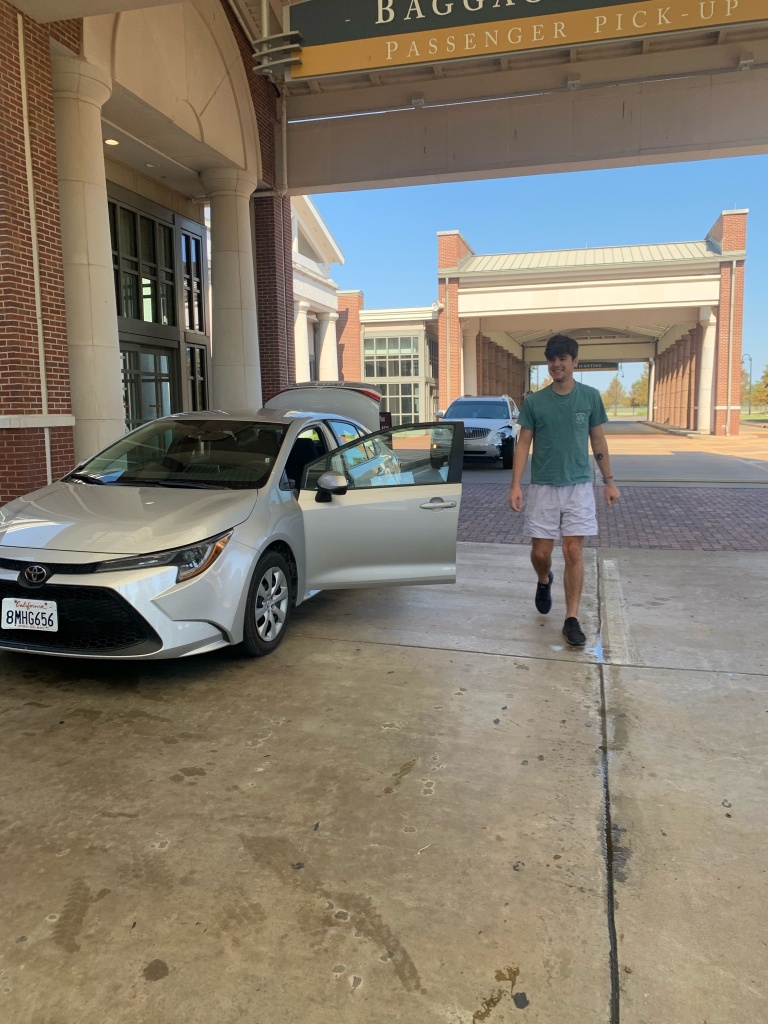
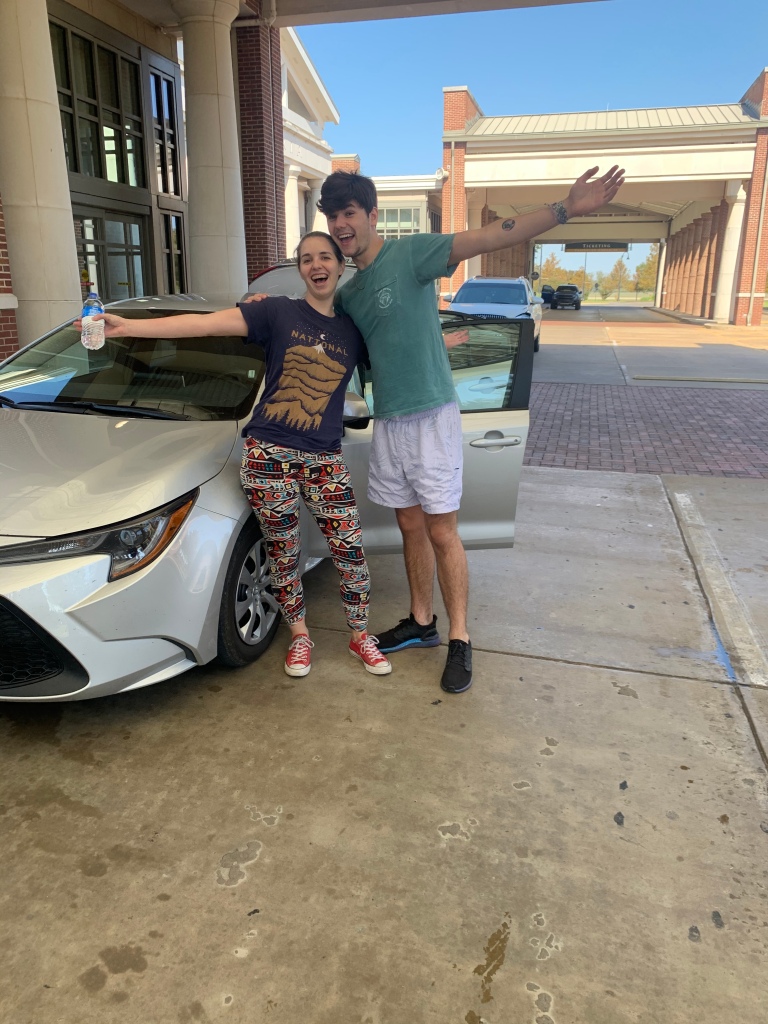
Our journey began at the Alexandria airport on Sunday morning. The date was October 4th. The time was 10 am. We arrived just when the rental car was supposed to be ready. Unfortunately, it was not. We had hit our first snag in the trip. However, I was far too happy to be bothered by the minor inconvenience – and the lady working at National Rental was far too nice for me to get upset about it.

This delay was caused by three factors: rental car customers not returning the cars on time, a limited supply of cars to begin with, and the time it took to clean and sanitize the cars before turning them over to a new driver. I don’t know if it’s because I didn’t feel rushed or distressed, but as luck would have it, we were only waiting a short time – by 11 am we were on our way from the airport to the highway.

Three days before, I had made my reservation and calculated things just so Jace and I could leave from his girlfriend’s house in Alexandria. A Mid-Size car for a week runs at $217.64 at National – PLUS Taxes and Fees of $109.36 PLUS a protection plan…and fees for late return. Put a little pin in that fact, because it comes back to bite me later. I was so naïve, thinking by paying the gas, Jace had the worse end of the deal. But we had a car, and in the moment, that was all that mattered.

The road is an exciting place. It’s more exciting when you’ve been fantasizing about hopping in a car and just driving for years – literally romanticizing Kerouac’s On the Road and praying to the universe for the opportunity to do what so many Americans take for granted – blast music from their own speakers without anyone else’s approval and go on an adventure.

Needless to say, I was literally buzzing for the first 3 hours or so of the trip. Then the fatigue set in as every rice and even the beautiful white cotton fields all started to look the same. Jace and I alternated a few times as I found myself get more and more weary.

We made it to our first stop, a basement airbnb in Evansville, Indiana. One episode that stands out from the 12+ hours on the road was our stop off in some town in Kentucky. We stopped because it was time to refill the tank (wow, gas goes fast!), I needed to use the bathroom, and we both decided if we were gonna drink that night we would need to go ahead and buy our booze before getting to Indiana. It was about 6 or 7 pm I think, and the chipper lady behind the counter rang up the drinks I’d grabbed without even asking for my ID. When I tried to pay, there was a restriction. Dry after 10. I laughed in confusion. It was still early. The lady kindly clarified: No alcohol can be sold in Kentucky after 10 am on a Sunday.

Now I don’t know what kind of law this is except: BACKASSWARDS. But unfortunately there was nothing she could do but recommend a liquor store or bar or something (warehouse?) down the way that sells alcohol even after legal hours. Once again, I was more amused than bothered. That’s just life, but there was no way we were detouring for that.

I discovered that something essential when you’re on the road is using your time wisely. Jace and I began racing from day to day so that we would not waste too much time on the road.

Our stay in Evansville was…quaint. The lady, a slender ginger woman with long braided hair, seemed to have a stiffness about her. She did not answer the door right away when we got there (admittedly it was late and we were very embarrassed and apologetic). Then when Jace ran off to get food, he gave her a headsup yet she still locked the door – causing some more chagrin as I struggled to unlock it before finally resorting to knocking on her door – this was after midnight.

We were delirious and exhausted. Surrounded by what seemed to be a perfectly set up classroom for fundamentalist Christian homeschool, replete with a Biblical history of the world and “The Lord Jesus Christ” scrawled loudly in beautiful cursive script on the whiteboard on the other end from the queen sized bed – somehow we were exhausted enough to pass out. Until we were woken in the morning by the sound of her three children running around. Walking past them sitting at a dining table near the living room/ante chamber was…awkward. So that was our first brush with the quaintness of the famous Mennonites – the slightly more modern version of Quakers and Amish people, I guess.

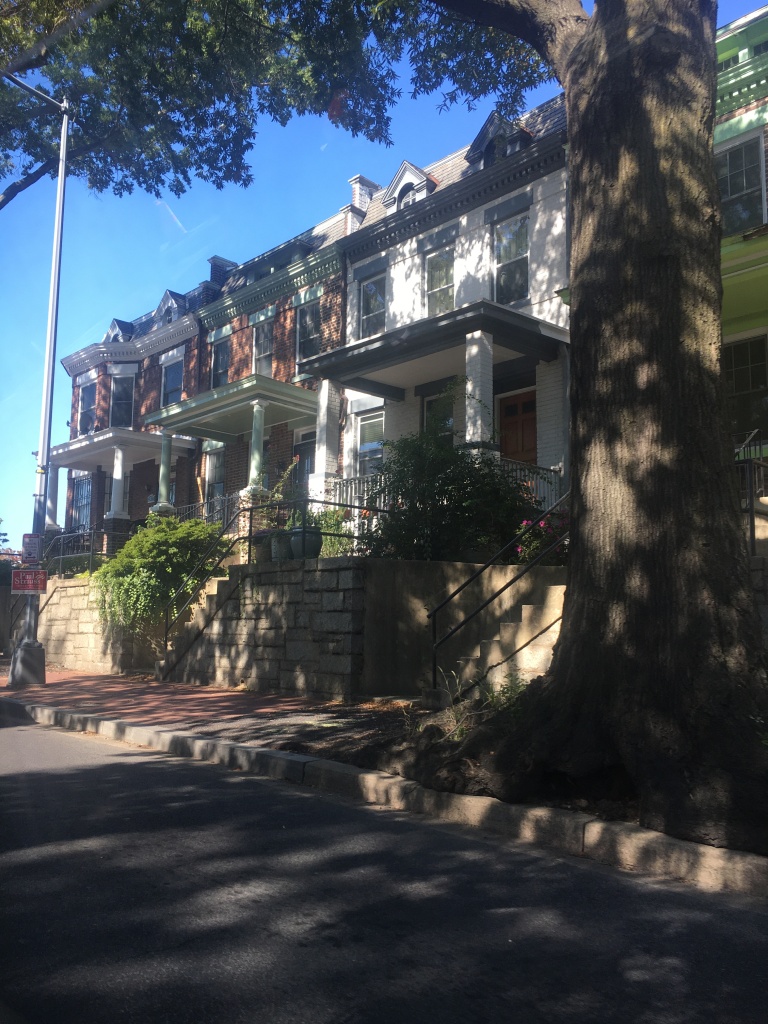
Anyway, we got on the road early that day. Each day was about 12 hours driving, and we were more excited than ever to reach DC. Our airbnb in DC was flawless. If a kindly uber driver hadn’t later informed us that we were in a “sketchy” part of the city, we would have never guessed – aside from the unavoidable smell of weed. And the view of it growing in broad daylight across the street the next day. But still, not necessarily a “sketchy” thing.

You see, DC is interesting because marihuana is decriminalized and yet technically still illegal to sell. So you can have it, but you can’t sell it. And if you buy it, you are technically giving a “donation.” Don’t ask how I found that out. But DC was a lovely experience. Our airbnb was a different kind of basement – quiet, a big comfortable bed and a big sofa bed, a big kitchen and clean bathroom. And still basically the same price as the place we stayed in in Evansville. Well, maybe a bit more expensive. My brother was in charge of lodging on the way.

We had imagined taking a bike to the historic part of the city. We didn’t realize how warm it would be. Yes, it was cooler than Louisiana, but under the midday sun, DC still felt just as warm. We opted for an uber to what is known as the National Mall.

We visited the Washington Monument, the Lincoln Memorial, the Vietnam memorial, and even the Smithsonian Institute focused on American history – all for free. The only expene was the uber and our lunch.

Most restaurants were closed in DC because of the virus. Jace and I noticed people were still active, walking, vlogging, and visiting museums – but few places to eat. Not even a coffee shop. We eventually found the sculpture garden after leaving the Smithsonian and had some good sandwiches and a drink, which we ate outside in the garden.

We passed by tons of museums and old state houses – the city was absolutely gorgeous. And the people were friendly as well. Unexpected bonuses?: We got some free edibles and some lady was walking around with her boobs out. Questions were asked. No answers were given. And the White House was still being watched by every political newscaster in the biz, no doubt speculating about the health of a recently Covid-stricken Trump. DC, my dears. A dream fulfilled.

With our day in DC well spent, we turned our eyes northward to our true destination: the Big Apple.

*Note: I’m having issues uploading pictures, but there will be more to see soon!*

Want to read more AND learn what not to do while staying in NYC? Leave a like or a clap!

On Discovering How to Be Your Own Woman (on your own)

2020 has not given as much as it has taken away. That is an irrefutable fact. And I speak not only for myself – in fact, I speak more for the world than for myself. 2020 has taken away our ability to be together without fear. But in spite of this, and disregarding how lucky I’ve been, the solitude 2020 has given me has been an unexpected gift. The solitude, while seemingly empty, has proven that it’s full – full of possibilities – right, not wrong.

As a society we have experienced great losses this year. But many of us have also been able to find the glimmers of hope within what appears to be an endless abyss. Apocalypse does not just mean the end. According to William Blake and his contemporaries, the true meaning of apocalypse was rebirth – destroying in order to introduce something else. Apocalypse comes from Greek words meaning to uncover, to reveal. In the case of the history, humanity – to reveal a new world after the old one goes down in flames.

So, with that in mind, even if you aren’t Christian, perhaps there is some hope of redemption in the ideology of apocalypse?

Much has died in my life to bring new things to life. I had to cut some people out of my life that disturbed my growth. I think this time has been a crucial time and space for us to collectively analyze our paths. As a species, how can we continue down the path that is unfolding? What other options are there? Where did we go wrong?

The time in solitude led me to questions, as I pined over old pictures of drunken nights and thought about old lovers. A part of me has always known that I romanticize the past, once a new challenge comes along. The conquered challenge always seems like the more appealing one when faced with new paths and pitfalls.

At some point, I had to start asking myself: am I moving towards my goals? Are these people nurturing my true self? Or am I simply stumbling along looking for some relief from loneliness? Some external cure for an internal ill?

This journey for me began in my apartment in Valledupar, Colombia. I was totally alone for almost 3 months (with a few moments in between where I spent time with my neighbor or met up with a friend). I had to reroute myself. For so long, my life had been a constant race from one destination to another. Work – gym – tutoring – sleep. Long ago, I began learning the value of self-care. But it wasn’t until I was forced to truly take care of myself that I realized just how it was done. And how little I had dedicated to my own well-being before.

As one day seemed to bleed into another, I became more and more aware of my routine. I began to construct my time around the goals I wanted to achieve. I was inspired by greats like Kobe Bryant and Seinfeld and authors like Brandon Sanderson – people that had made their passions into their careers, against the odds. The lessons they taught were rooted in a simple concept: Don’t break the chain.

I began setting goals, for meditation time, yoga, exercise, languages, reading. And it paid off. For once in my life, I maintained a routine that was both productive and balanced. Balance is an important concept when it comes to self-care. Too much of anything can be a detriment – too much exercise, too much work, too much productivity. I found that in creating my own routine, I also need to be mindful of my multiple needs.

I began to get to know myself again. I left a harmful relationship a little over a year ago. As is generally the case, my healing didn’t happen overnight. I tried to convince myself I was over all of the pain by working out, socializing, casually seeing other people – the typical escape plan from the doldrums of daily life which I know would inevitably make me turn inward and reflect.

But in quarantine, I began to realize that there was no escape. The things I had learned in therapy, meditation, self-help books – all of it was true and valid. You could not passively set out to improve yourself. You had to make an active effort to address different issues, just like a pianist or a basketball player trying to improve their precision – they focus not only on their strengths, but they actively put time into the areas they are weaker in. That’s the only way an average person could become an exceptional person. The solitude wasn’t something to numb myself to.

The solitude was teaching me how to be. How to be myself again. How to be my own woman. What does that mean, to be your own person?

As a woman, you grow up having your identity attached, not unlike members of any other gender, to external concepts. But for female-assigned persons, this emphasis tends to be on the social group, the community, the partner. The feminine sphere is set up in this landscape, intentionally and subconsciously. Women are taught they should nurture. They should attach their identity to a partner – and then, when the time is right, they must eventually surrender themselves to the ideals and identities of another.

I once had a partner who threw this blatantly back in my face. You see, like most, I grew up feeling like I was lacking. And as a result, most of my energy went into pleasing others. Pleasing others meant never doing anything wrong. It meant being predictable. Pleasing everyone meant being perfect. And yes, that’s what many young women feel they must do in order to be accepted and therefore successful in society.

One step at a time, I developed my identity. I had my own interests. I had my own convictions. But I found something troubling in me: I was too malleable. I would try to match the person I was with, my social circle, my partner. When one ex told me that my entire identity was fake – all borrowed from others – I was understandably hurt and furious. All of those experiences and interests weren’t just someone else’s – they were mine. They formed part of the person I was becoming every day.

And yet, in the solitude, I began to see the truth in one aspect of that harsh and reductive judgment – I did change myself to suit others. All the time. I felt anxiety when I couldn’t play the right part, when I couldn’t be what someone else wanted. And in my last relationship, this impulse to please at all costs nearly crushed me. Until I couldn’t take it anymore. Until I looked in the mirror and said to myself, “Either I die, or I stop living this way.”

And with the support of others, I took the steps to be free and end my last relationship for good. But the truth is, I didn’t really feel okay with being alone, not until some time alone passed and I learned to breathe on my own again.

How can you be your own woman? By embracing solitude. By reserving your attention for things that grow and inspire you. By agreeing to disagree but refusing to agree in order to appease someone else. So long I thought I was being “good” by biting my tongue and taking the path of least resistance. Other times, I thought in order to be authentic, I had to fight, and not only that, but I had to win at all costs. And yes, being a skillful arguer and being persuasive is important. Being diplomatic is equally incredible. It’s so important to me, in fact, that I plan to make a career out of diplomacy. Use of words and the ability to understand the perspectives and arguments of others – these are important life skills that all human beings need.

But like I said, anything in excess can be a detriment. Censuring myself reflexively had stunted me. It made being myself seem like a fight or flight situation. And over time, living in another culture, dominating another language, I had begun to brush off little by little those self-imposed restrictions. I was moving toward being my own woman.

You see, I realized something. In the past, I had associated my singleness with some of creatively, the best years of my life. I wrote a book, essays, took pictures, reflected, studied actively, with no one to get in my way or distract me. Yet when the wrong person came along (the right one to catch my eye and attention), I would sacrifice my interests, little by little, or seek constant validation from my partner in the case that we shared the same passion.

My search for validation overshadowed my search of self.

When I came home, I began spending time with my younger brother. I wasn’t expecting to learn something so important from who I may have easily written off as a hormonal, mercurial teenager, a person still in the stage of life where he is “figuring himself out” – except, wait. Did I ever take the chance to really figure out who I was? Well, those were my experiences, right? The sum of them was equivalent to who I am.

No, something stood out to me about Jace’s search for self: rebellion. But not just the teenage rebellion we all have experienced growing up in strict households. No, I realized the answer was sitting under my nose all the while.

See, I’ve always been resilient. When I put my mind to something, I have an unbreakable iron will. Except when the issue became one of conforming with others. Most of my choices never led me down the path of least resistance, down the feminine, communal, passive path. Oh no, on the contrary, the times I asserted myself, I became more and more removed from the people that I was supposed to care the most about – and I did and do care about them. But my choices, while not simply self-serving, never brought me closer to them.

And I saw my brother doing the same thing. And struggling. But being real and authentic and honest with the people around him. Refusing to lie about who he was anymore. We both had grown up with the same limiting circumstances – our parents expected us to be one way, but that did not match who we are on the inside or what we believed, even in secret. Our convictions ranked supreme.

The element I had always been missing was radical honesty. An honesty with myself and with others that was unwavering. In discovering myself, I was discovering that I needed to be more honest. Living at home was no easier than living in isolation – and with hurricanes and living with relatives which were of different minds than my own – well, I felt like I had to play that game again. Sacrifice the self for personal relationships. Again.

But slowly, as I began to rediscover my passions and interests, I began to radically embrace this new approach: to stop telling people what they want to hear, and to embrace the moments when people share their truth with me. Because we all have our own truth, our own worlds within us. Nobody can take that from you. Be you non-binary, trans*, man, woman – you are entitled to your identity.

So many existential struggles have come down to this core truth, this core right to an identity.

And yet, for so long, in the pursuit of perfection, I would not allow myself to be myself. Even with people I loved and respected and trusted – more so because their opinions mattered even more to me. You could melt under that pressure; you could lose yourself. And I had, several times over.

I noticed a shift. As I began pouring more energy into myself and embracing my own interests and identity – even when other people didn’t like it or made fun of me for it or misunderstood me – I also stopped projecting my insecurities onto others. I became free to observe others with less self-conscious baggage. I was no longer analyzing things through a twisted, dirty lens that warped things to reflect back on me. And I opened up.

And you know what? Other people began to open up to me. My parents, the people who had been best at making me stifle myself and discard the things that make me unique (and the people whose love and acceptance I craved the most as a child, un-coincidentally), saw the real me and embraced me. They have openly told me how much they love who I am – without prompting. Just by me being my uncensored, unapologetic self. They have been able to appreciate me without all of the layers of anger that pinned me down before, layers of guilt, layers of insecurity – shed.

I got out of my head. And I was able to be present for others – a perfect bonding of my love for Stoicism and Buddhism and Mindfulness, all these things I have read and studied and attempted to apply to my life for the past 5 years or so – I finally started feeling successful at applying them to my real life. The joy as well as the pain overwhelmed me.

And I realized I was whole. I was not all good nor all bad. I was simply my own woman, my realest, truest, most conflicting self, the protagonist of my own story. And knowing what I know now, there’s no going back. I can only continue in this process of Becoming. And now I know: anything or anyone that gets in the way of that will be no true obstacle. Because I was my own biggest obstacle, my own biggest critic – all alone, all along.

9 Iconic Film Locations of Wild — LocationsHub

National Domestic Violence Awareness Month: Teach the Right Lessons (the right way)

Please note: Entry contains references to instances of domestic abuse, dating abuse, sexual assault, abuse or harassment. I encourage you to take whatever precautions necessary to seek help for emotional and psychological safety.  If you would like to speak with an advocate , please contact a 24/7 Break the Cycle peer advocate at 866-331-9474  or text “loveis” to 22522.

October is Domestic Violence Awareness Month

When we think about breaking a cycle, what comes to mind? Do we think about what makes us the way we are? The choices that we make? The choices we don’t want to make?

I feel like many times breaking the cycle brings to mind a sort of reaction we have after we have been exposed to so many problems. It often has little to do with premeditative action, prevention. However, the reality is that we often don’t have the tools to prevent until we have already gained some experience. And failed.

Recently I’ve realized how the first step to breaking a cycle of familial and relationship violence is to teach the proper way to love. Ironically, I reached this conclusion after reflecting on the lessons and messages I got about relationships while growing up within my family. I became aware of how those lessons and examples have continually crept up in my relationships. And it’s no coincidence.

My aunt said it best. The message came in a scold directed at her son. My cousin is an active kid. He’s very loving and very physical, which is normal in young children as they are molded by their environment to conform whatever cultural standards exist in regards to boundaries in their families and communities. You see, my 3 year old cousin had been getting too rough with his dog. Luckily, the dog is old and fairly patient – instead of retaliating, he runs from my cousin when he goes too far. In this case, he was chasing, grabbing, and kicking at the dog, thinking he was playing. My aunt intervened quickly, saying, “When you love someone, you don’t hurt them!”

This was a brilliant teaching moment (as a teacher, I was taking notes) – especially since our reaction to this type of behavior is usually a knee-jerk sort of threat or positive punishment to teach the child a lesson by means of intimidation. Do as I say, not as I do.

Yet in my aunts’ household, I saw a very different narrative unfold. Lessons were taught, as we idealize, with love. Firmness off-set with compassion. The example of two loving mothers who value their child more than anything else in the world. The lessons of those that really want to avoid the mistakes made and perpetuated against them in their own childhoods or those of people they know.

This, to me, is how you break a cycle. By teaching the right lessons, the right ways. And by unlearning old lessons and habits. This is a part of becoming a fully mature individual, and it is a process, easier said than done.

I have often reflected over the last few years on just how little I saw healthy relationships modeled as a child. My parents were the type that chose to stay together out of mutual dependency – and perhaps a greater fear of being alone or going through traumatizing experiences from their own past again (or putting us, the children, through them, as is usually and ironically the case). They were trying to fix past wrongs, the wrong way. Without mindfulness.

Meanwhile, my siblings and I were sent mixed signals throughout our childhood of what it meant to love and the appropriate way to treat the ones we love. We were expected to comply to rules which we were given with no place to question or encourage the development of our personalities – what religion we should practice, what sorts of friends we should have, the ways we should express our emotions, the things that were and were not taboo to discuss openly. So many shadows, so much confusion.

Corporal punishment and domestic violence lend themselves to these strange, tense emotional landscapes. They are perpetuated usually by those children that experienced those same things growing up, those that would be responsible for breaking the cycle. Those that should know – it has been proven that these methods and conditions do nothing to develop empathetic, healthy human beings. Yet when a child behaves in a spoiled or entitled way, we assume they had never been spanked in their life. In spite of knowing they were raised badly, the victims often become the perpetrators.

The contradictions accumulate. Each day my mom would reset, my dad would reset, no matter how bad the night before may have been. Nothing was worth risking their bonds – or bondage – of matrimony. And we all got to suffer together. That builds character, or so they say. When you suffer for someone, that proves you love them unconditionally. Right?

That narrative is the one I see being avoided by mature, healthy individuals like my aunts that remember that love is taught by example and through clear intention and reciprocity. It’s as simple as reinforcing what my aunt said: if you love someone, you shouldn’t hurt them. Nobody wants to be hurt. And nobody deserves to endure that because love somehow can justify it.

I look back on my own experiences within the past years, and I recognize how much I have struggled to figure out the proper way to communicate, to define boundaries, to share love, and most importantly, to love myself enough to know when I am simply repeating old lessons I never realized I was taught and knew by heart. Being in a culture different yet so similar to my own background, a small town, a rural closedmindedness, a Roman Catholic dogma underneath – I thought I was prepared, but I was not.

When you grow up in a state of fear, you begin to create bonds on the base of trauma. When it appears in your relationship, there’s at first a sense of shock and outrage which if left too long can turn into a twisted sense of normalcy – I’ve seen this before. I know what this is. But I don’t – how was it that you should handle this?

In my last relationship, the fear and tension escalated in a way I could have never anticipated, even though I felt anxious as I began to open up to him. My ex reflected attitudes that I realized, subtly, reminded me of my dad in the way that he treated me and my mother when I was young. This wasn’t something that attracted me to him, but it was familiar. And it only started to become apparent after the honeymoon phase faded and reality slowly started to creep up in the worst way – once we were living together. I came to abhor it, but there was something in the familiarity. The constant struggle. The unyielding, visceral toxicity. It was a slow-acting poison, and by the time it got really bad, I feared I was in too deep.

In relationships like this, we gloss things over. I watched my mom do it everyday. I learned how to do it. Every day I got to school, I became a different person. I thought, how strange, am I bipolar (dramatic preteen me had also been gaslighted into thinking that 1, there was something wrong with me, and 2, that if I were mentally ill, I must automatically be a bad person, so asking myself this question, while silly, was also something that produced its own sense of unease and dread) – why was it so easy for me to put on a smile around my friends when I spent all of my time fighting constant battles at home, watching my parents fight, fighting and picking fights because I couldn’t stand to feel weak?

So when I finally began to realize just how abusive my last relationship was (which did not take to long to figure out; the fear and anxiety were immediately apparent and all of the warning signs I ignored up to the point seemed as constant as the chronic pain I carry in my back), I became confused. I knew I didn’t want that. But as has happened many a time with me, I didn’t know how to walk away without this intense anxiety attached to it, this regret or fear I would regret removing someone from my life. This need to fix things, somehow.

But you see, this wasn’t something I was born with. People that get stuck in abusive relationships are not inherently weak. What happens is their vulnerability derives itself from years of invisible reinforcement. Invisible because most don’t realize it’s happening – not even the parents. And yet the seeds get planted deeply, and the roots can run deep if there are no positive role models to help fill this emotional void.

Unsurprisingly, the perpetuator of the violence – physical, psychological, and emotional – had once been a victim of these same acts. And to my horror, I began to realize he idealized his childhood. He had no interest in breaking the cycle. He had no interest in being better. Empty promises covered bruises, and it seemed like I was getting buried within a blackhole, a vortex-like vicious cycle. The cycle I had promised myself to break.

I’ve never talked publicly about all of this. I’ve always been afraid it would seem like I was whining or saying poor me or dramatizing my own life or something. But lately I’ve been having these conversations again and again, with close friends, with relatives, with my own parents who now realize the consequences of their unconscious actions and modeling. And the truth is, there’s something to be said about how insidiously we learn how to behave without any explicit teaching. Although nobody told me to put up with abuse or to put love above my own health or welfare – that’s the behavior I saw and mimicked daily growing up. All of my female role models were in these sorts of relationships. As a child, without context, thirsty for the one thing all people thirst for – love and acceptance and an identity – I found myself contradicting the messages I received, hating them, and yet acting them out in my daily life.

Until it snowballed and I realized, through therapy and self-reflection and just a more open environment where people actually talk about these very real, very common issues, that in order to do better, we have to confront the lessons we learned subconsciously. We have to look for separate narratives. And we have to take on the role of educator as well. We have to prioritize and protect our peace.

I still have a fear of falling into those patterns again. They seemed so ingrained in me, the anxiety can be almost unbearable. But I know there is strength in honesty. By creating a discussion about this, I’m performing a personal exercise, yes, by acknowledging something I’ve often denied or been told wasn’t valid or real in spite of the very real consequences. But I also want to open myself to hear other people’s stories and to help them and to encourage them to see that no matter what anyone says, the cycle of abuse you have been trapped in is not your fault. And it doesn’t have to be sempiternal. There are ways to get out and to become more mindful.

And I know how easy it is to get stuck. How innate these patterns become in our lives. And if you’re struggling with this, I want you to know, you aren’t weak. You aren’t alone. You just weren’t taught the lessons you needed to know in order to set boundaries, in order to communicate, in order to express your needs and listen to those of others. The ways in which we need to give and receive respect. Or maybe you were taught but the lessons were muddied with other forms of abuse. Whatever the case might be, everyone’s struggle is valid. Everyone needs validation. Everyone needs to feel heard. And with that knowledge, we can all step a little closer to learning how to love the right way and to teach the right lessons to those who look to us for answers.

Why open up about this now?

During this past month, I have been tried, but I’ve also been taught. It has been strangely uplifting in all of its frenetic, unpredictable vulnerability. Truth be told, I hate feeling vulnerable. I hate being pushed out of my comfort zone involuntarily. I leave my own comfort zone all the time. That doesn’t mean I like the pressure that comes with external, unexpected circumstances.

In spite of not being where I wanted to be, everything seemed to fall into place. And this lesson crystalized itself more and more during the month of October. To love is not to fear, yet so often we are taught by those we love through fear, it is the tool that shapes us. But this month, something inside me has been awakening slowly but surely. The strength of others inspires me and makes me want to believe in my own strength. I want to acknowledge the worth I so often refused to give myself. And that’s powerful, but for many people, accepting and loving ourselves is a daily struggle.

Just know that you aren’t alone. And if you fear judgment by people you know, look for a safe person, a therapist, someone that can help you see through the prison you’ve been locked in and can help you pick the lock and be free.

Breaking a cycle is not always taking preventative measures. Sometimes we fail – we’re human. But we can always ask for help and learn from our own mistakes and those of the people we believed were infallible in our childhood. It’s just a matter of learning to discriminate between the right and wrong lessons and ways of teaching them.

For more resources: https://www.breakthecycle.org/blog/it%E2%80%99s-national-domestic-violence-awareness-month

Looking for “normal” in a “weird time of life”

I’ve been wanting to write a confessional tell-all for a while now, ever since I became more mindful of myself and my journey. Unfortunately, I’ve also wanted to write about a million other topics, and for some reason (hmmm) it hasn’t been easy.

For starters, I am not writing this on my own laptop. Hell, I’m not even sitting in my own house. Well, for the time being, I don’t have a house of my own. I do, but it’s in Colombia, across the Caribbean Sea, which might as well be the other side of the world. But relatively speaking, I haven’t returned thanks to the Coronavirus, a global pandemic, but also because this has been an important time for me to spend with my family.

To recap, I came home in June of this most “blessed” year – 2020. I made this decision in spite of the risks to my own health and even the health of my family for a somber reason: my grandpa – my pawpaw – was dying. He had been given 6 months maximum to live back in March, just as the virus was being recognized internationally, and nobody believed he would make it until December. His C0PD had crippled him. For several years, he struggled with the aftershocks of years of hard labor, asthma, smoking, and alcoholism. He did not have an easy life, and I knew that if I waited until the pandemic passed to be with him, it would be too late.

So even though I was relatively comfortable in Colombia, if fairly isolated, I chose to leave after getting the greenlight from my school’s principal. Before coming home, ever day seemed the same. I was trapped in that quarantine loop of endless “What day is it?” and a routine of pacing around my apartment, cooking, watching shows, repeat, with a weekly outing for shopping. That became my new “normal.”

Then I came home. And once again, the illusion of normalcy shifted in another direction. I watched my pawpaw die, held his hand as he took his last breath – after a full week of being there to support him while he suffered and refused to eat, unable to speak after some time, expressing repeatedly that he was ready to go. I was grateful to be able to be there for my grandma, to cry with her and comfort her as the presence of her husband of 45 years faded from the house they had built together. Family gathered to be near to him, friends came to say their goodbyes, until finally his last will – to be allowed to die peacefully rather than being kept alive on life support – was fulfilled.

More than my own sorrow and anxiety at being home for the longest time in years, this was my grandma’s journey through grief. We were all ready for the moment when it came, but no one could imagine the empty feeling that would follow. I could see my grandma’s restlessness growing even as she accepted my grandpa’s passing. I felt her tension acutely. And yet, she persisted. She developed a routine that worked for her, that helped her to keep moving forward. Just as my grandpa had admonished, she did her best not to lie around crying and missing him. But the tension hung over us, and my anxiety was making it harder for me to be there for her.

Around this time, I finally spoke to a doctor after getting on Medicaid thanks to my low income status (after all, I am still only making money in pesos and far below what is considered an average income in the States). For years, I have struggled with the ebbs and flows of anxiety and depression. I recognized it, have been to therapy for it, and actively sought to overcome it with a combination of mindfulness meditation, yoga, and other coping mechanisms, some healthier than others.

A year ago, I was awakened to the extent of my father’s bipolar disorder. His struggle to find the right ratio of medications and therapy had been difficult to watch, sometimes frustrating, other times equally upsetting as it seemed almost futile and inadequate against all of his years of trauma, unhealthy coping mechanisms, and escalating mental and physical illness.

However, there was one thing I took away from all of that. He had improved. The journey was tough, and progress was not linear, but the change was undeniable. So although my mother and other family members have a wary view of medication, I decided to follow my doctor’s advice to see if it could help me sort out my physical and mental issues.

Honestly, I could not have picked a better time to try. I’m not sure how else I would have gotten through the rollercoaster that was only just beginning in mid-August. Once the emptiness of my grandfather’s death passed – or at least was managed – we became almost immediately and comically (if in only a “divine” way) uprooted by Hurricane Laura. I don’t need to describe the devastation of the storm – it’s left its own mark on the media and public imagination as much as Hurricane Katrina has, even if it has received what most would consider less coverage (which as others have pointed out, could be due to all of the other natural and human disasters shaking the globe). We were displaced for an entire month. Three of those 4 weeks I spent living in my uncle’s house so that I could continue to teach online. Most of my time has been consumed by that work, and I am so grateful. Routine and responsibilities do help loads during uncertain times. They create a sense of normalcy, a grounding of consistency. Plus they help to remind you what day it is. My students have been a godsend during these times.

But after all of it passed, we were still left with land covered in debris and homes, while inhabitable, feeling alien to us. My grandma and I returned and steadily began to clean up and pick up the pieces left behind.

And then, almost ironically, just after the ceremony we held to lay pawpaw’s ashes to rest in Bogata, Texas…another storm reared its nasty head. Hurricane Delta went through while I was comfortably traveling with my younger brother, yet for all that we enjoyed ourselves, the twist in my stomach at not being able to return home – again – was sharp and sickening. Once again, we are craving normalcy during an utterly weird time of our lives, a time when everything seems possible and yet nothing seems easy. A time when so many are struggling, losing parents, neighbors, and loved ones of all sorts.

And I am brought back to the purpose I seek – the unity, the understanding, the compassion. And I am reminded that by being able to face my own problems, I have been more equipped to achieve this with others. A calm in the storm, a clarity of mind unattainable by me before.

To close this reflection, I would like to share some poems I have written over the past year that I feel encapsulate this awakening, this painful growth, and the power it has given me to persevere in spite of all adversity. These are more so portraits of what I’ve seen and where I’ve been. Yet they make me all the more grateful for where I am today. Weird a place as it may be.

Depression is not a silent killer

Depression is not a silent killer.
It screams and shouts
Sometimes
It breaks things –
Plates and forks and frames
Sometimes –
It just breaks hearts.

Depression is wishing:
You were dead
Thinking:
Who’s gonna care anyway?
Being immobile:
Neither asleep
Nor awake.

Depression is a flatline
It’s seeing your dad dressed for his own
Funeral –
It’s not knowing
If waking up is ever really worth it
While the dreams fill you with fear of sleep –
But still –
It’s a cycle.

Depression is living –
It’s alive and breeding
Making a home in your darkest thoughts
Making a chant of your biggest flaws.

Depression is feeling
Awake while you’re asleep
And asleep while you’re awake.

The fact is –
Even though you can’t hear it –
Even if it doesn’t make sense –
If the words don’t come out right –
If there are no I-need-you/help-me’s –
No cries for help –
The signs are there:

Depression is not
A silent killer.

Trauma

Trauma lives
deep inside our bones.
We can’t sweat it out,
our tears won’t make it go away.

Trauma
blinds us
and breaks us.
But sometimes
it breaks us free.

When I remember
his hands around my neck
my hands pulling his hair
our fists and teeth clenched
his fingers pinching the razor blade
till red paint bursts across my eyes
the hatred in his eyes
the fear and heavy breathing
the sweat and heady tension –

I remember that
I am free.
And I thank God
that it’s just a memory:
a deep-seated
PTSD.

Unhealthy

How to break the cycle?
How do I become more whole
So that I avoid breaking myself
In two for someone else?

Today
The earth reminds us
With every fire, every shake, every storm
Of the old adage
That no matter where you are:
What injures the hive, injures the bee.

I thank you, reader, for looking outward and inward. During this time, we must remember that we aren’t alone in our struggles, and while there is no one simple solution, we can overcome the worst and the darkest. We might need to fall a thousand times or lose our homes or just have the courage to reach out to others. But it’s worth it. Today, in spite of all of this, I feel grateful to wake up every morning, to have something to write about, to be alive – and that’s not always been an easy thing to say. And I’m grateful to you.

Thanks for accompanying me on this journey.