Be your own best friend (Tu Mejor Amiga Eres Tú)

How I learned to accept and love myself and stop suffering (Cómo aprendí a aceptarme, quererme y dejar de sufrir)

I found this audiobook on Spotify. It’s extremely relatable for any person, especially femme, that has felt too much, sacrificed their own authenticity, and surrendered their power to others. Who has listened to a drill Sargent (as the author Cris Blanco aptly calls it) in their head yelling at them Elsa style: “Conceal, don’t feel! Don’t let them know!”

This has been my journey since 2023. Forming a cocoon around myself, trying to emerge, struggling to accept what I perceive. I’m learning the message that any therapist helps you see: You need to be your own best friend. The person that believes in you the most has to be you. It is vital if you want to move forward and overcome doubts, about the self, the future.

So, instead of summarizing her words, I’ve decided to translate them for this blog today. I’m sure an English translation already exists online, but I am intentionally combining this with a daily practice. I started translating while listening in the past month since deciding I will test for my ATA translator’s certificate.

Let me showcase the resounding wisdom this author shares in her book. Let me know in the comments if you can relate to this subject as much as me! And if you want more. 🙂

Part 1: Feeling like you aren’t enough

You think that your perfectionism is your worst enemy. That you’re a failure for having anxiety and intrusive thoughts. For only knowing how to relate to others in a toxic way. Or obsessing over your body and your self-image. For feeling like you don’t fit in with the people around you. For not knowing what to do with your life. Sound familiar? If the answer is yes, then this book is for you.

I’ve always had the feeling that the things that I thought or felt only happened to me, and this caused me a lot of suffering. Life can be a real rollercoaster, full of twists and surprises, ups and downs, and strong emotions that we often don’t know how to handle. No one teaches us how to, either. And ultimately, all of that ends up blowing up in our faces.

For years, I’ve done everything possible to be the perfect girl. For example, I would try to conform to all the unattainable standards. I had a huge fear of disappointing others. Without realizing it, I kept putting more and more pressure on myself – pressure that was gradually taking me over from the inside and ended up destroying me emotionally.

Additionally, in my short life I’ve had the opportunity to experience different types of relationships from romantic to platonic, that while painful, have allowed me to understand that my way of interacting with others perhaps was not the best. In these relationships, my insecurities were reflected through many behaviors that could be considered toxic, although at the time, I was incapable of seeing them that way. Jealousy, dependency, and control are the worst enemies of a relationship. And I had to learn that the hard way. I guess that being a highly sensitive person also did not help when it came to regulating my emotions.

I always considered being sensitive a flaw, or rather, a synonym for weakness. And for years I have felt it is one of my greatest insecurities. I’m still in the process of understanding and accepting my sensitivity. Trying to start seeing it as another personality trait. That while it makes me feel everything, both good and bad, with more intensity, at the same time it allows me to appreciate the little things in life. To be more creative and to connect better with others.

This load of self-imposed requirements, perfectionism, limiting beliefs, and toxic relationships took the form of long-standing anxiety. I believe that I always had it. It was just silenced until these situations became too much for me and I couldn’t control it anymore. I could say that what seemed like the worst thing that had ever happened to me was in fact a new door opening for me. Both my body and my mind were telling me: “I can’t do this anymore. This has to change.” And as the saying goes: Once you hit rock-bottom, the only way to go is up. And that’s what I did.

It took me a lot of time, therapy, tears to start dismantling those limiting beliefs that I held about myself, the world around me, and to recognize that I’m still in this process. In fact, I think I will always be in the process. There is still plenty of things for me to understand and experience. But in the meantime, learning to accept what I think, feel, and am has given me the freedom I never thought I would achieve.

How can something that sounds so simple radically change your present and your future? In effect, it seems easy, but it isn’t because throughout our entire lives we force ourselves to repress our emotions. We try to control our thoughts. In short, we train ourselves to be living robots – bodies without souls that go around doing what they must, trying to satisfy the desires of everyone except themselves. How are we not going to explode at any given moment?

For me, accepting this vulnerability that makes us human was an authentic wake up call. A call to stop rejecting who I really was. And above all else to understand that although I couldn’t control my thoughts or my emotions, it was in my hands to decide how I would respond to them. Who would have thought that recognizing my vulnerability would be precisely what would make me successful? Understanding my success as the joy of being able to dedicate myself to what I’m passionate about. Fulfilling many of my dreams. Knowing that with it, I am making a positive impact on hundreds of people and real connections with them as well.

Aware of the road ahead of me, everything left to live, and all of the lessons that I still have to learn, I find it therapeutic to express myself and speak my truth. That’s why today I’m writing what I hope are the words that will stay with you like a heart-to-heart between friends.

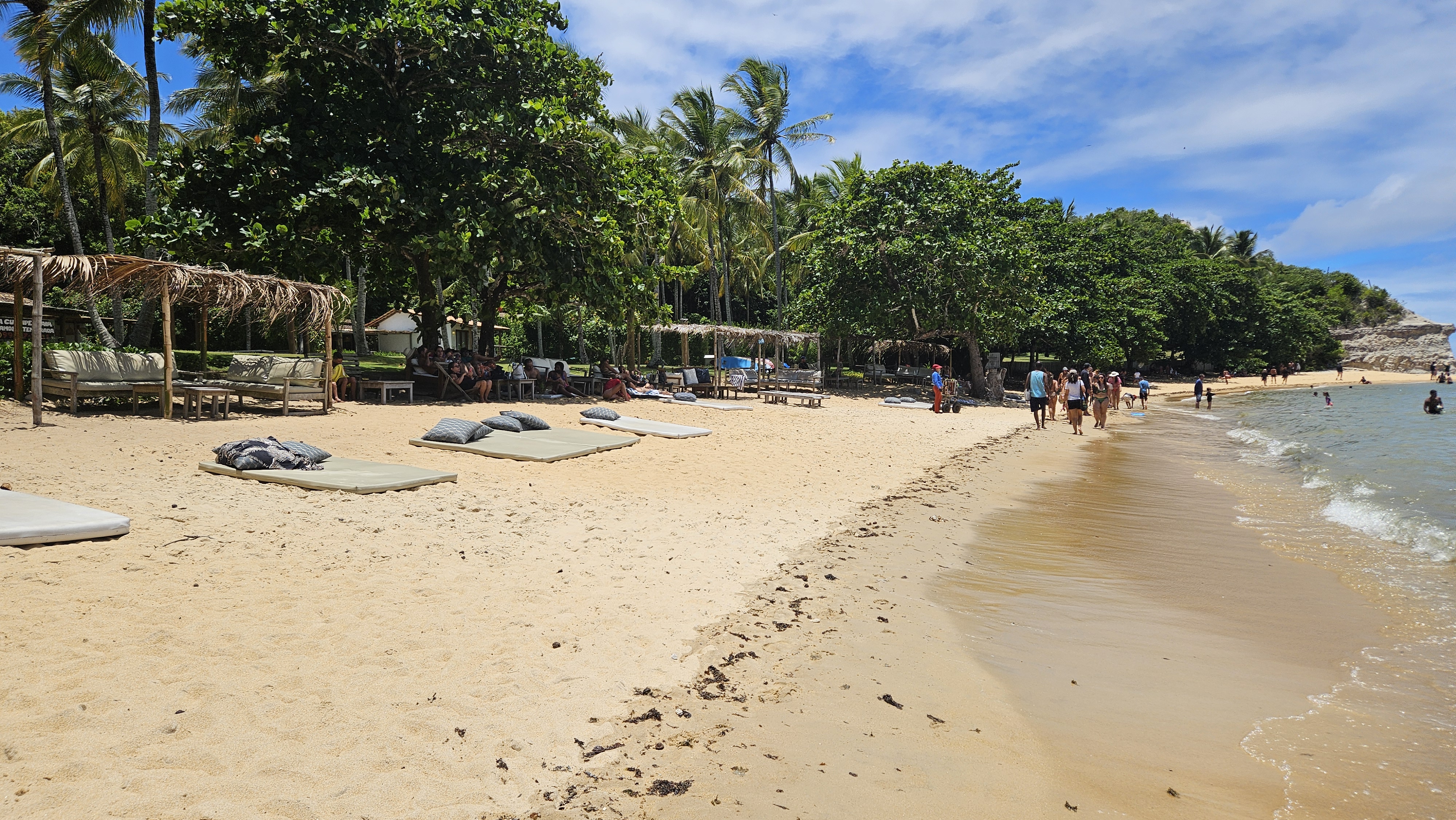
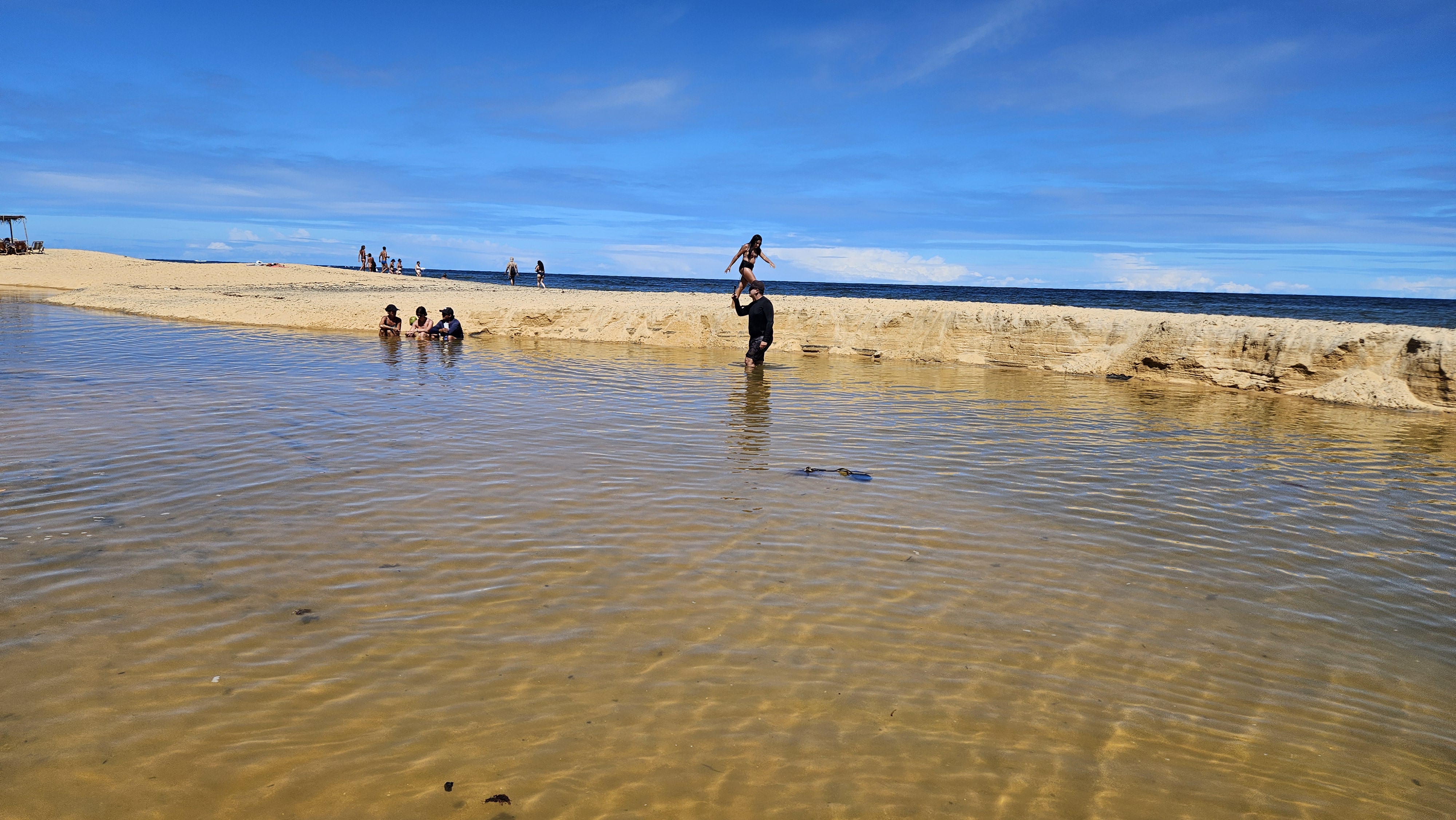
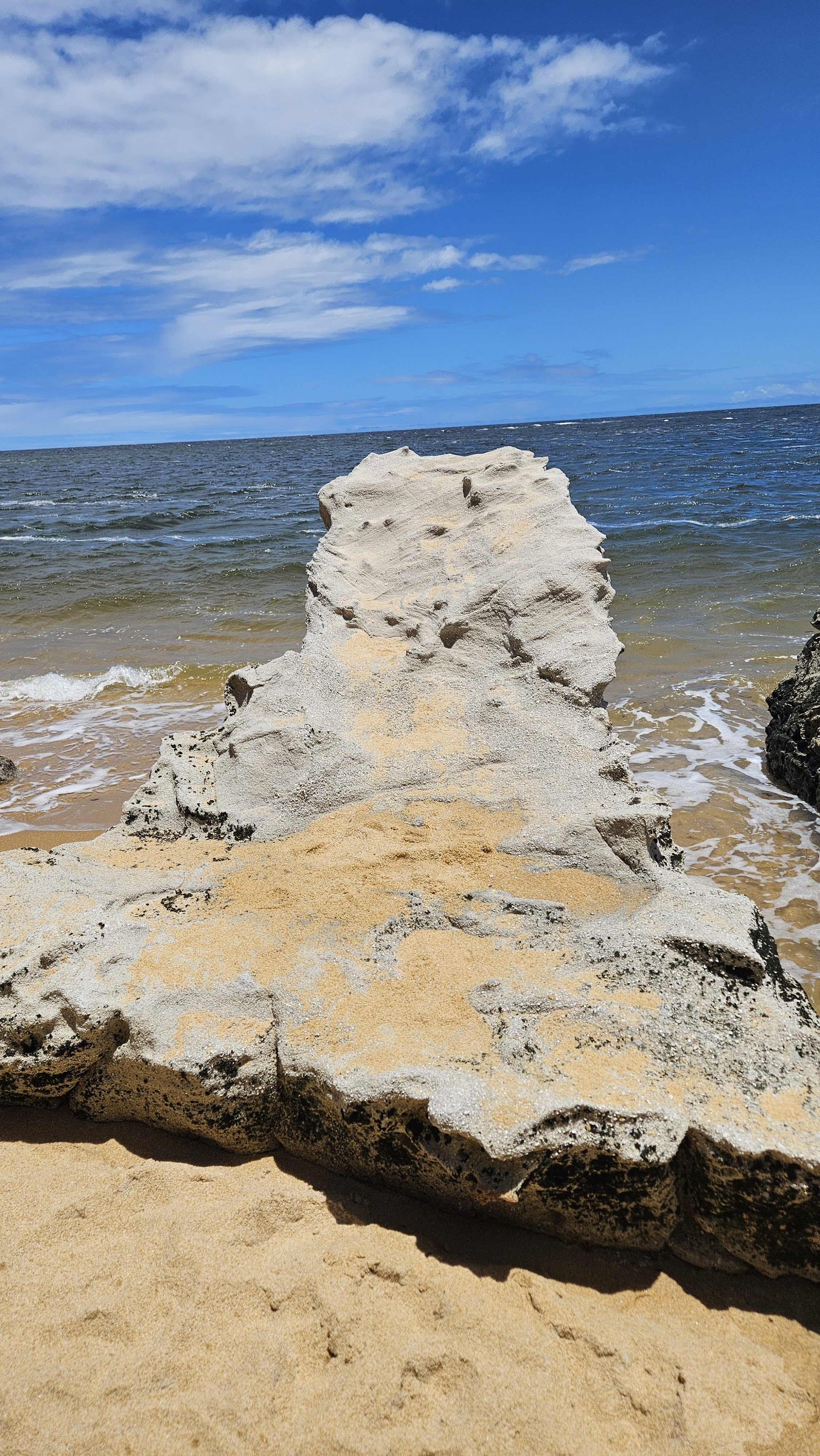
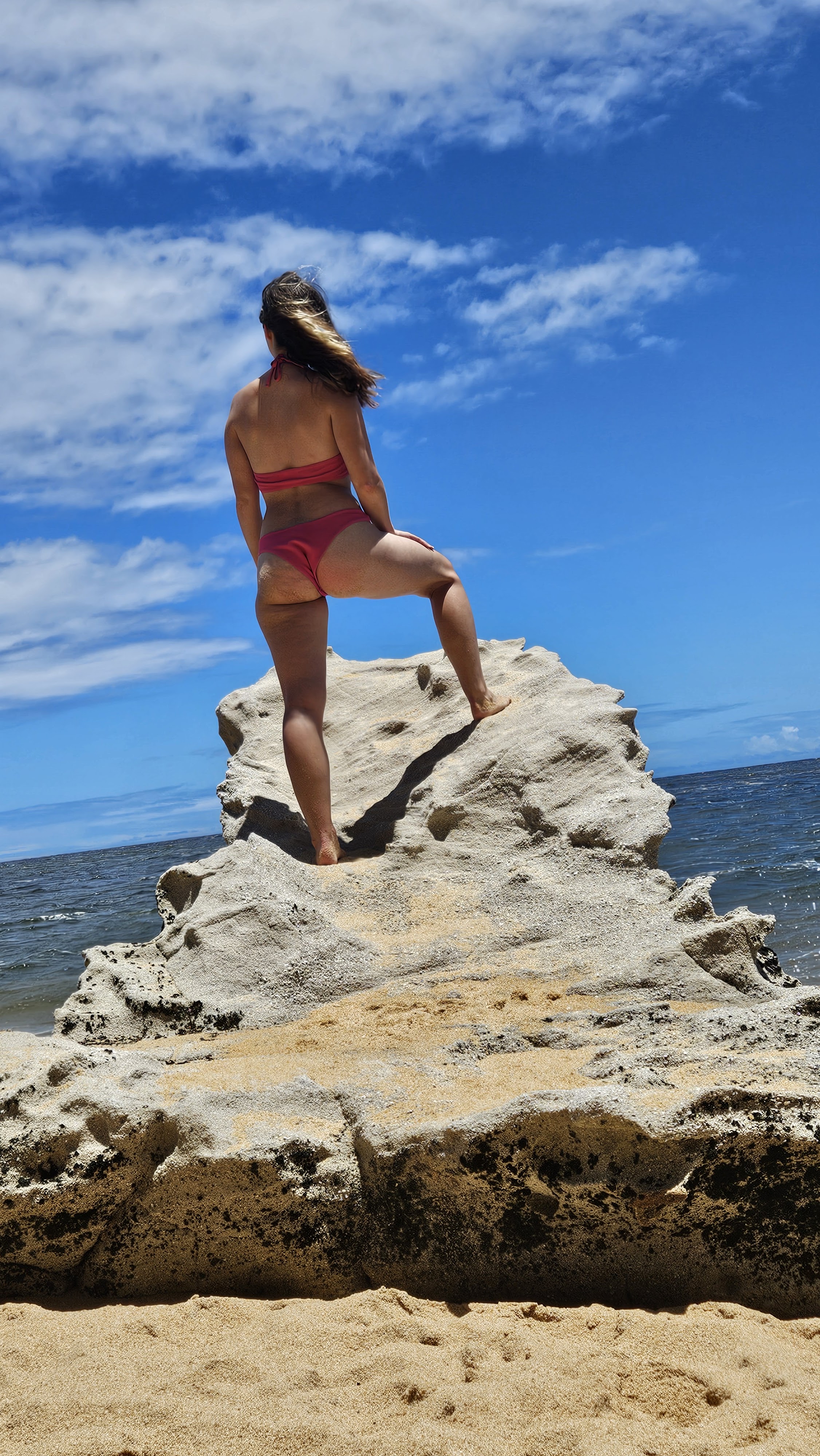
Beach Day in Brazil: Reflections from Praia do Espelho

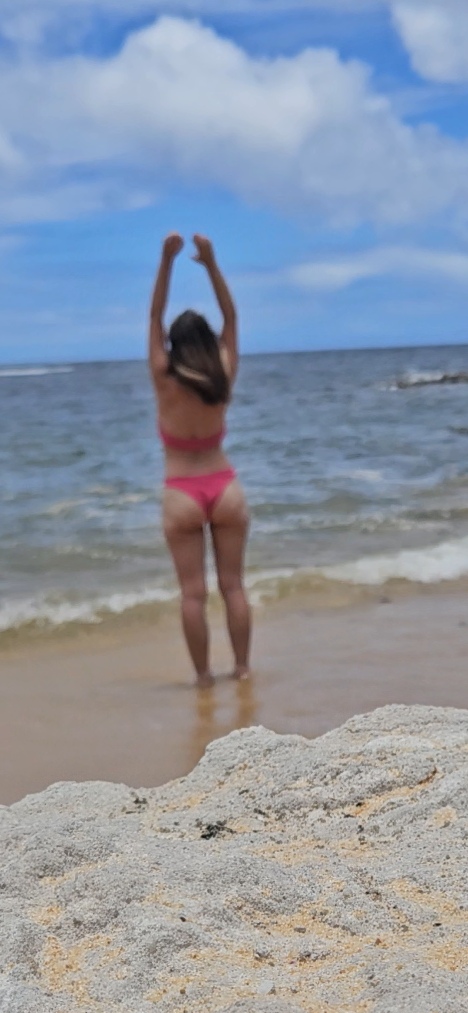
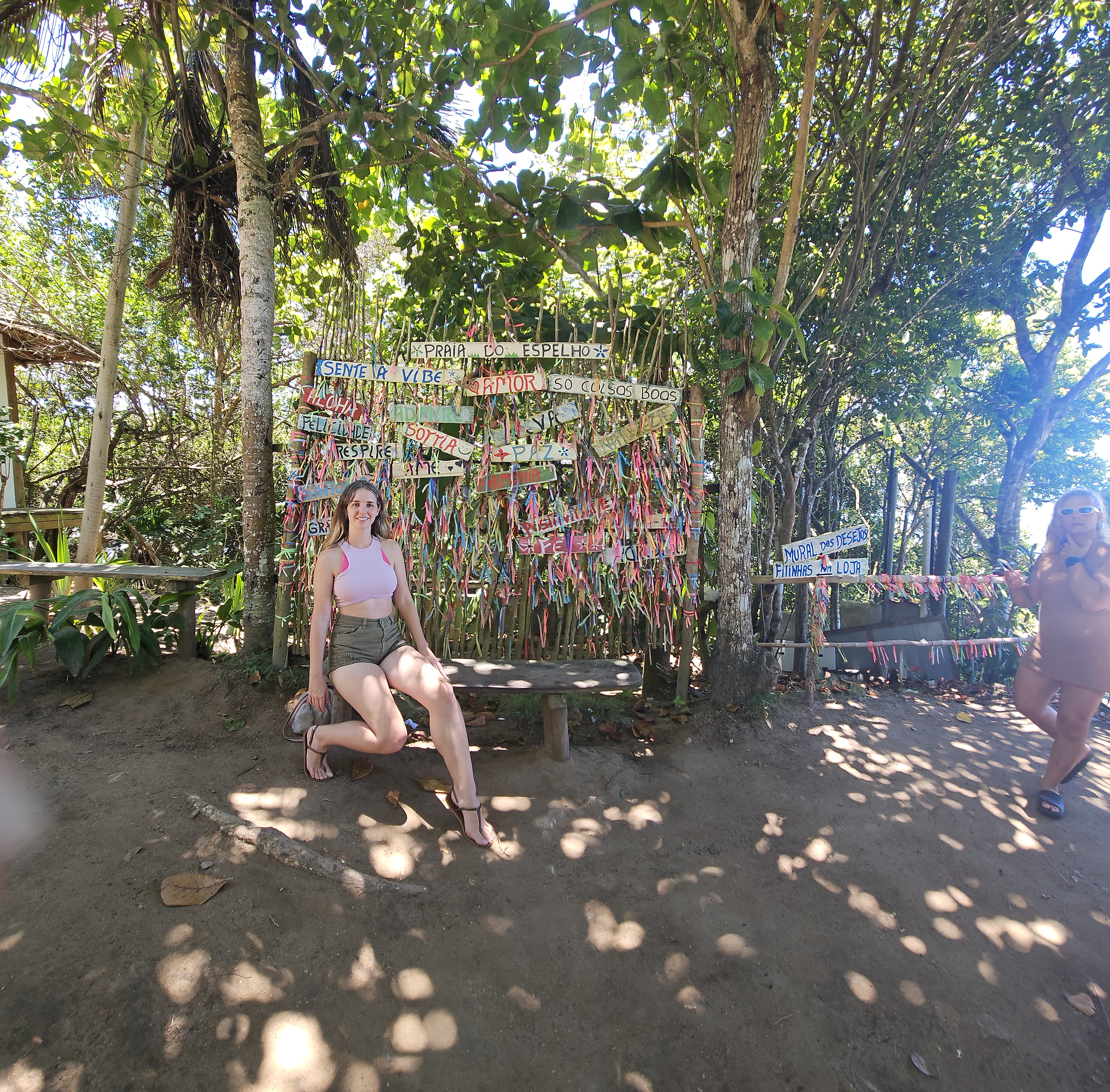
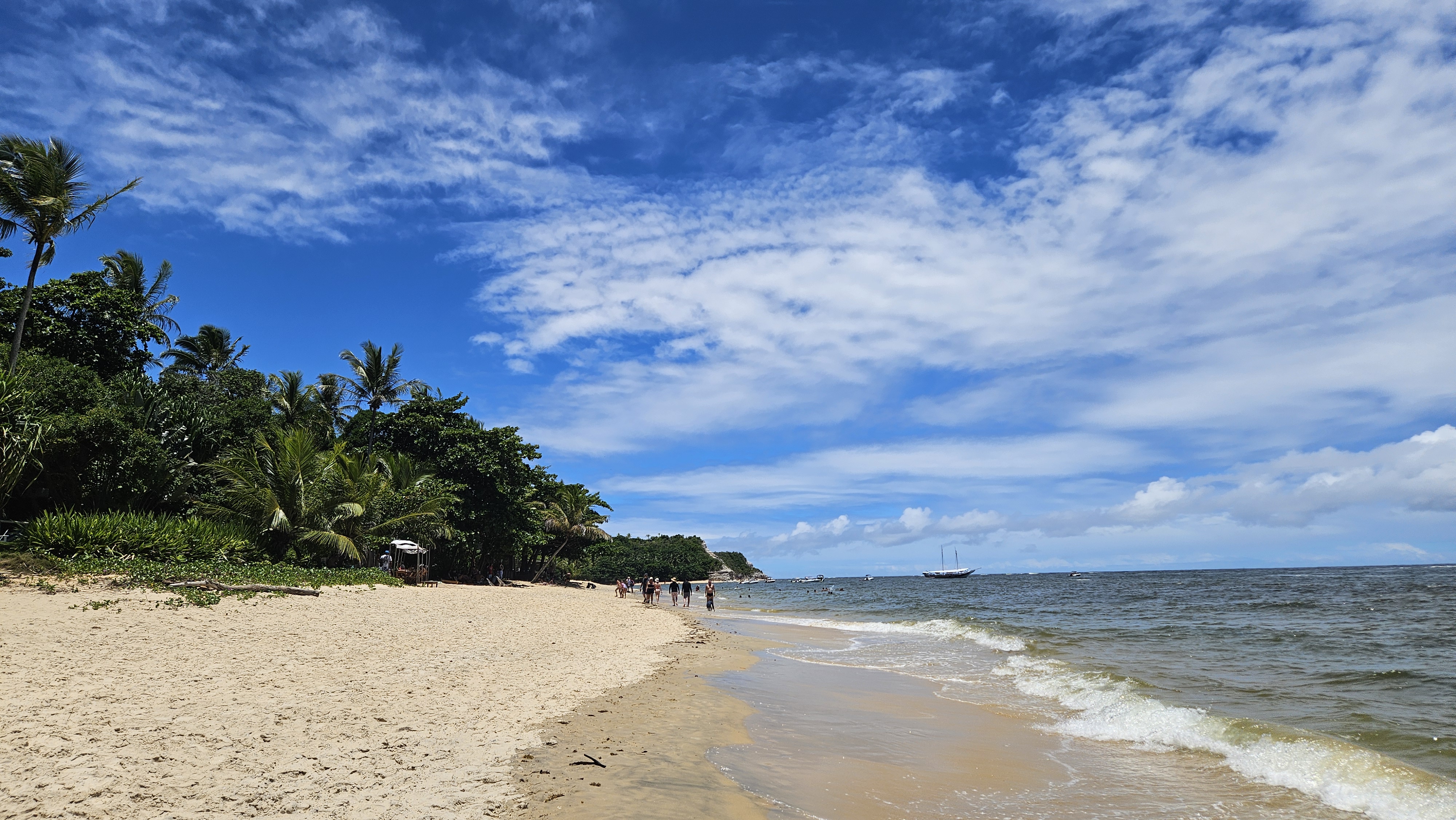
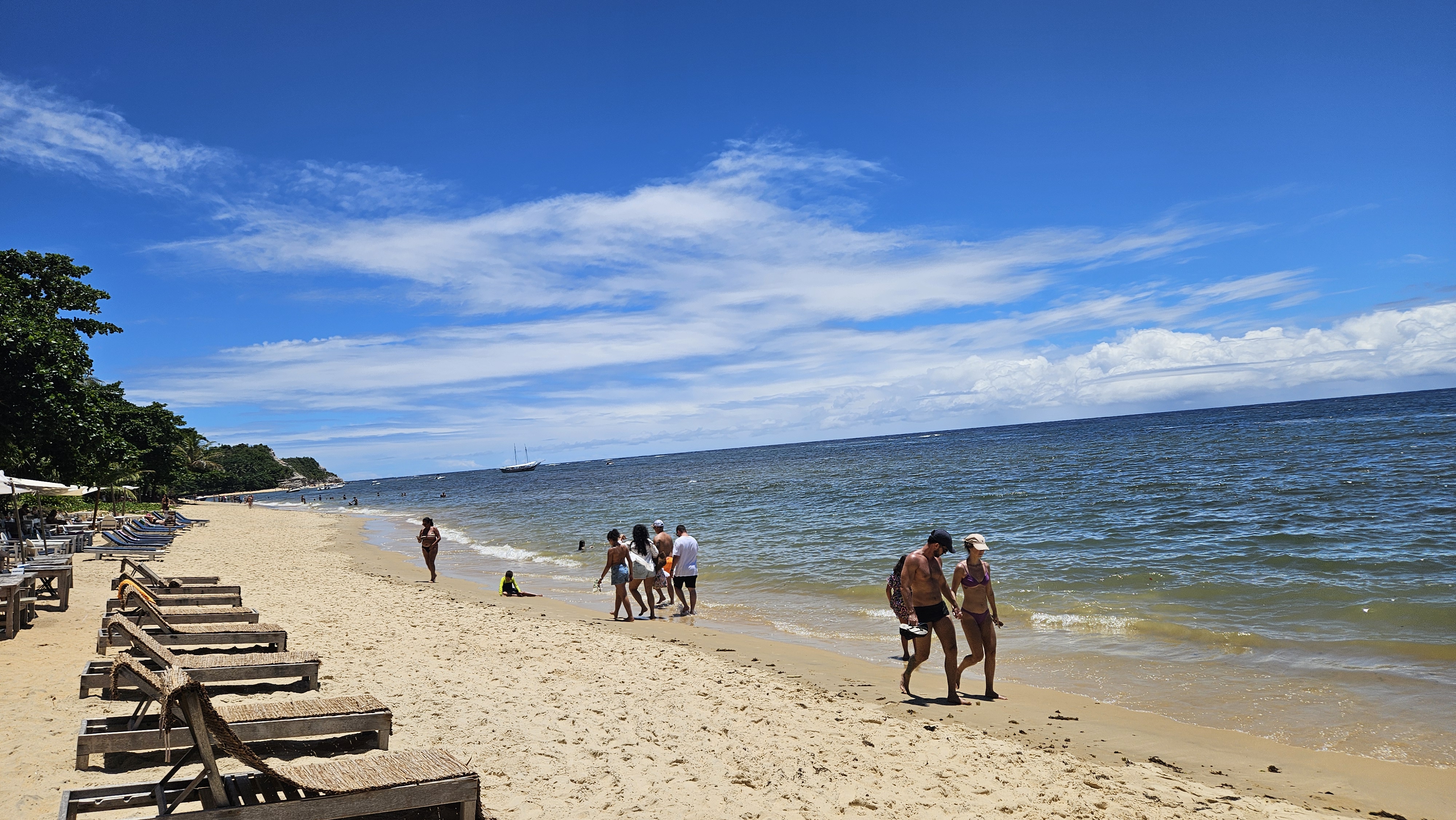
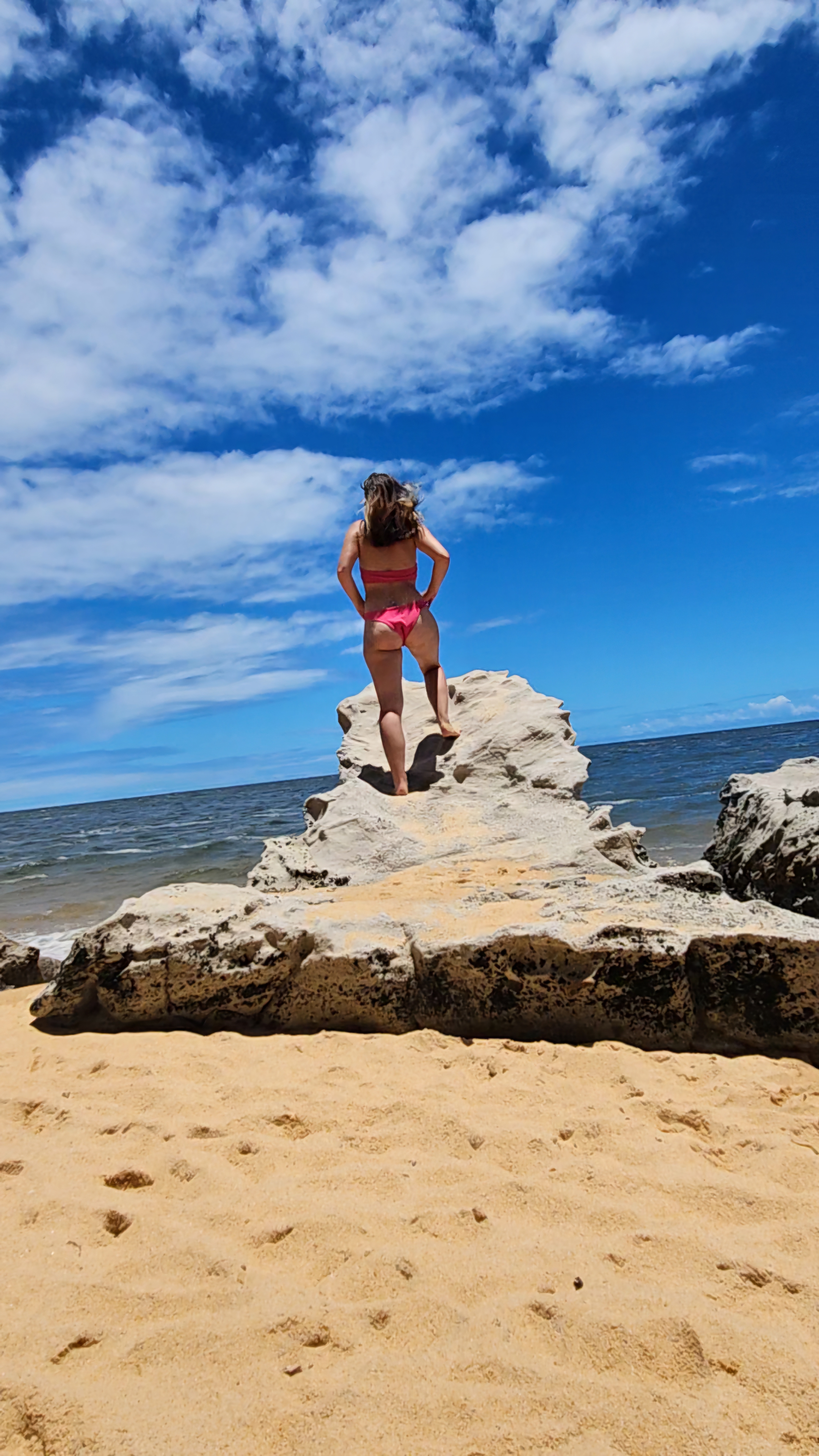
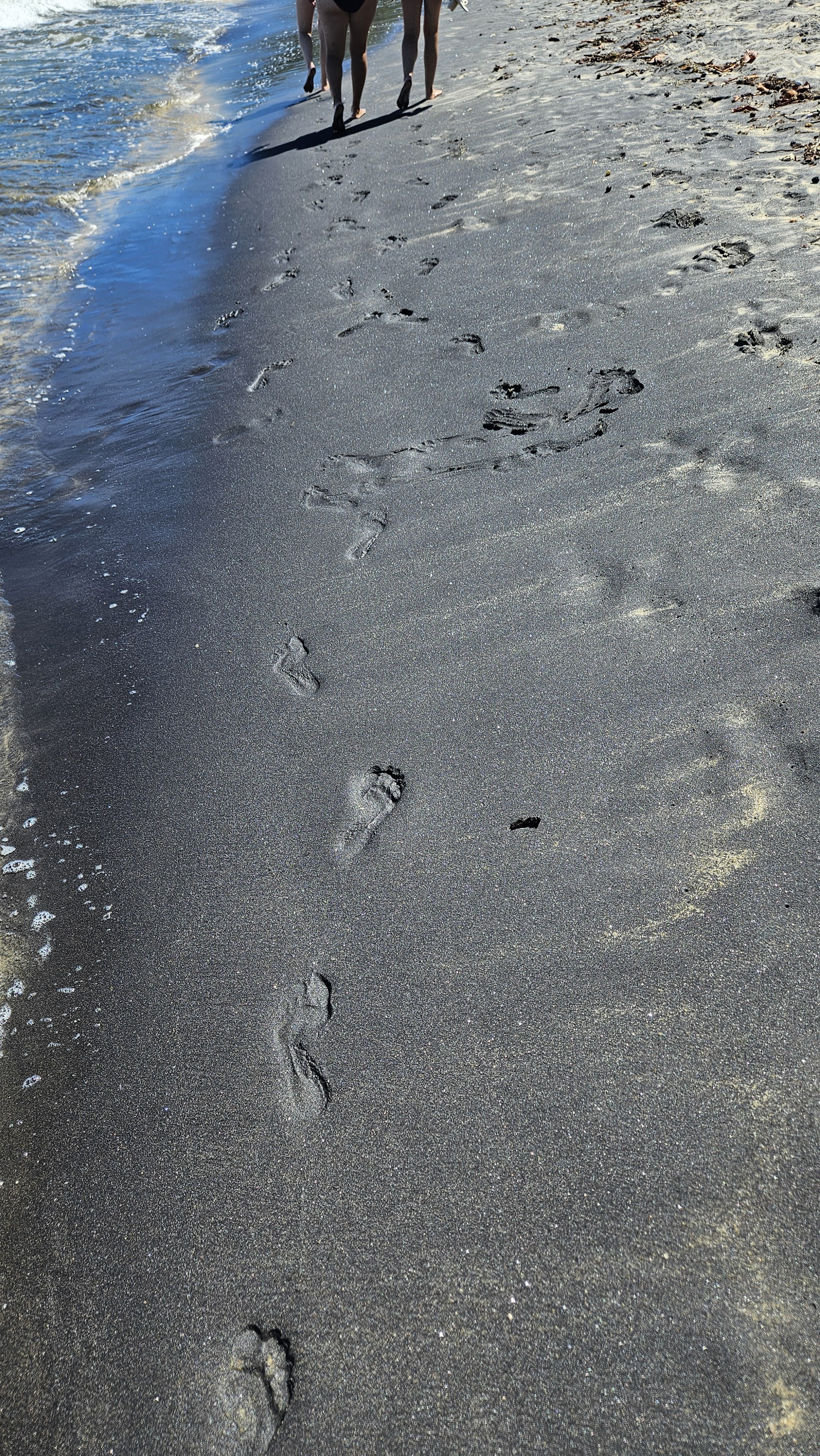
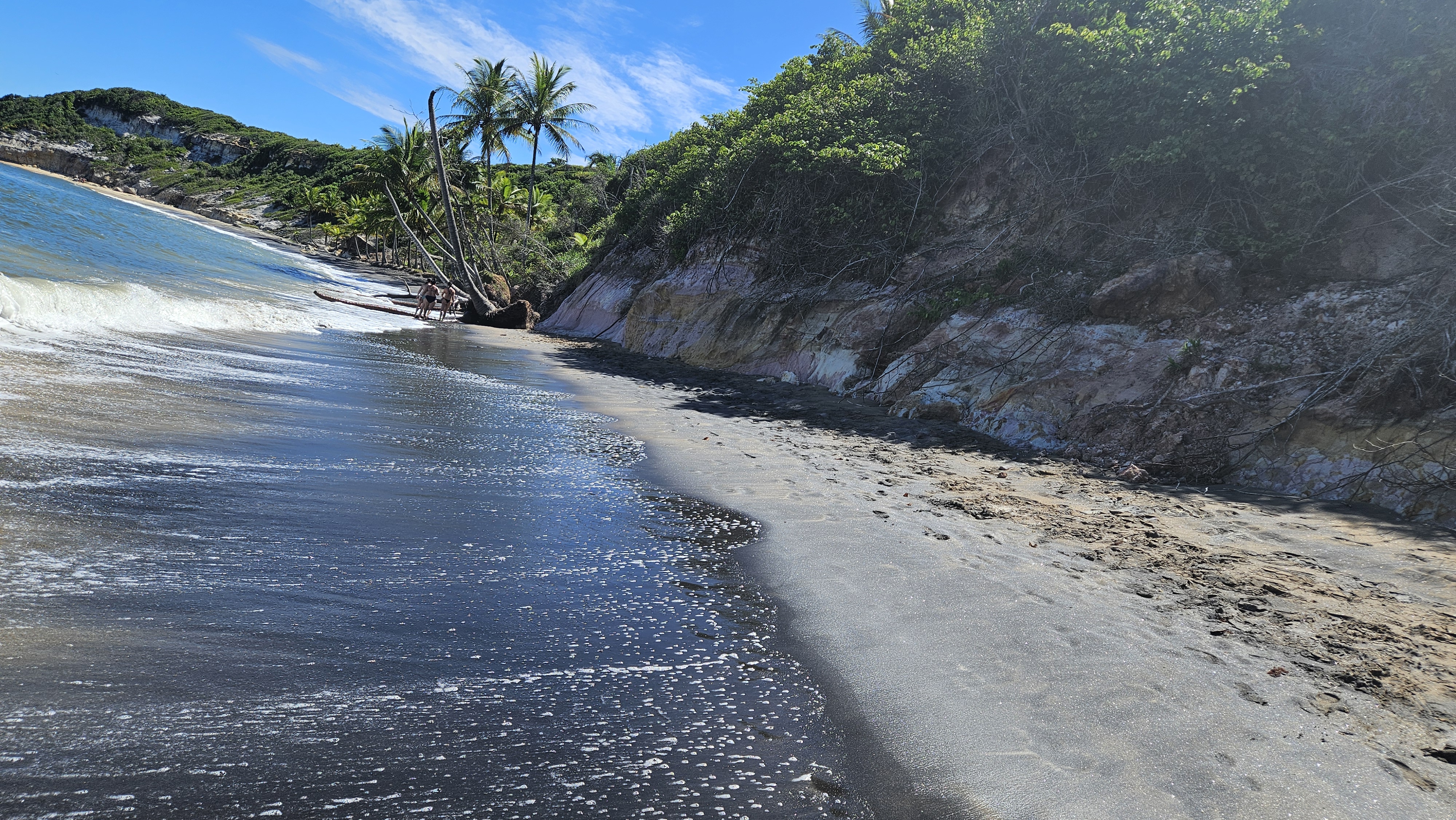
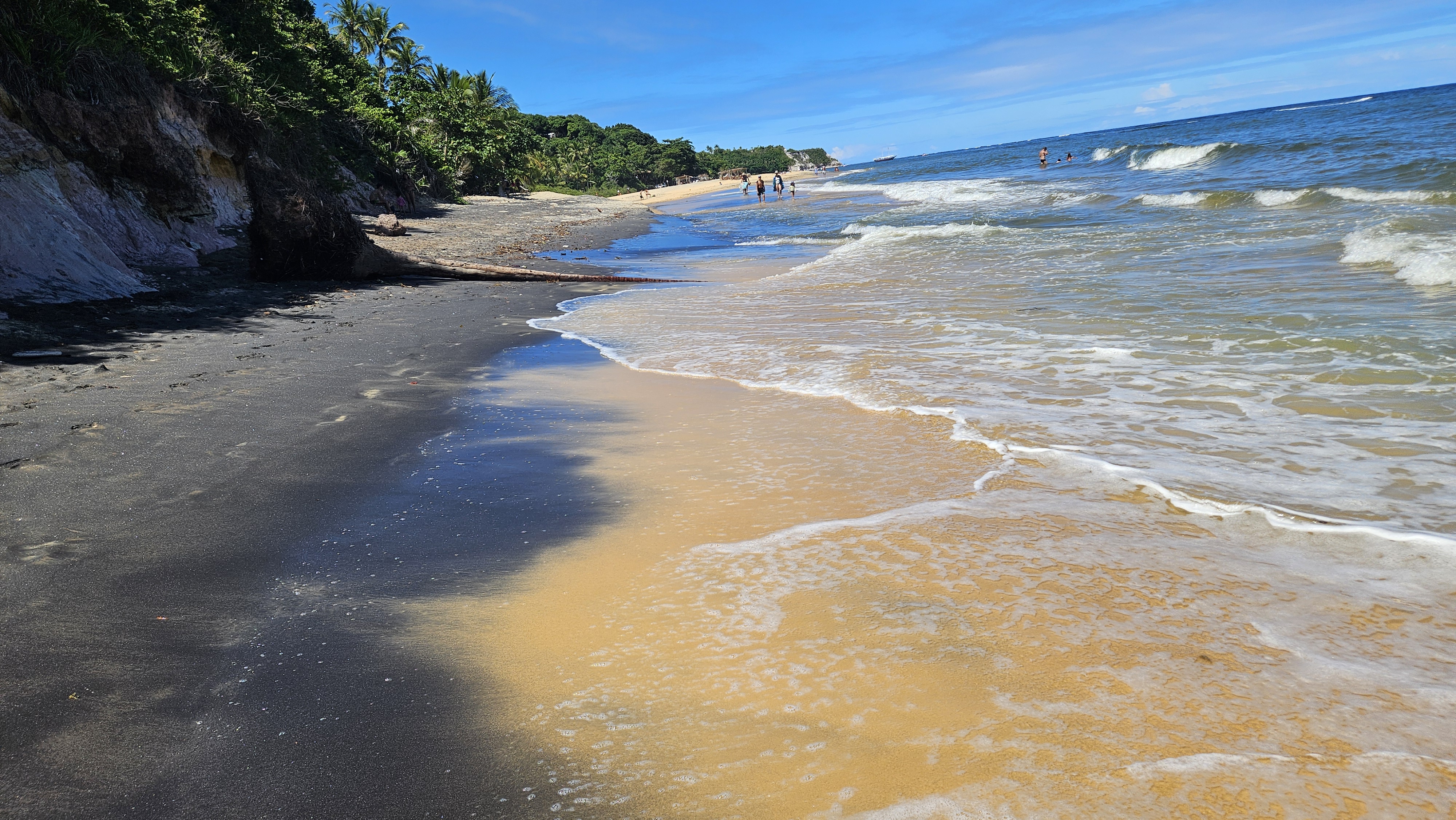
This journal excerpt is taken from week 4 in Brazil, January 25th, 2025. Since I named my blog “adventurer’s diary” I figured, why not post one of my journal entries? Along with some photos taken at this stunning destination.

This entry came 10 days after my time in Salvador. I arrived in Brazil on December 28th after sorting out the over-stay fine with Colombian immigration in Leticia. I took a motocarro to Tabatinga, the Brazilian border town, with my flight ticket bought, ready to go to Manaus. Or so I thought.

My entire time in Brazil, I had issues with GOL Linhas. I would buy a ticket online; they would say it was confirmed. Then I would find out my payment was refunded. With no email notification. Both in Tabatinga and Manaus I ended up having to buy the ticket in the airport. I never did figure out why. Was it due to the security on my credit card (which is supposed to be ideal for travel – come on Aviator Mastercard!)? Or the hold they put on my bigger transactions after a random case of fraud.

Whatever the case, I showed up at the airport thinking I had a flight and found out it was canceled. Lucky for me, there was another flight leaving about an hour after the flight I showed up for. So, it all worked out.

That was to get to Manaus. After attempting and failing to buy my Manaus-Salvador flight ahead of time, I knew what to expect. I made sure to get an airbnb close to the Manaus airport. Then, I went to buy my ticket in person.

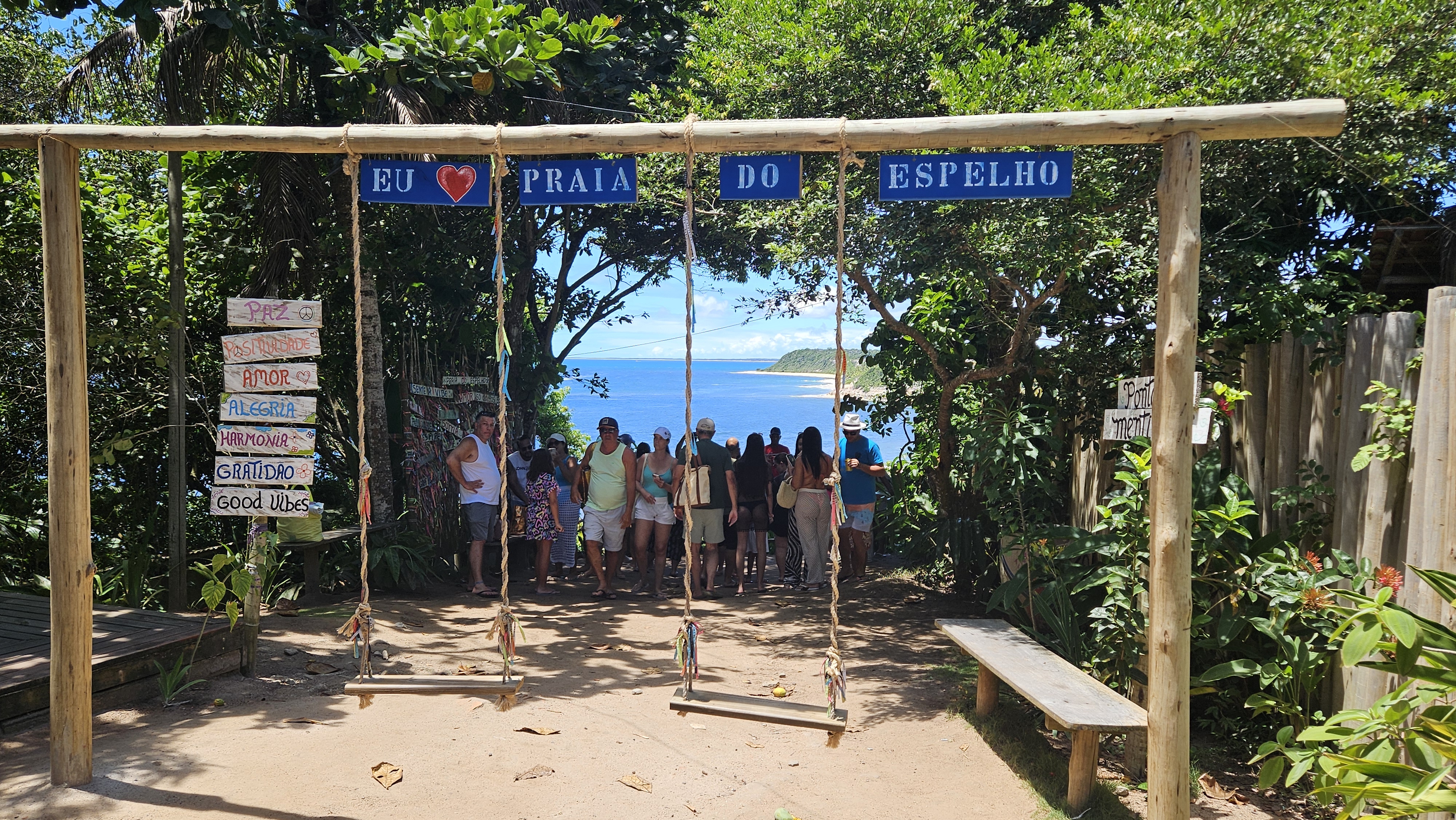
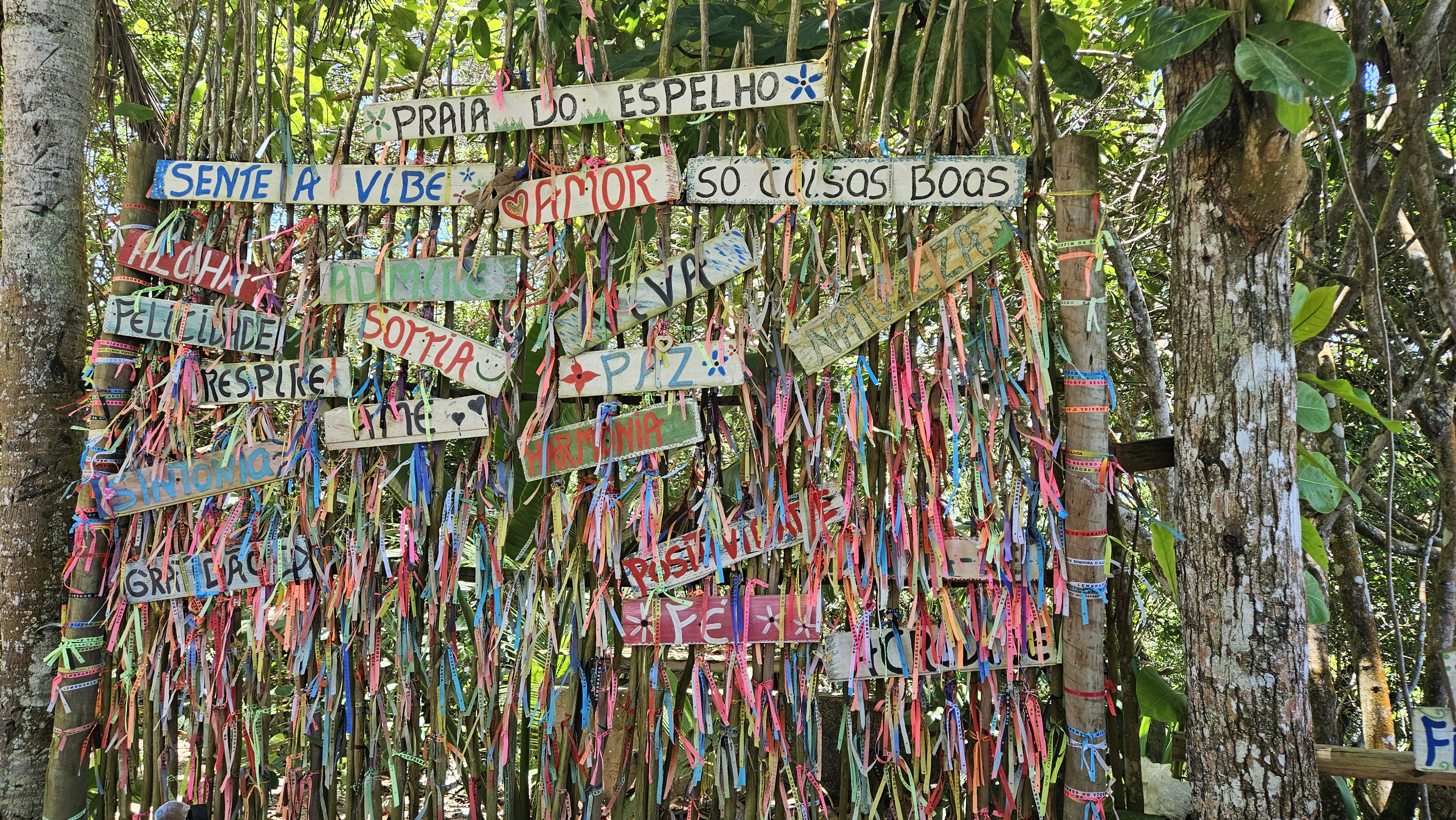
This was just a sample of the setbacks I experienced. By making a plan, I finally could have this transcendent day at the beach – Praia do Espehlo, some 2 hours from where I was staying in Porto Seguro.

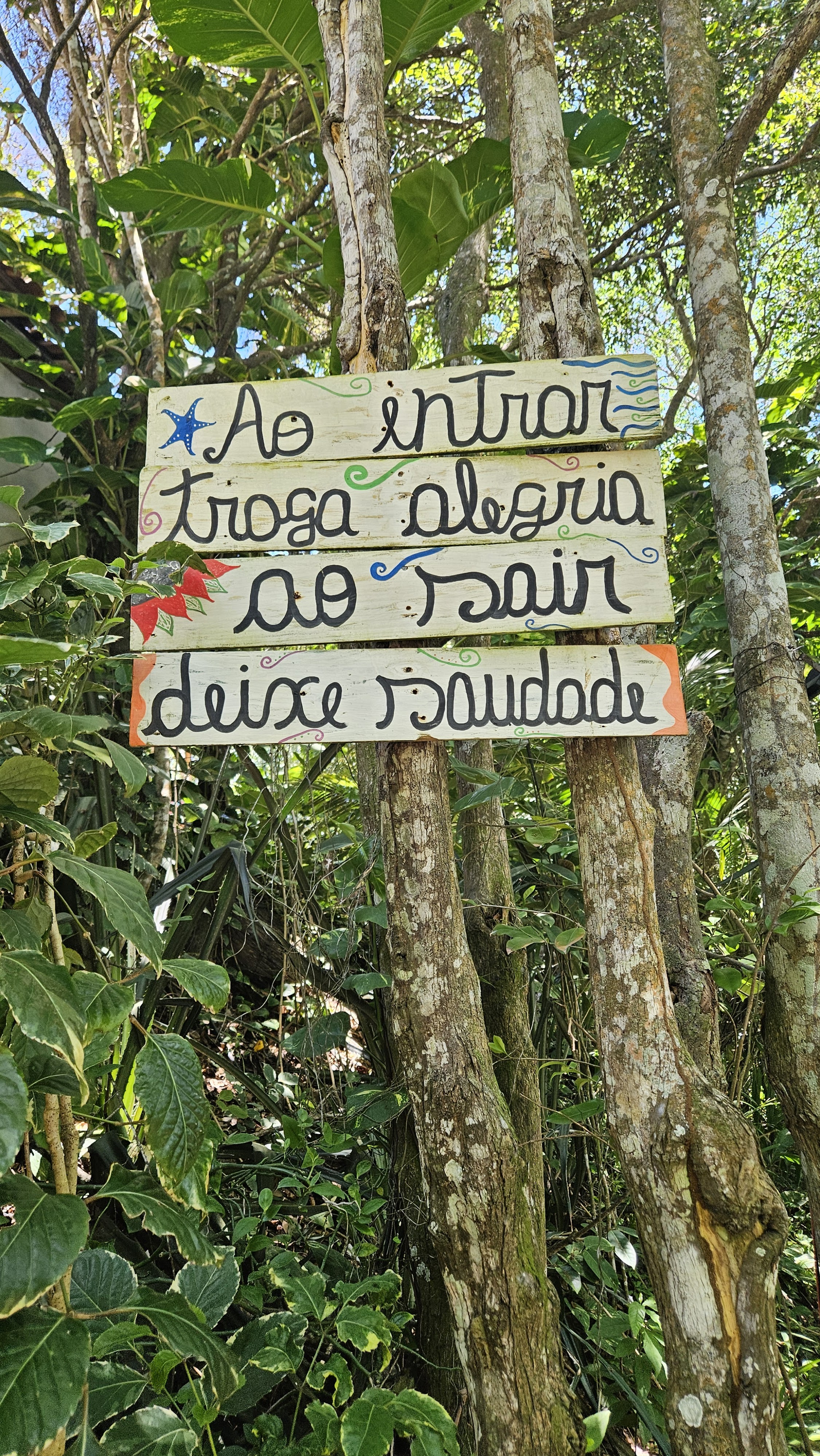
When you enter, bring happiness, when you go, leave yearning.

Here’s a slice of my experience:

I’m at Praia do Espelho with a tour group. The tour cost 120R$ (~21 USD). The ride here on the tour van was bumpy, but I’ve been so tired, I still fell asleep.

It’s hard to describe vibes and generalize my experience with Brazilian people. On one hand, groups I have been haphazardly integrated into have been hit or miss – sometimes coming off as cold or discordant. I guess in those rare cases where I was invited to join close friends, I felt like there was little room for a third wheel. Or maybe I’m not confident enough in Portuguese to break the ice. I could just as well be misjudging the situation based on the little I can see on the surface.

All the same, Brazilians have been some of the most helpful and patient people I’ve encountered. Even on the street. One of the silly little things that has stood out to me after so much time in Colombia is how people actually respect pedestrian crossing. Even in the States that is insanely rare – you’re at a crosswalk, and the drivers stop to signal you to cross. Even bike riders take heed. The sense of awareness of other people and road rules seems stronger here.

What scares me is the intensity of the men. If they find you cute, they shoot their shot at all costs. I’ve gotten three or more new contacts because of this. You have to set boundaries, but I learned that well in Colombia. Been there, done that, could write a book on it. You can’t take all the flattery too seriously because that is typical modus operandi. A thinly veiled tactic to convince you they’re sincere.

But, on the other hand, it’s been nice not being pegged as gringa right off here. Brazilians come in all shapes and sizes. And they’re aware of that. It helps that I also speak Spanish. Still, I try not to default to speaking it. That has made being spontaneous more challenging. But that’s the idea. I’m mainly asked if I’m “Argentina” because most tourism comes from there. After all, it is summer here in the Southern Hemisphere. It’s high season in beach towns (so not great for my wallet). I imagined that but still didn’t prepare. Sometimes you just have to do things, accepting all consequences of your rash decisions.

Brazilian music is fire. You don’t hear Colombian music much or any music in Spanish. And, why would you, I guess? You rarely hear Brazilian music in Colombia. Brazilian’s have such a rich variety of musical styles and rhythms of all types that unless you happen to be in a community where Hispanic people live (mainly of the Venezuelan diaspora), you aren’t likely to hear Vallenato or merengue, or even reggaeton for that matter.

That means full immersion.

I just explored the beach. We got here around 10 am and leave at 3 pm.

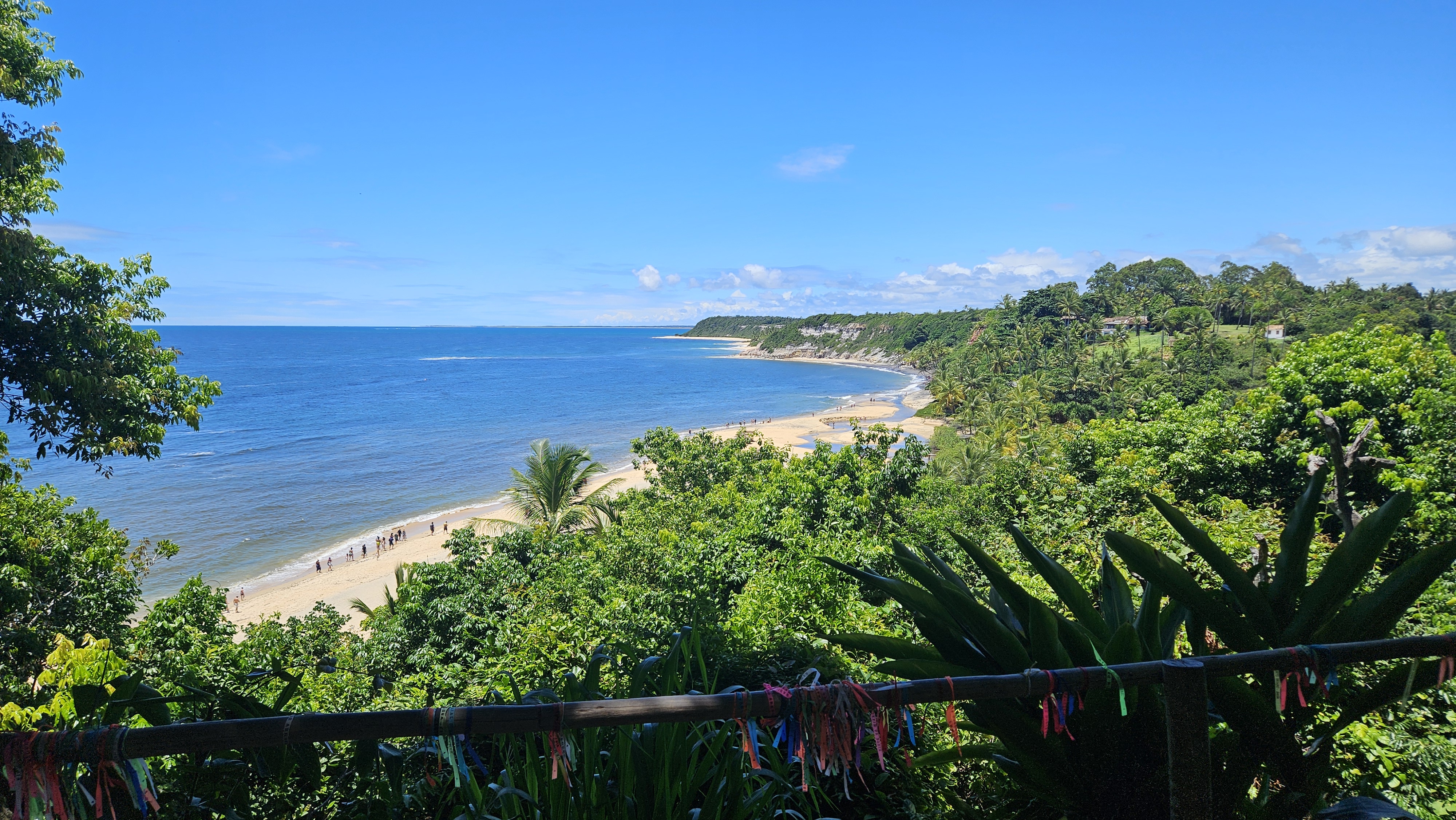
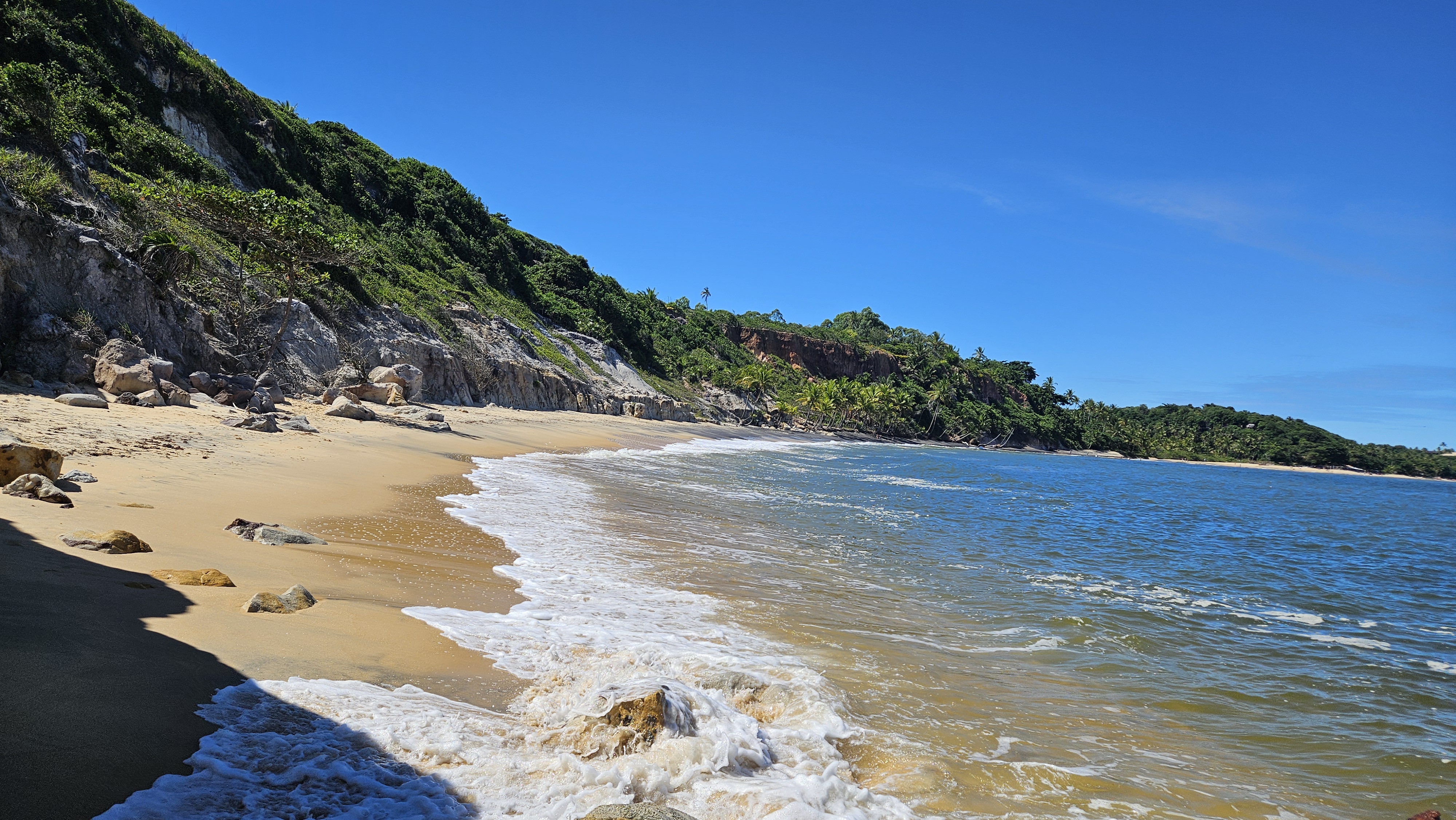
The beaches here are like natural swimming pools: few big waves, soft, fine sand, lukewarm water – cool but not cold enough to shiver. I walked along 4 different small beaches connected to this stretch, sectioned by rocks, cliffs, and reefs. I saw people snorkeling, and I imagined all the colorful fish, coral reefs, and anemones they could see.

I floated on my back, peacefully rocked by steady waves. No rocks under foot in most of the sections. Some are covered by black sand that ripples when you walk on it, others orange, almost red when mixed with the deep blue water; the sand turns black and seems to pulse like something alive when you step on it. In other parts of the beach stretch the sand looked almost tanned ivory, shining in the sun, lending credence to the name: Mirror beach. All of the sand is smooth, inviting when wet, hot from the Brazilian summer sun, but I followed the shoreline to soak my feet as I went.

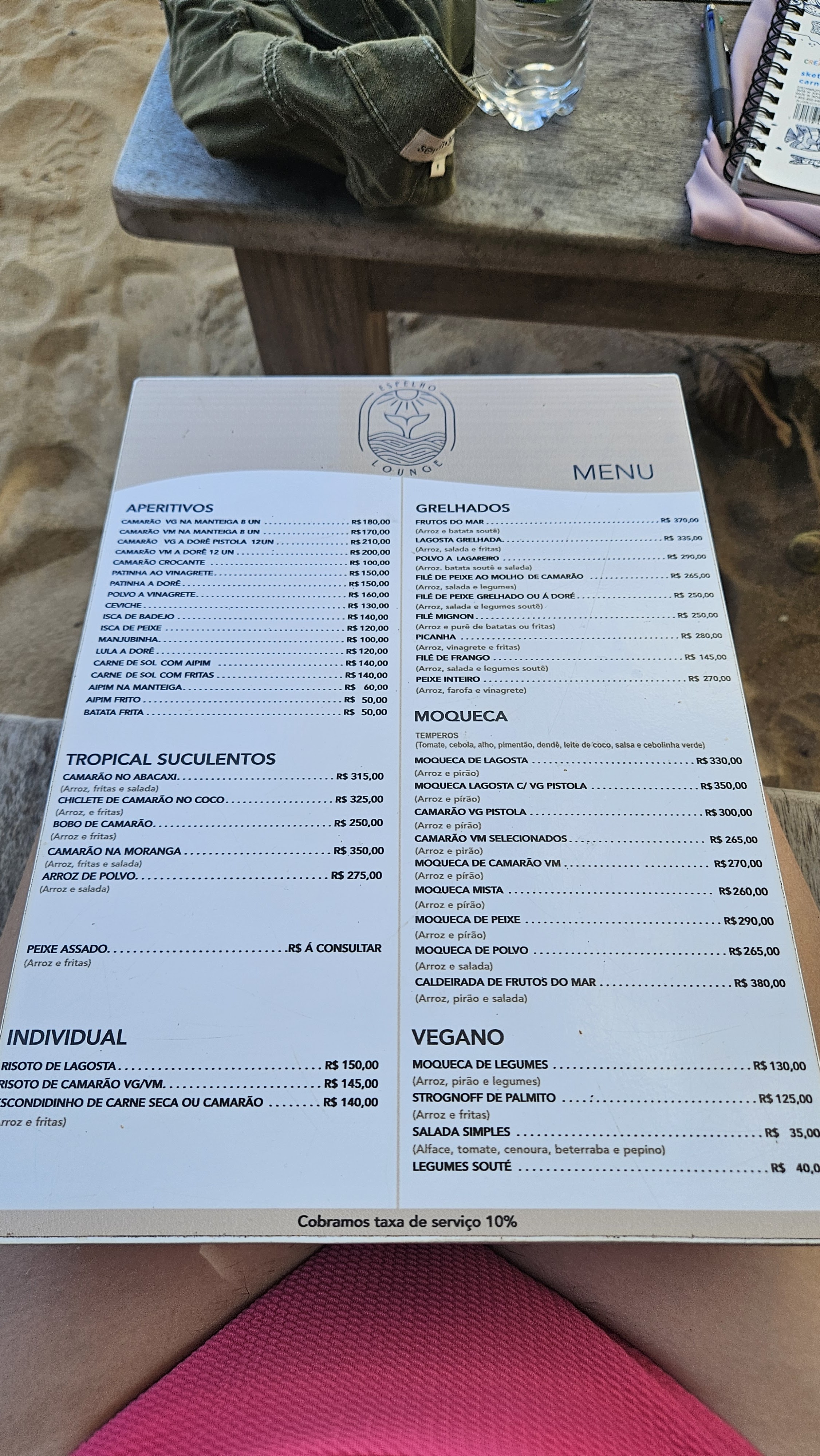
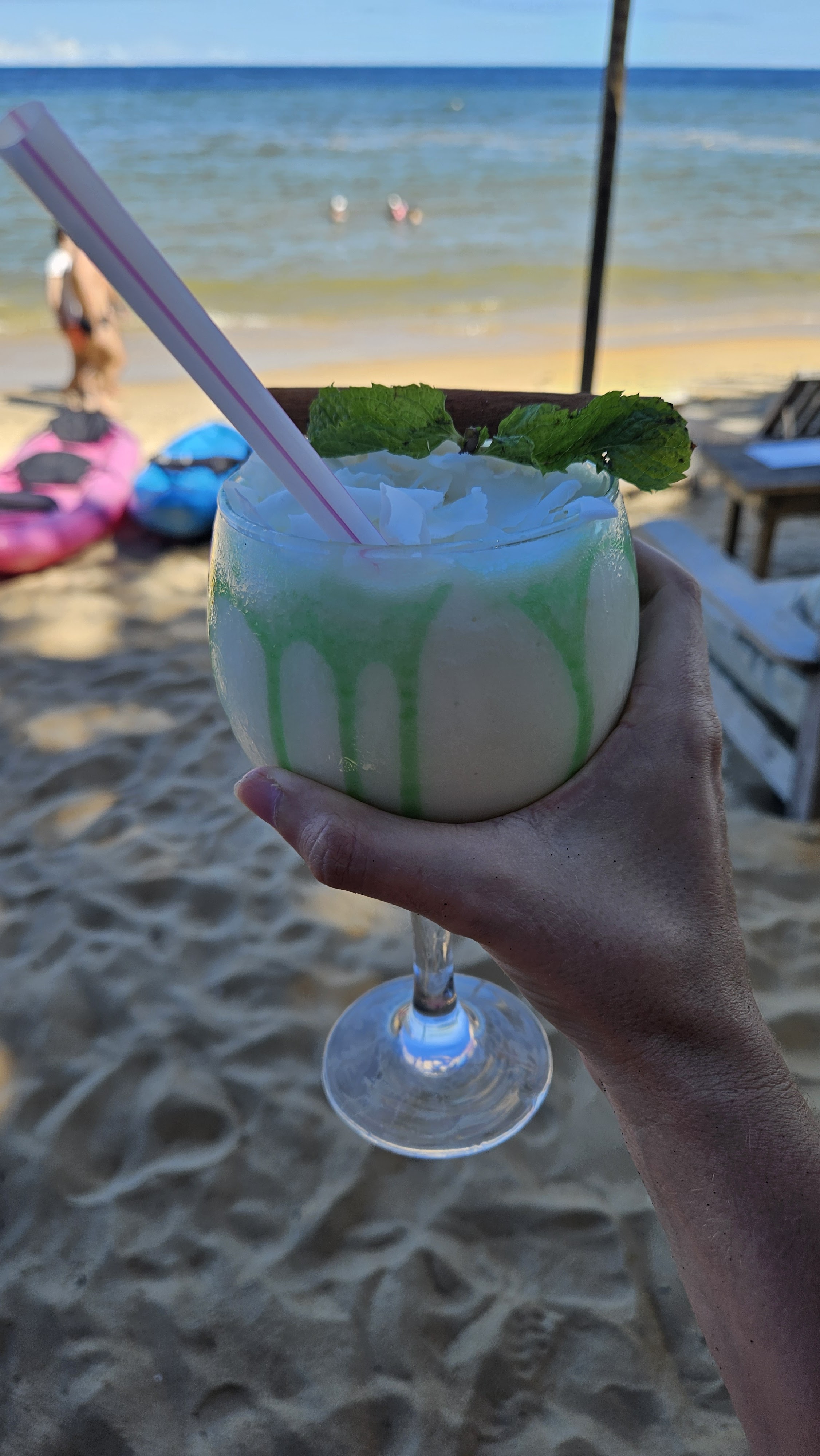
Now I’m listening to a three-man band play what sounds like Brazilian zydeco. They play the same type of accordion popular in Louisiana. There’s a guy playing a triangle, and the accordionist is also the singer. I think I’m in heaven: sipping my obligatory (over-priced) cocktail, a mint-flavored piña colada, taking it all in from my wooden beach chair in front of the ocean under a parasol…

Survival Mode and Learning to Slow Down to Thrive

I wrote this on October 15th, almost a year ago when I was over two months into working at a jungle hostel. The transition from living in a city working at a private school and working and living in the middle of the jungle, in the middle of nature, in the hospitality industry, was not an easy one, as much as I wanted to be there and felt blessed by circumstance. There, I reflected and wrote about my internal struggle with living in survival mode and how hard it is to truly thrive in that state.

I went to walk down the closest stream today with the intention of simply observing and being present – meditating. All day I have been in fawn mode. Our body’s response to being in danger can come in many forms, but we are most familiar with fight or flight. We forget about fawn and freeze. Fawning is when we think we can placate the cause of our extra-alert state and by doing so, be safe from danger (the reason our nervous system is dysregulated). Freezing obviously is when we shut down completely (playing dead) when we can no longer fawn or fight or run away.

In this role I feel constantly stuck between the 4. I have been living in survival mode for so long, my nervous system doesn’t even know how to regulate itself – or rather, the processes it would go through need to be heavily strengthened because as it stands, I am in a state of hypervigilance that doesn’t allow me to function properly. This affects mood and bodily functions, and everything in between.

But the biggest thing I’m finding that it affects is the ability to be present. Without being present, you cannot observe and take in anything around you. An animal being chased by a predator does not stop to notice the ripples in the river or the color of the plants around it or even the scents left by other animals. It compromises this ability to stay alive, and to survive, it only needs to run as quickly as possible without feeling its own exhaustion.

That’s flight, but the same is true when we fight and black out. We might not even remember what set us off or who threw the first punch – this is why we so often misremember events after going through something dramatic or traumatic. We act on instinct, and that instinct could be to hit back.

It might equally be to fawn. No one is threatening my livelihood, but I fear being hated by my bosses and coworkers, making a bad impression on customers, and so on, and since these things rely on my disposition and the way other people perceive me. So, in this state the urge is to perform behaviors that will keep the perceived threatening party happy. The worst thing for me about being stuck here is that I can vacillate to fight because I am aware that this job is not a big deal. I am so grateful for the experience, which can lead to me being fearful of doing something wrong and losing it, but in reality, I am free, and my livelihood is not relying whatsoever on me working here. And I know that.

Sometimes though, we just freeze. For me it feels like my head is full of cement. It’s trying to move and form thoughts, phrases, actions, but it’s like pushing a boulder through pudding. Sometimes nothing makes sense to me. I can’t even breathe, think, take a moment to connect with my body and my surroundings.

That’s when it hit me. The water in that stream is full of ripples, forming little waves. Those ripples are caused by the movement of tons of tiny, small fish and insects and living things living in the stream, pushing against the waters. And that is every person and circumstance, moving through a stream we cannot control, hitting obstacles, running into other people and their feelings and their consciousness and not being able to see what causes those ripples. We can only see it if we slow down. We can only see the cause of the movements around us if we are present, observing, noticing. This has been coming up in my meditations a lot, the reason being still can be so essential to meditation. The need to connect.

The need to acknowledge other forms of consciousness and life. Living matter all must have some level of conscious awareness, even if it is not able to manifest itself. The living matter is full of energy that changes forms without being destroyed.

I would not notice this if I didn’t choose to slow down, stop, observe. I cannot notice anything in survival mode.

This thought led to another of my theories. Our bodies and our biology have a reason and a purpose molded by all of the thousands of years of evolution and changes we’ve faced as living things on this Earth. At one time, our survival depended as much on observing as it did on fighting or any of the other instinctual behaviors. Well, observing can be instinctual as well. It has also served us to thrive as living beings. And with our lives today, our threats have been misplaced to mundane situations related to our source of livelihood: money, jobs. For that reason, we cannot tell the difference between a true threat and something that simply feels uncomfortable.

Furthermore, we spend so much of our day passively engaging with technology. I realized that the energy in my body must be channeled in an active way. Otherwise, it could only be fueling my anxiety – the cortisol levels are not divorced from eons of evolution. We feel stress because we were wired to some extent to move. To use our consciousness to think, analyze, and observe. To use our bodies to walk, run, be useful, be active. And yet so much of our time is dedicated to sitting and staring at a screen and reacting to other people’s actions and thoughts and possibly expressing our own but in limited and formulaic ways. This can’t be serving the purpose we human beings have, our needs as complex beings to move both mentally and physically and act.

These reflections came to me sitting on a mossy rock in the middle of the jungle, watching the stream, observing mushrooms growing on a log. Something this mundane is still crucial for us to reach our full potential as living things. A leaf has as much purpose as we do – it grows to feed its tree; it dies to feed other living things and to nourish the soil. And the cycle continues. 

Thinking about life in this way is hugely comforting to me. It reminds me I can find the motivation I need to fulfill my own purpose as a living being, no matter how small and insignificant it may seem. But I must use all the tools available to me as a human: my mind connected to my body and the environment that surrounds me.

Culture Shock: Safety and Violence

Imagine.

You and your significant other have just arrived to a new city. A small city. Practically a town. Safe. Inviting.

So you were told.

The city is surrounded by countryside, farmland, the Sierra Nevada mountain range marking the beautiful view to the North, greenery and small towns to the South going towards other departments. Sure, the border of Venezuela is not so far away, along with an endless stream of refugees, the young and the old, the tired and the desperate. They fill out the city streets and contribute to the population growth, but the unrest of Venezuela is not the issue here, and much less its people. None of this came with the brochure anyway.

You walk down the river, the small city’s main attraction. Around you the shouts and squeals of children and their families fill the air. On the corner just several meters away is the police station. You feel light as the breeze that pushes you towards the river’s waters, your hand cradled by that of your significant other.

An illusion. Shattered when your partner suddenly freezes. You feel the grip tighten on your hand then release as they turn. There’s something there, something you can’t see as you look back at them. You can’t see past the flash of shock on their face. You scream.

There’s a knife at their back. A lanky local looks at you both, your partner a tall foreigner that would stand out anywhere in this town (you hadn’t been told that was a problem though). The look on the assailant’s gaunt face grinds into your brain. He looks hungry–

He demands you both give him your cellphone, whatever you have. At first, you scream for help. You want to refuse. You want to fight back. Where are the police?

But nobody looks at you. You scream for the police, and you know you saw them in their green costumes and badges, but none of them appear now. The families, the children, everything around you keeps moving while the three of you are frozen in time and space.

You hand over your phone. Your partner does as well. There’s no use giving in. The risks are too high, and now it’s clear that nobody is interested in helping you. The thief stalks back to his motorcycle and disappears, never to be known or confronted, at least not here.

This is a reality all too common in Valledupar, Cesar, Colombia. This exact story was told to me by my coworker. She isn’t even a foreigner, but a Colombian that was born and raised in Bogota, the capital of Colombia. She now feels safest avoiding the streets, avoiding being exposed, double checking taxi license plates – and nobody would blame her.

She had never been warned about Valledupar’s high crime rates – especially this particular scenario where petty criminals will assault you on the street. She – and even I personally – would have never expected to be robbed in broad daylight. With witnesses and the police nearby.

When she went with her boyfriend to file the report, the attitude was glibly indifferent. She tried to tell them about the attacker, get them on the case as soon as possible – she was given the wrong address to a different station to file her report. She learned very quickly that the law here was corrupted, present but flimsy and crooked.

I’ve seen it myself. Of course, I wasn’t robbed in a situation where you would never expect to be assaulted in a million lifetimes or universes. I’ve been assaulted twice in my 3 years living in Valledupar. Both times, I remember feeling angry and humiliated, more than anything else. More than fear even. Both times were nocturnal: the first I was with an ex, and it was like a Series of Unfortunate Events. I just happened to have left my key inside. The elderly woman I lived with was taking lightyears to come down the stairs, it was midnight on a Friday, and the house I was living at the time had no fence (I’ve learned how practical those are in pretty much all neighborhoods here). Being so close to safety, I wanted to fight back, but there were two, my ex was between me and them, and they acted like they were armed (I had my doubts), and later I found out a third guy was somewhere near by. So he gave up his phone. I gave up my purse which luckily didn’t have much, just my id, a little money, a debit card (I quickly canceled), and the purse itself which was a gift (and I hated parting with it). But I had been instructed to throw it over, the old lady nearly had a heart attack coming down to open the door, and that was all we could do. The attackers fled once they had what they wanted.

The second time was equally infuriating for me. I was alone, taking a route I had walked so many times when going home from the gym. I always walked even though my gym was several blocks away in a nearby neighborhood. I happened to be going down a dimly lit, narrow street (stereotypical, you can see it coming) and motorcycle came up along side asking for directions. He was asking for a nearby park which I thought was strange – must not be from here – I thought but kept walking. When I thought he had turned to go, he quickly turned his moto around and grabbed my purse strap from behind.

I learned a very important lesson in both experiences: don’t go out with a purse (at the very least, not a noticeable one) and be careful not to be in a dark or lonely place for too long at night. Common sense, but I’d done this so many times, my guard was dropped. I wasn’t alone the first time, but that didn’t matter – it was still late, I still had my purse, there wasn’t much we could do, only the old lady witnessed it.

Getting robbed in this city is like a rite of passage. They even have an annoying expression in Colombia: no des papaya (don’t give…papaya? like don’t give it away?). Basically it’s a victim blaming phrase saying you shouldn’t make it easy for people to steal from you. Always keep your guard up. Don’t leave things unattended. Don’t walk around at night with a purse. Basic things if you’re Vallenato or Colombian – but especially if you’re from this part of Colombia. As I’ve stated and restated, Colombia is such a diverse country.

Security is not as big of an issue everywhere. In fact, many parts of Colombia are far less corrupt than the Northern part where I live – it depends on the local power because even though this is a central country, and while laws are stable, how much they are enforced is NOT. Plus, as I mentioned with the influx of refugees (who are often scapegoated and blamed for these safety problems), there is a lot of disorganization. No institutions really settle how these fluxes should be handled. The police are definitely visible, but I’ve never felt helped or protected by them.

My second time being robbed, I took off knowing that I was close to a park. I shouted to a man what happened – he didn’t react. Typical. But once I got to the park I found some police patrolling. I knew they would be, or at least a vigilante (neighborhood watch security guard). I told them what happened, spirits high, attempting to describe as best I could. Reports were made on walkie talkies, an officer was sent out to look, but ultimately no followup was given. I gave my number to an officer for the report, and all I got in response were flirtatious text messages where he was attempting to engage me in English.

Utter. Bullshit.

But you need to be prepared if you’re planning to work in Latin America. Talk to people that work where you are planning to go ahead of time. Do some research – but avoid the touristy aspects. This is the part schools seem to love to play up. After all, in more isolated places, they are just trying to get a teacher to be interested and sign on. They need it, but they don’t think about their future employees needs and concerns about safety.

Police brutality and negligence is an issue I’d like to explore further in future posts, as it’s also related to the Paro Nacional (national protests/strike) which was particularly strong in November and December. I’ll go into that in a future post, but suffice it to say, as an American, it’s not as shocking to see police corruption and opportunism.

What’s shocking is the lack of information, the lack of preparation. You learn to keep your wits about you. I’m not afraid to walk alone at night, but I know better than to do so with my cellphone on me or a purse, particularly on a dark or quiet street. In pretty much any location my spidey sense starts to tingle in those places and I get out immediately, even if it means doing some light jogging. I guess I can thank 3 years in Colombia for my street smarts, along with living alone in LA for almost a year. Comes with the territory.

So I implore any reader not to be afraid to go to another country – and certainly not alone – it’s always worth it. But know what you’re up against. Do your research. Follow your instincts and be prepared to think ahead, even if you’ve been guaranteed safety, and especially if it sounds too good to be true.

Image result for dando papaya

Summarizing a Decade: 2010-2020

I want to open this entry with some food for thought: writing is a spontaneous process, guided and crafted, edited and poked at, but at the end of the day, for me, it is best done as a spontaneous, passion-filled, heat-of-the-moment endeavor. My best writing comes at my best moments. I never really know when those moments will strike. So I will try to write more in the hopes of having more of those “Aha!” moments.

My friend’s mother gave me the best spark to the meager kindling of my inspiration on New Years Eve. We were discussing, as many have, how this 2020 is the beginning of a new decade. How crazy is that! We both were meandering along the paths our lives had taken during this decade, and how with this new one, we were granted more new paths, more new journeys and lessons. In a sudden “aha” moment burst, I told her that 2010 had been for me my first full 10 years as an adult. And what a strange concept being an adult is. But it was true. She looked at me, a long look, the type you know will be followed by something you’d better take note of, and told me I should write it down, reflect on what these 10 years have meant to me, how I have grown, where I have been. And how that might show me well where I can go in the new decade.

And, as you can guess, I am heeding her advice.

Being an adult is no small thing although in the US we make it as simple as having a car and moving out of your parents’ house. In the past, passing from a child to an adult was a huge deal, communal rites of passages established in every culture and religion. We still celebrate many of these landmark moments: graduations, confirmations (if you’re Catholic), marriage (in many cultures, the first time you are made to leave your family home), and more. The age marker shifts depending on these cultures and traditions, just as what it means to be an adult can shift.

How did I know I had been an adult in 2010 for the first time in my life? Well, yes, some of it is obvious. I moved out officially, although I already lived and studied outside of my home from the age of 16. But still, once I graduated from high school and moved to New Orleans for college, it became a ritual to only visit home about twice a year. And it’s been like that ever since. I have not once lived in my house since the summer following my graduation in 2010.

Responsibility is also a common thread. We joke about it when we proclaim we are “adulting” just for getting out of bed, having some caffeine, working most days, cleaning our house, paying bills, etc. Being autonomous beings in a Capitalist society, basically, where our biggest concerns are first HOW and then WHAT we will eat, HOW and WHERE we will sleep, and HOW we will provide for ourselves to shape our present and maybe, just maybe, our future. These are things that as “real” adults we have nobody there chiding us and telling us when to go to bed or how much money to spend or save or even forcing us to go to work. Our choices become autonomously OUR OWN once we are Adults. And now I had this role, well I had for a while, but now bills and jobs were also included in the picture. Of course it became even more “real” once I graduated college, but that can just be added to the list of milestones marking this decade of First-time Adulthood.

When discussing the decade, my friend’s mother (being in a much more advanced stage of life) mentioned that hers was defined by loss. Loved ones and friends passing away, in greater and greater number. I, too, felt this shift during my 2010’s. For the first time, I began to lose people I had cared about and known since I was a child. When I moved to California after graduating from UNO, I was hit by two very large losses: the death of my paternal grandpa and two close elderly neighborhood friends. It was at the middle of the decade, 2015, when I realized that I had made a very tough choice. Even though moving away was the dream I had fed and pursued since I was young, I had no idea how hard it would be to have to hear over the phone or read a message stating that someone that I had loved and felt eternal had passed away. Death really does exist in a paperweight – it is a part of life, one nobody escapes. It is a season, and as seasons go, we will experience our times of abundance and our times of loss.

I was lucky, however, looking beyond those I lost, to experience an abundance of love in the form of new friendships, new journeys, and new opportunities. With time, these experiences brought confidence, something which has not been entirely stable for me by any means, but has completely shifted the way I view myself, others, and generally the world around me.

I lived as a nomad, or so I believed. Almost 5 years in New Orleans. Graduated. On to almost 3 years in California. And now 3 years in Colombia.  Three very different places. Each place has marked me, just as the tattoo I have marks my chest. The symbol is important to me – the heart, guiding and guided by travel. Why did I end up in California? Well, I fell in love while I was studying in New Orleans. Many times I fell in love during my first decade as an adult. Many times I was made to say good bye and let go of people, realizing that perhaps I loved something more than the person, but the concept of a perfect existence in harmony with someone else. In truth, only the universe knows what’s in store, and so I guess I’ll keep wandering, although I’m not anywhere the nomad I like to think I am.

Comfort. Economic stability. Struggles. Transition. All of this marked the second half of the past 10 years. I had moments where I felt perfectly content, and yet still anxious because I wasn’t completely doing things on my own. I still needed help. Being autonomous does not mean you stop relying on others. We all are in this web of interconnection and interdependence from the very beginning – there’s no escaping it. Sometimes I made choices simply out of necessity, living with people because I feared I could not afford to live alone, or taking jobs (or extra jobs) to keep myself afloat. I’ve been lucky to reach a point where I have no imperative to do either – I can finally be a self-sustaining individual. But that comes from years of sacrifice, saving, and biting the bullet when asking for help.

I thought moving away would magically give me a complete detachment from my family and the humble, somewhat embarrassing place I come from. It does not. In fact, becoming a full adult has made it sink in even deeper that we must embrace ourselves for what we are, and that means accepting our roots. It also means making peace with them and the people that brought us up, as flawed and problematic as they may be.

In these ten years, I broke ties with people I thought I loved, and I mended and forged ties I never thought possible with the people that watched me grow. I spent Christmas with my family this year, and I couldn’t help marveling at how at peace I felt being at home with them. I wasn’t running from the reality of things. The illnesses, the financial struggles, the religious tension – it’s all there, but as an adult, I’ve been able to forgive the scars given when I was too young to understand them and fully understand why these things had happened. It was not an overnight process. It wasn’t some lifetime hallmark experience where one holiday we finally all came together and put our differences aside – no. This took years of healing, years of talking and not talking. But in the end, somehow, throughout all of the turbulence that was my 2010’s, I found peace. I was able to let go of all of that bitterness and just forgive and accept the things that had happened.

No small part of that was realizing that I didn’t need to let myself be ruled by those negative feelings. Therapy helped me become stronger during this decade, and I hope it continues to do so whenever I need it. Friendly reminders that we are all humans living on a rock floating in this infinite galaxy just trying to do basic things like survive and be happy – and all of the complications our expectations can put on that and stress us out.

In this decade, I found stoicism and meditation. I found family with new friends in different places. I found commonalities in things that seem oh so very different at first glance. I learned how to listen more and react less.

Most importantly, I am still learning and will continue to learn in 2020. I never intend to stop learning. I think I may have even finally found my calling, or the “Next Phase” in the plan. I always like the feeling of having a plan, something I can coordinate and follow when my internal chaos seems too much.

Yes, I was shattered many times. I suffered in relationships that I chose and chained myself to. I became a victim, the thing I detested most, just to “save” someone else (I guess that would be a martyr, right?). And I realized that true love really does start within oneself, within one’s friendships and the ties that bind beyond romanticism and physical and chemical urges. Love, as a concept, is so much more than anything we give because we feel we must in order to be loved. I began to learn at several points of love’s infiniteness. And I continue to walk that path and realize it’s okay to walk it alone at times, to walk it sure of one’s own steps, without diving in and getting lost in the murky waters of another person’s ego.

I survived this decade as someone who honestly didn’t want to survive sometimes. A person paralyzed by fear, yet willing to travel to another country and try something different. A person believing herself insignificant and flawed, yet willing to make mistakes in order to learn. The 2010’s may have been my rite of passage, my baptism by fire. And the truth is, I am and will always be the same person with a few new ideas and experiences and traumas to carry along with me.

But at the heart of this is growth. Growth and change, not fearing either of them. That is the pride I carry after so many dark and inspiring moments in the 2010’s. I started believing I had nothing to show for myself and my dreams. I have ended it and walked into 2020 knowing I have everything, certain that I will somehow continue to be exactly where I am meant to be.

10 Things I wish I would’ve known about living in Colombia

Before I moved to Colombia, as you can imagine, I was completely nervous. Excited, yes. Prepared? I wasn’t sure. The uncertainties were all around me.

So, like most people in the age of technology, I took to the internet. I looked for blogs/vlogs, lists, articles, College Humor pieces – anything that could give me an idea of what it would be like living and working in Colombia.

Unfortunately, I came up mostly empty. For all that travel blogs and teach-abroad blogs are quite popular these days, I couldn’t find many vlogs or posts with information I found pertinent (and personal). It was all mostly general or stereotypical – salsa dancing, tourist attractions, and the general basics for travel and work – how much you could expect to make, where you could expect to work, etc. But as far as the different elements of culture shock, language, daily life, traveling on a budget, making friends and forming relationships – well, the internet seemed silent.

Maybe I’m just bad at search engines. Either way, I feel there is a need. So I would like to share my top 10 things I wish I would’ve known before moving to Colombia.

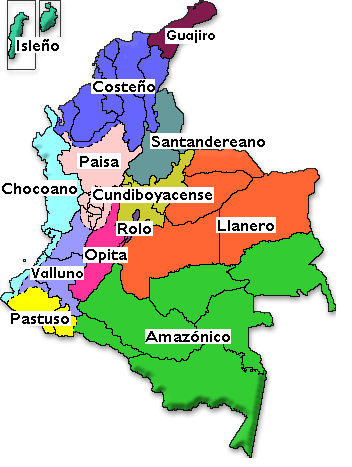
(I should preface this by saying this information mostly applies to the Colombian coastal region, and the difference between the interior of the country and the coast definitely makes the list of things I wish I would’ve known about Colombia before living here.)

Image result for mapa de las regiones culturales de colombia
Just keep this in mind – there’s practically a different dialect for every one of these regions.

  1. Bogota is not Colombia. And the differences between regions can be much more dramatic than one would expect (culturally, dialectually, etc.). I knew this because I had visited both beforehand, but I didn’t realize just how big the rivalry between different regions in Colombia is. You won’t be just adapting to a new culture based on the country, but also based on the region you choose to live in as well.
  2. Colombia is not as dangerous as it once was. You are not likely to get kidnapped by random taxi drivers anytime you go out. You won’t see violence in the streets. However, crime caused by the incredible degree of inequality and poverty is real. Because of this, you will probably be robbed or mugged at least once – oh, by the way, don’t go out with your cellphone at night, or if you do, don’t own a fancy, expensive smartphone. You have been warned.
  3. People are not always to be taken at face value. Things are not always what they seem on the surface, and if money is involved, one should err on the side of caution. It is very likely if you are working in anything that requires charging or loaning money that you will have to hassle that person in order to get it, because Colombians either never have money because of how awful the economy is or simply don’t want to pay when they do have money.
  4. Relationships and gender roles are truly influenced by machismo. But it’s not always as obvious as you think. Lies, deceit, and general toxicity all tend to play a role, and to many people here, this looks normal due to the culture.
  5. The cost of living and exploring is inexpensive. Even though you can’t expect to make a lot of money by US dollars standards, you can still manage to save and live your best life. Travel by bus and plane to different parts of Colombia is inexpensive, but work can be extremely draining (because schools here are not well-organized, and the hierarchy can be extremely stressful – more on this in a different post). It’s a real game of give and take with your schedule to keep things in balance.
  6. Your personality will change if and only if you are truly immersed in the culture. You wanna get good at dancing to Latin music? You have to let yourself be taught and be spontaneous. Same with your degree of fluency in Spanish. Most people here don’t speak English and are very shy to do so (aside from the annoying cat-callers that only know one phrase – like “I love you” and “hello”), so if you are interested in learning Spanish, this is a great place to do it. However, you should come willing to make an effort and learn from the people around you.
  7. Most people do not know that much about the US. So questions get repetitive. It’s kind of like how when I’m in the states, questions revolve around 30 year old issues like Pablo Escobar and drug cartels…yeah, ignorance is the same no matter where you are, but at least the questions are mostly about Trump, somebody who is actually alive and relevant.
  8. Colombia really does not have seasons. I honestly didn’t realize that. So if you pick a hot place to live, expect that to be a constant. If you pick a colder, rainy place (like Bogota), that will also be a constant, with some flux depending on the months and dry or rainy seasons. Weather is not necessarily a constant, but the general temperature and variety of weather definitely is.
  9. In a small city like Valledupar, transportation is so easy and cheap. Of course, the same can’t be said for sprawling cities with a shitty Transmilenio bus system in place of a metro, but trust me, if you live in small town Colombia, moto-taxis for $2 mil a ride will become your best friend. Cheap street food like arepas, empanadas, deditos de queso, and papas rellenas will become your best friend, too. I should probably just do a whole post on food, let me bookmark that for later…
  10. People will embrace you. Sure you have to root through the people that want to use you for the perceived money or influence that gringos have, but people here are truly so warm and willing to share with others, so long as they sense that you are a genuine person as well and you are willing to open up. That has to be one of my favorite things about the culture.

Now that I’ve written those 10, several more things occur to me. But I’ll leave that for another post. Basically, living in (coastal) Colombia is a spontaneous experience, so you need to be open-minded and aware of your surroundings. Appearances often are not to be trusted, but life is looser and more flexible – which means if you crave and thrive on structure, la Costa probably isn’t the place for you.

However, that being said, I think this country offers something for everyone. Medellin, Cali, Bogota, Bucaramanga – all of these great cities are different from cities in the coast. In Colombia, one size definitely does not fit all.

I hope this is helpful to anyone considering living, working, or at least traveling in Colombia. As with life abroad in any country, a willingness to adapt to your environment is always important and necessary. There will always be things you don’t like – be it the slowness, the poor attitude toward customers, the backwards gender norms, the superficiality, in the cases I’ve seen that were less than pleasant – but you can learn and grow from these differences and observations as well. All of that makes the experience that much more rewarding and totally worth it.

If you’ve lived in or are living in Colombia, do leave a comment below sharing what you discovered but didn’t realize before living in Colombia (along with which part of Colombia you lived/are living in!).

Birthday Reflections: How living in Colombia has changed me (from 25 to 26)

It’s been an amazing birthday week, the kind of week that has me reflecting on all the changes in my life that have brought me to where I am today. One of the greatest changes by far has been all of the transformations and confrontations with self I have made since living in Colombia.


Before, I was never one to socialize among coworkers. I kept my head down and my eyes on my work. I felt afraid to show who I really was most days because I wasn’t sure if anyone I worked with would be able to relate to me. As a result, I stole from myself the opportunities to form bonds with my coworkers and create lasting friendships. I also struggled to define limits in my romantic life. I spent more time spinning my wheels than actually acting with the end result in mind, and that was mainly due to self-doubt and insecurity.

Last year, I was still green to living in another country. I didn’t know many people – I barely knew my coworkers. I mostly spent time with a girl that lived in the same house as me and took care of the kids and the chores (we became friends and have been ever since!). I was far from home and at moments very lonely. But with a few spontaneous invites – and then spontaneously accepting them – from my coworkers, I slowly began to go out and really experience the culture of Valledupar and form relationships which became key to my self-esteem and growth.

I’ve learned that ex-pat camaraderie is strong, even if you don’t come from the same country. My first step outside of my comfort zone in Colombia came when I made and shared king cake with a few coworkers. One of them, Noel, took interest in the place I’m from, Louisiana, mainly for the food and music, and I couldn’t help but open up, little by little. So we began to hang out more, and from there we decided to make a king cake together and have a get-together to share it. Since then, he has become more of a brother than a friend, a trusted confidant that has seen me through hard times, listened to me and my whining, and shared advice with me, and I with him.

Slowly, I allowed myself to get to know my coworkers more and stopped closing myself into my classroom and focusing only on the serious aspects of work. It didn’t hurt that I also finished my TEFL certification around the same time and suddenly had the time to go out and socialize. By keeping my eyes peeled for opportunities to go out and explore my new home, I began to get to know a Colombian teacher at that time working in Prekinder in the school, Osiris, and a young woman from Nigeria working in Nursery named Dami. Osiris spontaneously invited us to go hiking up the local lookout point, Cerro Ecce Homo, one weekend in February and from there the three of us became good friends.


Shortly after that, the adventures began. Dami, Noel (my British brother), and I along with a Colombian friend spent a weekend in Nabusimake, an isolated indigenous village nestled in the Sierra Nevada. We slept in tiny bunk beds in a cozy cottage and built a fire outside to make our dinner under the night sky, sharing music and laughter throughout. It’s funny how strangers can become so close in so little time. But near-death experiences will do that. During that particular trip, when we decided to go back to Valledupar, it had started drizzling. Of course we thought, who cares? We were ready to get back and rest and prepare for another exhausting week of work. However, once we were zig-zagging and swerving up and down steep, narrow mountain passes covered in mud and clay, we swiftly realized the err of our thinking. We were screaming in the land rover and hiking up along side it, trying not to get hit, all the while and not to slip down the mountain in turns. It really brought a whole new layer of meaning to our friendship, as surviving a near-death situation usually does.

In this way, many of my coworkers also became great travel companions since we all have pretty much the same aspirations to get out of Valledupar and explore. Last year I managed to either plan or be involved in 4 different trips, including a weekend in Palomino and a whole week discovering coastal cities like Santa Marta, Barranquilla, and Cartagena, and then later go further South to Ocaña – but I’ll have to dedicate another post to those trips.

Then there were all of our little get-togethers. We would go to the large house that Noel and his brother lived in, a hostel of sorts because it housed many temporary or short-term tenants, and make food and blast music. At the end, we would always get fussed at by the house owners for turning the house into a discoteca (which, by the way, we now practically live in one since getting our own house), but we rolled our eyes and turned down the music, choosing to ignore the negativity and keep enjoying each other’s company. It’s not like we don’t suffer through the hours on end of blaring Vallenato music constantly.

Our team has always been close knit. There was birthday party after surprise party throughout the last school year that added to my sense of integration with my coworkers. Even my birthday was celebrated as a surprise which was and wasn’t a total surprise since there was a group dedicated to doing just that last year. Still, that party was one of the most beautiful moments yet and continues to stick with me to this day. After all, I could have never imagined that a group of virtual strangers would take me in, buy me a cake and booze, and celebrate my special day as if we had known each other for more than a couple of months.

People here have sincerely taken me by the heart and the hand and welcomed me into their lives. I began to dance and be myself among these diverse people. We traveled together, from the beaches of Palomino to the rainy streets of Bogota, to the Walled City of Cartagena. We rang in the New Year together, drank together, and complained together about the injustices we have faced at the school and the shitty discrepancies with our own expectations.

More than anything, I became entirely me this year, while also letting another culture transform me. I felt myself truly adopt the costeño dialect when conversing with my close Colombian friends while also being able to stand up and give presentations in Spanish and English in workshops and trainings. I’ve spoken my mind and stood up for myself and my friends more than once in the face of the aforementioned injustices at the school that range from unfair working conditions and sanctions based on false information and bias. I’ve realized I’m not afraid to be the person that says no, that doesn’t work and it doesn’t sit well with me. I’ve discovered my voice, both personally and professionally.

Now that I’m 26, I’m staring over an intimidating precipice. On one side stand my goals, my mountain, the things I’ve been working toward tirelessly since I was in college, and perhaps even before that. I’ve always been tenacious, and now I feel I’m halfway there. First, I wanted to get out of the country. Before I turned 25, I accomplished that goal and found a job that worked for me. I wanted some semblance of stability, which I have achieved, while still being able to save and travel all at once. Then I wanted to continue my education and explore other avenues of employment. That is the part I’m still working on – mainly with writing and translating, but I also have a desire to break out into work related to human rights, social justice, and international relations, because that is where my passions truly lie. But in the meantime, I have to give myself some credit – I’ve become a full-time, certified teacher, and damn competent one, one that knows her students and does everything she can to help them reach their full potential and learn and to be passionate about learning.

I’ve discovered my capabilities and that I don’t need anybody else in order to feel fulfilled in my life or have significant and extraordinary relationships. I’ve also learned and thoroughly internalized that it does no good to compare my life to others. We all get where we need to go at different times. The key is living our moment one second at a time.

I am now quite content with my close friendships, with the variety of people that share their time with me and support me in a variety of ways. The next step is simply deciding: which direction do I need to go in in order to get closer to my mountain? How can I stop measuring every step and just let go as I fall into my future? Because in the end, all we are doing is falling. Nobody knows where we will end up, as much as we try to plan and plot our stops along the way of this vast journey we call life.

I will say that the spontaneous choices I’ve made have ended up being the most rewarding. When I set my mind to something, from the age of 5 to 25 and beyond, I have always found a way to see it through. And even if the results are not what I expected, I find a way to learn so much that the experience is totally worth it and part of what makes me me.

In Colombia, I’ve encountered some of the most loving and genuine people I have ever known. I’ve also encountered selfish people, rude people, people that are only interested in themselves and think nothing of how that self-interest can affect others. That, however, is the human experience – no matter how much culture shock was locked into that experience, it is not culturally dependent – and learning how to distinguish one group from another is also part of growing up. I guess what I’m trying to say is that this year in Colombia has been like a rite of passage for me in which I came through the other side as a fully-fledged woman that has committed herself to her vision and doesn’t back down in the face of adversity.

That’s the direction I want to continue going: upwards and outwards, to help and to let myself be helped in order to grow and mutually impact others in a positive way. The interconnectedness of people is one of the great lessons I’ve learned here, just how much we can make or break an experience by being involved with each other. For those that have blessed my days with their light, I will be forever grateful. And for those that steal my energy, I am thankful to know how to distinguish them from the genuine people who are worth the effort and simply remove them from my life in order to focus my energy on the people that fan my flames.

Life happens fast. I imagine we all experience different rites of passage throughout life and at different stages. When was yours? When did you look in the mirror and realize that you were no longer pretending to be a self-sufficient, self-aware adult, but that you actually were one, and not just a scared, lost kid trapped in an adult’s body? I’m interested to know what that turning point is for people. But I would say in spite of everything I lived in my two post-university years in California, Colombia has defined that for me. And to the universe, I will be forever grateful for pushing me to leap from that precipice and into a new challenge. May I have the courage to leap some more in all the deciding moments that come my way.

snapchat-2108508966.jpg

Goals for 2018: Consistency, Discipline, and Amor Propio

Lately I have a lot of good energy moving around from my core to the tips of my fingers and toes. I feel like now is the moment to take advantage of that energy. To write, to share, and to manifest what I want from my life.

What sort of energy do you find yourself with today? Were you tired, tense, stressed? Indifferent, restless? Unsure, neutral? Relieved and relaxed? Calm and content?

It’s good to read your own energy and know how to spend it in the most efficient way. After all, we are made of the energy we surround ourselves with as well as the energy we generate and put out into the universe. One of my personal goals has been to carefully monitor and manage my own energy as well as the sort of energy I allow close to me. I’m an emotion sponge – always have been – and by being mindful of that, I can use that trait to benefit myself and forward my goals.

It’s all a matter of balance. Which is where I’m going with this post. How do we manage our energy? By putting in the right amount of time and energy into the right sorts of pursuits.

And how can we do that more effectively? I’ve been reflecting on that a lot since the beginning of this year. My personal answer has been a love of self and respect for one’s own needs, goals, and energies.

I want to share my goals, and the methods I will use to pursue them, not just to have a typical resolutions post but to show how the short-term goals we call resolutions can be turned into the beginning steps towards long-term projections toward the future.

Of course, there are no guarantees I won’t fall off the wagon and lose sight of all of this. There are never guarantees that we won’t suffer depressions or tragedies that muddy up our energy and take time to treat and heal. But that’s okay. My goal is not to be rigid when I commit myself to this disciplined mentality. Rather it’s to be adaptable and focus on all of the different avenues that help me to continue moving forward while still coping with the ups and downs and fluctuations of life.

Every day is made up of 24 hours. Time is limited and finite. I know, everyone knows that, right? But it’s also fluid and, yes, in some ways, a social construct. One of my primary goals is to construct my plans around time in this sort of way. Do I know if I will be able to commit to a master’s program by next year, for example? No, and I don’t know if it will be completely necessary to fulfill my long-term goals; however I’m in the process of figuring out the next step in my education, so I think putting that in there makes sense because it’s a part of my projection for the future.

Speaking in broad, fluid strokes, my goals are the following:

  1. Writing: Blog, Poetry Collection, Novel, Essays

Writing is not only something I want to focus on for professional reasons: it’s a necessity to me. I’ve realized throughout my life that, no matter how tired or stressed or frustrated I am with life, I am always writing. No matter if nobody reads it. No matter if I don’t share it or it’s completely therapeutic. Or it’s dry and academic. In some way or another, I always have to be writing and expressing myself in this way.

So my goal is to build on that. To hone my craft and develop my voice, and beyond that, to put my voice out there and allow others to hear it. In the past, I have been very self-critical to the point of over-thinking and limiting myself. My goal now is to produce, to create in every way that I can, a la Neil Gaiman. Because, come on, no one ever got better by not trying. If I don’t apply myself now, all of these ideas I have floating around in my head will never materialize.

To put it in terms of time: this year I want to create a concrete collection of poems and send them for publishing and/or send them to different journals. I want to fill this blog with posts every month (a new post at least once a week) – and develop within my niche. And I’m hoping to have a good draft for my novel, The Dark Realm, by November. I haven’t really started working chapter by chapter because of energy place on establishing other habits, but once I have a good rhythm, I plan on taking my outline/planning and starting to chip away at those ideas bit by bit until I get something concrete to share. Essays, of course, go with the blog to a certain extent, although the blog will also include more anecdotal and list stuff. It’s more of a platform to highlight various parts of my experience.

     2. Travel – and Document

This summer, I’ve already got two concrete travel plans: Backpacking in South America independently (with a little help from my friends that live in different countries and couch surfing/hostel friends I have yet to meet). The other is a mochilero trip with a friend who was actually my chaperone back when I went to Spain for a couple weeks as a senior trip in high school (how cool is that continuity?). I’ve been saving a lot to make these plans a reality, which of course is another big goal/goal-facilitator that can’t be overlooked.

In these travels, I want to combine my writing and picture-taking to tell a cohesive story of Latin America, the reality that I once only knew on an academic level, which is to say the complexities of the culture and societal dynamics (economy, history, current events, etc.). I love exploring for exploration’s sake, but if I could do at least a little to lessen the ignorance we see on a broad scale in the States, well, hey, I sure as hell want to contribute my two sense/cents.

Plus, the goal is to get other people intrigued so that they will go out and explore more, too. By living an experience, immersing yourself in another culture, we grow as individuals and as global citizens. Our mind’s horizons expand. You can feel the change and, I kid you not, nothing is ever the same. It sounds dramatic, but I know living abroad has changed me for the better. It’s made me more aware of what matters to me, the sort of person I am, and what other’s can teach me. We grow up thinking the world consists of what is truly only a bubble of reality, a small fragment of a much larger novel (hell, it’s more of a Robert Jordan-esque multileveled universe of epics, but I digress). So this goal is a real big one for me and for my development as a human being, which revolves around the broader goal of self-actualization.

     3. Get a good camera and develop a photography portfolio

On that note, I need to get a good camera (which, again, is where saving right now is so crucial) so that I can properly document these experiences. There are so many things which catch my eye: people, relationships, shades, little details that create connections between language and images. I’ve always had this goal, but I never had the means. Now, with my budgeting, I feel fairly confident I can afford a good camera by the time summer rolls around and start focusing on a new craft.

     4. Increase fluency in Portuguese and start developing some conversational/integrated skills in at least 2 other languages

This is fairly self-explanatory: by the time I’m 30, I want to be able to call myself confidently mult-lingual. That shit doesn’t happen on its own over night. There are some people that have amazing memories. Some people are surrounded by a multitude of languages and have to learn out of necessity or have the social circle that facilitates them learning. But the absence of those attributes and unique circumstances is not an excuse not to throw myself into self-studying and improving the capacities I already have in a few languages now.

The specific languages I’m focusing on are Portuguese (for obvious reasons, it’s the easiest for me because I’m already fluent in Spanish; it’s more being persistent and speaking as much as I can while developing vocabulary via listening, writing, and reading). I want to go to Brazil this summer, so this one is a big one. Luckily, I have a few years of casual study and a few Brazilian people that can help me. It’s just a matter of taking advantage of that.

The other primary language I would like to become conversational in is Japanese. You might ask, why Japanese? Well, I want to live and work in Japan by the time I’m 30. How I will do this, I haven’t entirely figured out, but I will make it happen. I’ve already got the basis in the language. I can write decently. The pronunciation is easy. But I need to get some good conversation practice and learn more vocabulary, which takes work. For now, I’m working on vocabulary so that when it comes time to speak I have some knowledge to draw on.

On the periphery, there is my basic knowledge of German and French. Those two are next on the list, but they seem further away. Language study takes time. I try to make it a daily thing so it’s easier to integrate it into my life and keep those mental pathways open. However, there aren’t that many people around speaking these languages in Colombia. So it takes effort. And these two are harder in terms of grammar and pronunciation. But once I have a good rhythm in Portuguese and Japanese, I’m going to start working more seriously on these two. And from there, the list goes on….

     5. Start a new career more centered on my passions*

This is going to take time, and I know it. Right now, I’ve got a pretty good thing going for me as a teacher. I enjoy it. It motivates me and keeps me disciplined. However, it is not what I want to do indefinitely, and I know it. It is a passion, but it isn’t the passion I want to marry, you feel me?

I want to work with non-profits. I need to volunteer more. Build a more diverse resume. Advertise my translation skills. What does that certificate I studied  and the money I paid for worth if I don’t? Hay que poner pilas!

     6. Translation and potential Interpretation Certification/Experience

Obviously this is a big part of the previous goal, but more specifically I need to build my translation portfolio. And look for an interpretation program. It’s a skill that takes practice, plus that will help boost my resume.

     7. Choose a Master’s program and work on the application process**

I’ve began looking into different Master’s programs. I know that if I want to go into diplomacy and international relations in the future, it would behoove me to, well, study and deepen my knowledge in that area. Living abroad isn’t enough. I need the contacts and the research to really get me to where I want to be as a professional. It’s just hard to decide when I haven’t settled on a place to live next year. Stability is something I have lacked and something I’m trying to cultivate despite my very spontaneous life style and multifaceted interests and pursuits.

Right now, I think I’m going to keep researching online programs. Its a resume-builder, for sure, but honestly, I’m more concerned with a continued pursuit of knowledge than a higher pay grade. Although that part would kind of help with the rest of my goals, so….it can’t hurt.

     8. Stay fit – in body and mind (dance, yoga, and weights)

I love being active. I love the way it makes me feel. I was reflecting today, and there are three activities that make me totally zone out and forget about everything that stresses me: cooking, dancing, and any other physical activity (as well as writing, but sometimes channeling that energy can increase my anxiety, too). Oh and washing dishes. I’m weird, okay?

In short, I don’t want to be fit to be skinny. I don’t want to be fit for the instagram followers or the praise or the interest of boys. I want to be active. I need to be fit to be active and healthy. I need to be strong so that my body can handle more stress. If I can handle more stress, I’m sick less, and being less sick makes me less stressed and being less stressed makes me less sick. See how that one works? So, really, being fit is more about being strong so that I can do more.

Also, I really love dancing, but I’d like to feel more confident when I do it. Yoga helps with balance and meditation. Weights provide strength. All of them require discipline and practice.

     9. Maintain a healthy diet and good eating habits – oh and more cooking.

All of my goals are kinda related, no? Well, if I wanna be strong and get sick less, I have got to eat better. This one I’ve been working on a lot lately, starting with waking up and making myself a good breakfast. Like, not just cereal or yogurt or breakfast bar, but actual omelettes (du fromage), granola, yogurt, fruit, juice, water…. The works. I still don’t really eat dinner, but I think I balance my meals okay throughout the day. And if I need to eat at night, I’m trying to cook on Sundays and plan meals ahead of time.

Last year, I started getting and staying chronically ill. Gastritis, acid reflux, and sometimes an inability to eat without feeling awful, no matter what I ate. During the holidays, I was able to reset, and I realized that the doctor that performed my endoscopy was totally right: my problems are linked to stress. Stress and poor eating habits. So I’m trying to work on both and get sick less. Because when I’m sick, I’m miserable. I feel like I’m unable to do anything, which leads to this awful sense of stagnation and anxiety. And then the vicious cycle repeats ad nauseum. Literally.

     10. Continue building and strengthening positive relationships with people around me and leave negativity at the door.

This goal is definitely a strong personal one. Networking is important, but having real friends that you can rely on is even more important. Living abroad has made me realize that these genuine ties are so vital. They practically set a benchmark for defining our own happiness and fulfillment in whatever life situation we find ourselves. Without a strong support system, everything else seems greyer and less meaningful. Work is just work. But when you feel like you are part of something and work to maintain good relationships with the people around you, life and its labors become more meaningful. It also creates a sense of peace of mind.

I’ve been known to be confrontational. Negative. A bit abrasive. And I’ve had some relationships in my life that did not help me overcome those sorts of character traits. Being abrasive and direct is not necessarily a bad thing, but like all things, it requires moderation.

Living in Colombia has made me realize the importance of strong, positive interpersonal relationships – for accomplishing goals and just generally living a more fulfilling life. I see how my attitudes and actions can affect others and also affect the general outcome of various scenarios. When I’m positive and bear in mind the things I am in control of rather than dwelling on those I am not, I am able to connect to others in a meaningful way and truly enjoy the moment. These lessons have been invaluable for me. My goal is to continue strengthening the close relationships I have and doing what I can to contribute to a positive local and global community, focusing on the Butterfly Effect, the ripple of every choice and action we make.


Okay, I think that’s a good broad portrait of the things I want to work on and accomplish.

Here is how I hope to achieve them:

  • Budgeting
  • Time Management
  • Prioritizing
  • Flexibility
  • Habits. Make it a habit.
  • Developing and sharing hobbies 
  • Mindfulness and meditation (be more stoic)
  • Focusing on the self and maintaining a healthy growth mindset
  • Getting help (and not being afraid to ask)
  • Dedicate time each day to the areas that need improvement 
  • Self-assess and check in (continue with therapy)
  • Read more and take advantage of daily learning opportunities (be a life-learner)
  • Game plan and follow-through

I would expand on each, but I think it’s all pretty clear at this point. We have a limited amount of hours in the day, but if we prioritize and think of how we can work on each area every week and find moments in between – well, we make progress. As long as we’re working and making an effort to do something with our energy, we are making progress.

And I want 2018 to be my year of progress. Every year has involved metamorphosis. Sometimes it has involved loss. Often it has. Mainly, the loss has been a result of focusing my energy on the wrong thing or simply not focusing at all. Harnessing energy and managing time in a meaningful way takes a lot of effort, but I know it will be worth it in the end.

Because, in the end, successful or not, I will have created something. This all might be fairly self-indulgent, but let’s face it: we all are self-indulgent. We all want to leave our mark and contribute something to the universe. We want our existence to be significant.

But significance doesn’t generate itself. I plan to take advantage of whatever opportunity I’ve gotten and not to spend as much time internally panicking and stressing the little things that ultimately will be forgotten by the next year, and more so by the next 10 years. It’s not about checking off every detail and simply focusing on the accomplishment itself. It’s about the journey towards these goals, not the destination.

How are you accomplishing your goals? Do you feel over-ambitious or under-ambitious? How do you manage your time and plan things realistically? Maybe we can swap insights. Leave a comment below!


Versos de Colombia

I’ve decided to share the poems that I have written since living and being inspired by life in Colombia. Some days the inspiration is so great, I can’t help but sit and let flow poem after poem. They generally aren’t long, but I feel they are significant for where I am in my life and the person this experience has molded me into being.

Plus, come on, y’all. I’m practically 26. I’ve been telling people I’m 26 without meaning to because subconsciously I’m already there. I feel like in this year and a half I have grown and matured more than in all of my years before combined.

Okay, maybe that is a bit hyperbolic. But yes, I’ve really settled into myself. And that shift in perspective, the embrace of self and denial of anything that does not grow or nourish the self is due in large part to the simple decision I made to live and teach in Colombia.

I will put the Spanish and English versions for those that don’t speak Spanish, so you can hopefully really absorb the meaning.

Al mal Tiempo

Her voice
Like the arroyo washing back
A reassuring hush

Her eyes
Like half moons hidden
Beneath dreamy clouds

Her bones
Brittle yet stark like yue bark
Not easily bent

I see her
Sitting in her mecedora
Reading Catholic psalms
In her flowing, multihued manta

The strength of the Colombian-
Of the Wayuu-
Al mal tiempo, buena cara.

This first poem I wrote back when I was first living in Fonseca at the end of 2016. I stayed with an older woman of Wayuu-indigenous origins (though she is very much a part of that culture presently) who was the sister of the woman that inspired this poem. I was always struck by her straight back in the face of difficulties and hardship and her unwavering resolve. Just every part of her radiates strength that her fragile body would deny. The Wayuu are a strong people. Even though there were moments she could get under my skin, I’m so happy for the time I spent with her and her family.

El Abismo

No es que sea por rencor
Pero espero que sigas con ese ardor
Y ese salado sabor
Cuando mi nombre pasa por tu boca,
Por todas las lágrimas y sudor
Gastados en vano por tocar
El abismo más profundo de mi alma.

The Abyss

It’s not to be bitter,
But I hope you still feel the burn
And that salty taste
When my name passes through your mouth,
For all the tears and sweat
Spent in vain by touching
The deepest abyss of my soul.

Love has come knocking at my door, although the fruit of that love was far from savory. Sometimes, recontextualizing myself within this culture, understanding the way people play the game of relationships, was something I had to do in order to survive and remove myself from situations that did not serve me on my journey or help me love myself, but instead led me further astray and caused me to forget myself and what has always been important to me.

Dark times, toxic relationships, shifts that have challenged me in this journey and have inspired my verses as well. Sometimes the best way to phrase and manage the hurt people can cause you is via poetry. The end of my last relationship can be summed up as a…

Twisted Fairytale

In truth, the slate has been wiped clean.
He broke the chains of my denial
With his poor, decrepit tongue
Sugar-coated in lies and poisoned in seduction.
I could never live, could never know true
Desire, love, heartache
Again by that harsh sword-

I would rather fall on my sword
Than taste those bittersweet remedies
Again and fall beneath myself.

Thank my pride for the strength it provides;
Thank my love of self and other to realize-
I was never loved by that other and never
Would be or could be-
Thank my nerve to say enough is enough.

And most importantly, thank the signs
Held up by angels among me,
Those gentle voices that know
And eyes that have seen and stung
With tears so that mine would not-

Thank my friends who have taught me
My own self-worth, to trust my own inner voice,
For they are the true heroes in this sad story
Where I am both the damsel and the knight,
And happy endings are never what they seem.


So, with that epoch sealed, I decided to love myself. To love myself ferociously and passionately, secure in the knowledge that I am all I have got.

Narcissus

I would jump into a million lakes,
Head down, face first
Into my reflection,
If it means that I could love
Myself,
Alone; Forever.

Faithful

I made a promise
To never be unfaithful again
To the most important person
In my whole world,
The one I go to bed with
Every night:

Me.

In spite of the pain I experienced, the journey itself has been totally worth it. It has aided in my process of self-discovery and the affirmation of my self-worth and independent spirit. Since breaking up with my ex, I have traveled both outward and inward – to Tayrona, Santa Marta, Ocaña, climbed the beautiful Estoraques, and began planning my independent summer adventures throughout South and Central America. The breakup opened a floodgate of creativity for me that has led me to be more reflective and respect and recognize the beauty in all the things around me.

Continuum

Puedo verlos bailando,
La ondulación como olas
En un mar ámbar
E inquieto.

I can see them dancing,
The undulation like waves
In an amber, restless sea.

IMG_20180110_222830361.jpg
Taken outside of a club in Santa Marta during my get-away in early January

Acertijo

Mi Esencia
No se puede atrapar
En una mirada de miel
Y un cuerpo
De carne y hueso.
Soy tierra y fuego–
El mar y sus olas bailadoras–
Soy palabra y aire–
Soy–

Riddle

My Essence
Cannot be trapped
In a honey gaze
And a body made
Of meat and bone.
I’m earth and fire–
The sea and its dancing waves–
I’m word and air–
I am–

The idea here was to be phrased like a riddle. I start by going to the root of my meaning, my essence, that which makes me as a person. I was reflecting not too long ago on the selfie sensation, the need to post pictures of oneself and show the world our best face. I realized that who I am really isn’t contained by that image–in fact, it could never be contained by it because that image of decaying perfection is also impermanent.

So what am I? I am a human being. And human beings transcend the prisons their flesh holds them in. Our spirits and energies make us one with nature, and nature brings meaning to what we are. I suppose it’s something I’ve learned about myself, the view I have of myself as being now far less narrow and 2-dimensional.

There have been other scribblings and fragmented thoughts along the way, but these were the principle verses I have written here. I feel like they represent the metamorphosis – the starting and beginning again where I started from but a bit fuller and wholer, the whole cycle of self-growth – really well. Now, to add some more to the list.

Anxiety and Working Abroad

Considering it’s the beginning of a new academic period, I feel reflecting on some of the struggles I’ve had with anxiety are quite apropos. I started this post last year, and since, I have made progress and even have some advice. That being said, and at risk of sounding cliche, this is a daily struggle.

For some time, perhaps my entire life, I have lived with all sorts of nagging fears I knew to be completely irrational. They’re the sort of feedback loop of kneejerk reactionary thoughts that have you literally rolling around in bed, tossing and turning for hours. Every time I’ve been under stress, that feedback loop tends to become deafening and even debilitating to my abilities to socialize and feel good about myself. Unfortunately, as much as I enjoy living abroad and the challenges it has brought me, the anxiety is still there, like a constant rain cloud a la Eeyore from Winnie the Pooh.

Disclaimer: I have never been diagnosed with General Anxiety. I don’t know if that makes my experience less legitimate or if I should avoid self-diagnosis, but it’s one of the few helpful frameworks I have for dealing with these types of feelings and experiences.

Before I knew anything about mental health, I thought of myself as simply defective. Why were things that seemed so normal for other people so damn hard for me? Why couldn’t I just go out and smile and talk to people when I lived somewhere new? Why was it so hard to acclimate to new situations, to feel stable under pressure, to cope with minor shake-ups? Why did I feel like I needed to hide away, to be invisible, to avoid some sort of terrible consequence that even I couldn’t fathom? Sometimes I still feel defective and angry with myself for being that way, despite realizing that it isn’t my fault.

Living with anxiety on its own is just hard. Being put into a new environment with strangers and rigorous expectations can be crushing.

My first year taught me how to cope with the over-stimulation I often get when my anxiety peaks. However, I still have a lot to learn.

As the holidays lurched to a close, it began to dawn on me just how unprepared I was. Impostor syndrome soon followed, and before I knew it, I was incapable of eating without my stomach tying itself into knots (fun fact: last year I realized the full link between stress/anxiety and my acid reflux/gastritis; my symptoms are mild when I am in a non-stressed, neutral state, however the peak had me thinking I had an ulcer last period and practically incapable of eating without suffering from extreme heartburn and cramps – the more you know).

I’m no stranger to this feeling; however, last year at this time, there were moments I thought it would actually fully impair my ability to teach. So, I developed coping methods. Some better than others, but they have served me well. Now, at the end of week two of classes with lots of projects and goals staring me in the face, I feel more centered than ever in spite of my strong bouts of momentary panic.

So without further ado, let me give you a rundown on some tricks I’ve learned (the hard way, of course) for managing anxiety and stress:

1. Me time. Me time, me time, me time.

When I leave the school and stop being forced to be around other people, I have come to realize there is zero guilt in absolutely indulging myself. That can be as simple as taking a long (*cold* – this is Coastal Colombia, after all) shower, painting my nails, laying around with phone in hand, and just generally doing nothing but soaking in the essence that is me. I can’t believe that ever made me feel guilty, I mean, seriously, how diluted was I to think the need to constantly be around others and not “missing out” didn’t just add to my anxiety. But boy, does it ever. So now, I embrace a night in or a solo date getting ice cream (or better yet, a smoothie from Cosecha’s) or a meal at the mall conveniently located at walking distance from my house. Nothing resets me more in the midst of exhaustion from a demanding work environment than bringing my gaze inward and treating myself.

2. Explore more.

I’m not talking full-blown trips (though that is related, but I have chosen to separate the two in my mind for reasons). It could be as simple, if the place is new to you (as Valledupar was to me), as looking up a restaurant containing your favorite type of food and making a plan to go check it out. Many times when I have been lonely and overwhelmed, I have taken it upon myself to arm my own plans to go walking and bathing in the local river, to checking out different art galleries downtown, to just soaking in the little things around me and letting myself meander along and get lost in the new place I now feel I can call home.

3. The arts are your friend – even if you think you aren’t an “artist.”

Whatever your interests, art heals. Performing for others has always amplified my anxiety, it’s true. But jamming with others, now that’s something I can get behind. It doesn’t have to be making music though. Writing – a poem, short story, song, journal entry – whatever floats your boat can really help with those stressful days when other, more pressing matters just don’t seem doable. It also helps process thoughts and alleviates  my anxiety in that way so that I feel less overwhelmed and burdened. Something I picked up back when I lived in Los Angeles and still do to this day is light sketching. I am by no means super talented, but that really doesn’t matter when engaging in the arts as an act of survival and a means of distracting from or channeling intrusive, anxious thoughts and energy. This could also include enjoying a good film or getting lost in a book. Creativity is the key.

4. Traveling, and doing so with as little baggage as possible.

Now, this was a hurdle I’ve had to overcome that also challenges me because it generates anxiety initially. But I love to travel. Truth be told, a lot of things I love cause my anxiety to peak in an uncomfortable way, but I’ve found if I can power through it, the feeling after the fact of satisfaction really outweighs the knots in my stomach caused at the outset. One of my favorite things about Colombia is the ability to explore the country on a budget, to just take off at pretty much any time and go almost anywhere on the bus. Is this difficult? Yes, sometimes it is, especially if you are the planning every pit stop type, but it has helped with the restless spurts I get with my hectic, demanding work schedule which often makes me feel like life revolves around work (and thus has me “missing out”). Of course, there’s no reason it has to be that way! It just takes effort to plan (minimally) and take off.

5. Don’t be afraid to talk to (relative) strangers.

I’m still not a huge advocate of approaching random people or inviting them into your house. I mean, friendliness is good, but reserves aren’t all bad either. But I’ve found that feeling down and anxious can lead one to perpetuating a cycle brought about by projecting onto and avoiding others. Then we sort of craft a negative reality removed from the perceptions and perceived criticisms of others which could even enhance that sense of loneliness and unease. So one way to combat the anxiety that causes it to simply talk to people. If there’s a topic or a question, hiding it away does no good. It can be hard, but when the moment comes, I have learned to embrace even the same conversation a million different times and ways with the taxista. These casual exchanges can sometimes lead to friendships or at least interesting encounters that can improve your whole day. Having an open mind doesn’t hurt, and I think being less guarded has actually helped a lot with my anxiety as a whole.

6. Ask for help.

I think this may be the biggest lesson the last few years have taught me. I recently started going to a therapist to learn more about myself and how to process my own experiences and difficulties related to anxiety and depression. All of my friends and family that know have been so encouraging. It’s true that we all have suffered in some way, and frankly I think everyone could benefit from therapy. But also asking for help in general can be so difficult when dealing with anxiety because, at least for me, it makes me feel like something of a burden upon others. Paying someone to shoulder part of that burden by simply listening and providing insight, strategies, and feedback is so nice. But if that is too much, reaching out to friends and family, as hard as it can be (especially if you’re like me and have too much pride at times) is so very worth it. That’s how we know we aren’t truly alone.

7. Be present. 

Don’t forget to breathe. Live in the moment. Let the anxiety settle on you like a restless, weary traveler – it’ll be gone before you know it. It just takes time. Those days have happened to me plenty often, the days when I feel like I’m buzzing or overheating and boiling over like a pressure cooker left on too long. Those are the days when it’s important to unplug and focus on the now. Mindfulness and stoicism have been some of my saving graces that I have been working on ever since I moved to California. Here in Colombia, it continues to help me maintain my balance when I feel tossed about by life’s unpredictable, fickle nature. Yoga, meditation, journaling – all are tools I would highly recommend. Just breathe.

Hopefully this list will continue to grow, as I truthfully, as I predicted, this experience has drawn the anxiety out of me and drain me. It has been an immense challenge at times – between the personal and the professional struggles I have faced and my own worries about the future – for me to follow this advice and remain present and in my element despite being pushed out of my comfort zone. But I will say, it has been worth it. I wouldn’t trade this experience for anything.

Please share your own experiences with anxiety in the comments. Anybody else living abroad who has had that utterly horrifying, restless feeling of not knowing what they’re truly doing with their life? Finding it hard to do simple, mundane things or to ask for help in a new environment? Trust me, I’ve been there, and I’m all for giving (and receiving) advice and tips.

Especially those that don’t involve simply downing a bottle of aguardiente until you forget what country you’re from, not to mention your anxieties. (You can file that under the list of unhealthy coping methods I would kinda-sorta-not-really recommend when dealing with these situations – you know, only when the situation calls for it, of course)